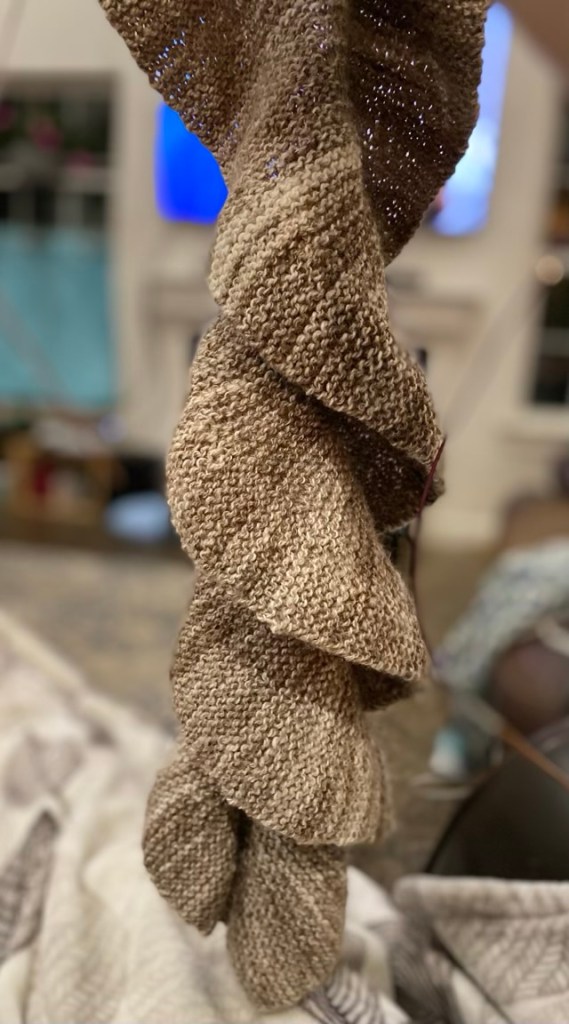
Photo description: garter knit scarf held up vertically showing a helix twist.
The pictures that accompanied the scarf pattern showed a lovely wide double-sided ruffle, but the title was helix scarf, which caused me to wonder, until I had knit awhile. So cool that the short rows on each side make this twisted effect. I really like short rows, and I like this pattern because it is a three-row repeat, which is easy to remember.
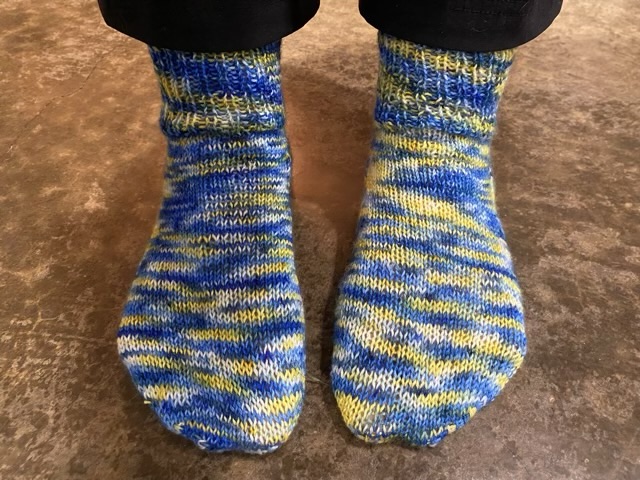
Photo description: blue, yellow, and white variegated socks with ribbed cuffs on my feet.
I finished a garment! Ok, yes, it was a pair of socks, but they fit! In addition I learned many things, such as I don’t like knitting socks top down, and I’m not a fan of a heel flap construction. I should probably use smaller needles, too.
What I did like about this project is knitting both socks at once with two circular knitting needle sets. When I was done knitting one sock, I was also done with both socks. No trying to make a second match! Two needle sets were quite fiddly with this pattern and method, but I have hopes for the next pattern that uses a toe up method!
I know other people really like the top down method, and enjoy double pointed needles. I’m glad we are all different and that there are people out there sharing their preferred methods.
It works! The three hook i-cord maker that I made (yesterday’s post) works quite well to make a cord that is usually made by sliding stitches off a needle to make a round.
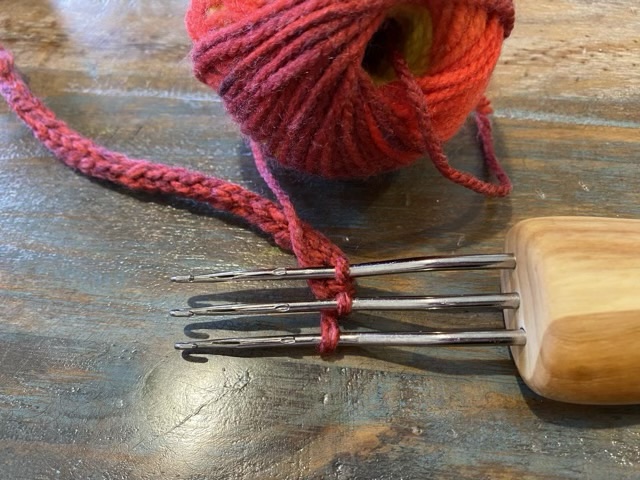
Photo description: three hook cord maker with a red i-cord in process.
Casting on three stitches on a regular knitting needle around size 11 makes the cleanest start, but if a needle isn’t available, making a chain with one hook, then placing the loops on the other two hooks, works just fine. To make the rest of the i-cord, you pull the loops on the hook down below the latches, lay the yarn loosely (really, I mean it), over the hooks just below the curve, and pull the loops up and over the hooks. The latches should close as the loops are pulled up, trapping the new section of yarn, and allowing the loops to pass over. A good strong tug brings the new yarn to make three loops, which you then pull back down below the latches. When I picked up the knack, it really went quite quickly.
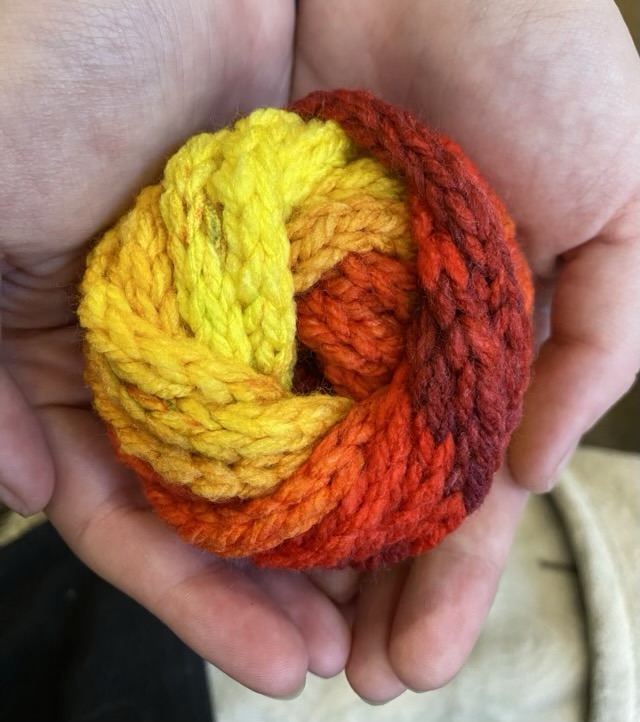
Photo description: wound ball of i-cord made of bulky red, orange, and yellow variegated acrylic yarn.
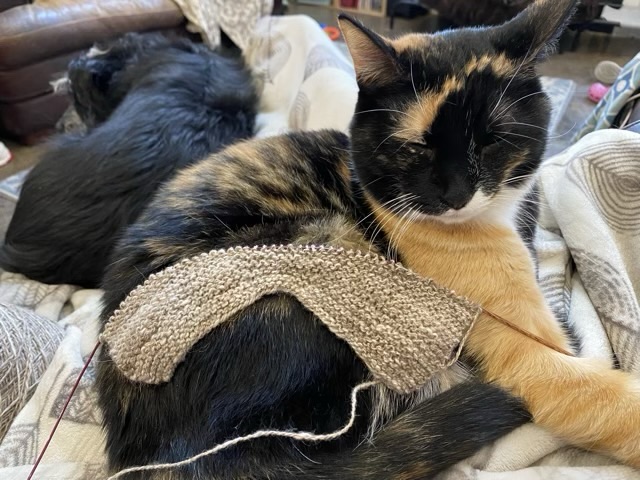
Photo description: beginning of a knitted scarf with short rows lying on a calico cat with a small black dog in the background.
I have cast on the Helix scarf from Spin Off magazine! I did make a modification, casting on thirty seemed very narrow, so I ripped out (only a couple rows) and cast on 50 instead. I adjusted the short rows to alternating 20 and 10. It turns out that I really like short rows, and the wrap and turn method. Izzy the cat doesn’t mind being on my lap as I knit, but Thor the cat thinks the yarn smells really good and keeps trying to take off with it, or chew on my circular needle.
Yes, I finished ripping out the sweater and the next day cast on a pair of socks. I am using two circular needles to knit two socks at a time. I have knit socks before, but it has been awhile, so I pulled out a book I found in a stash of craft books. These socks knit top down.
Photo description: two blue and yellow sock cuffs on circular needles in front of my steering wheel. I’m knitting while waiting for school pickup.
I made the mistake of working each sock from the same yarn cake, one strand from the inside, one from the outside. The yarn twists as I turn the work and I’m constantly untwisting as well as untangling from around the circular needles. I have done double pointed needle knitting, but all the ends capable of dropping stitches terrifies me.


 Critters and Craft