Twine as I go

I’ve started a new project using the processed flax fiber from Sally Pointer’s twine kit. I’m making a twisted loop bag and twining the cordage for it as I go.

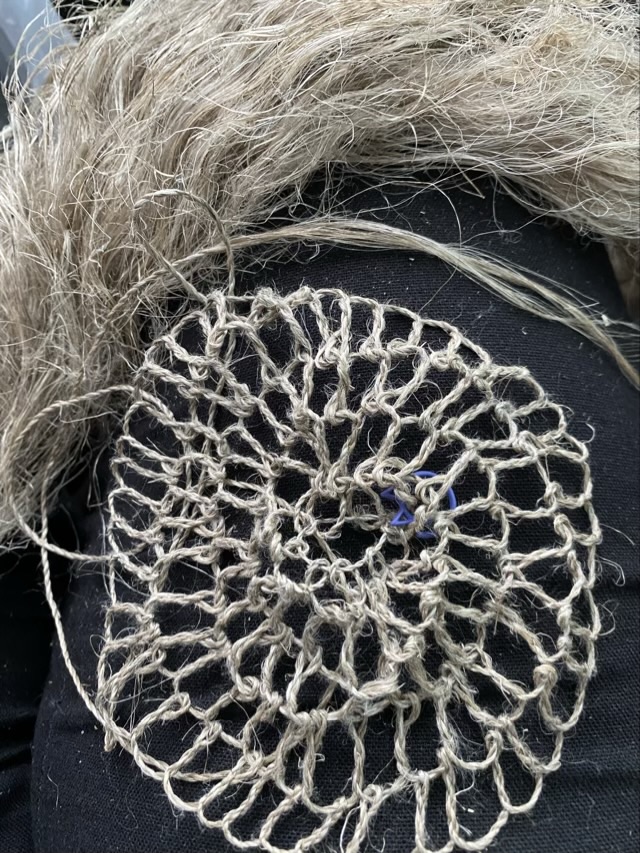
Photo description: two strand twined cordage made from flax fiber (in the background)
Photo description: the start of a twisted loop bag made of flax cordage, approximately six hours of worktime

I started the project as a car riding diversion. I like the twining because I can do it mostly without looking, which allows me to watch the scenery going by.

I learned to twine with a Z twist, which is opposite of the S twist that Sally Pointer demonstrates for beginners. This is fine, but when I went to start the twisted loops for the bag, the technique makes Z twists for each loop. I thought my bag would be happier (less twisty) if I made S twists to balance the Z cordage, so had to adjust the way I made loops by going in the opposite way from the video. It took some brain power, and I’m going to have to be careful going forward to keep the same stitch direction, but I think it will be worth it.

I’m not using a needle for this project, just flax and my hands. I started with a nalbinding needle, but it kept slipping off, which was irritating, but the newly made flax cordage is stiff enough that if I fold the end, it is easy to thread through the loops.

Last thought on this post: flax cordage is strong. The line I’m making is fairly thin, about four-five strands doubled, but I cannot break it with my hands.
Uh oh

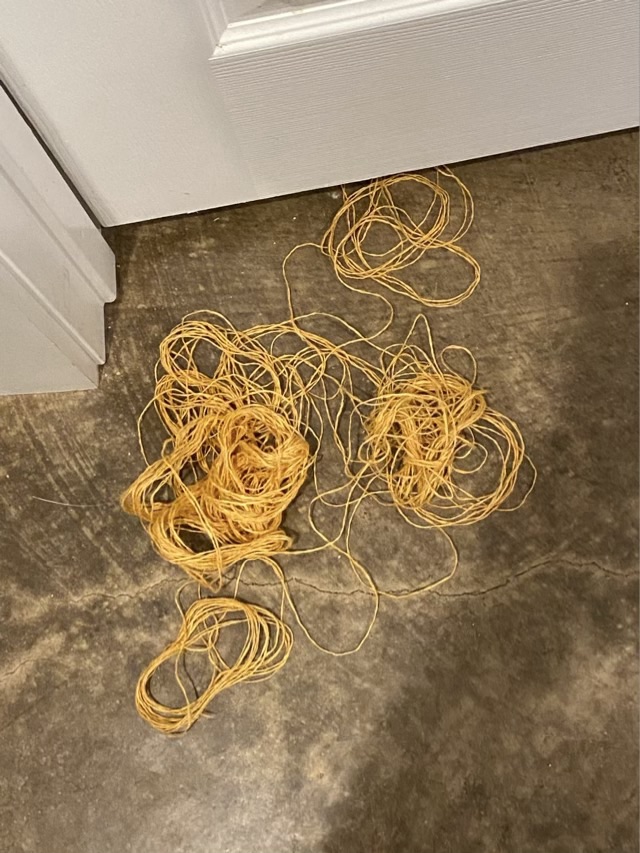
Well, I thought Thor the cat was mostly interested in wool, but I found this former ball of linen yarn out of its bag and in another room from where I left it.

Photo description: loose tangle of orange colored hand spun linen yarn on the concrete floor in front of a closed door

Here is the culprit, looking pleased with himself on Griffin the dog’s bed.

Photo description: large gray tabby cat in a larger brown faux fur pet bed

I don’t believe he ingested any yarn, and I was able to wind the tangle back into a neat ball without any knots. The yarn ball is back in the project bag, and hung up where the cat can’t stick his head into it. Yeah, I love yarn and I love cats and cats love yarn. It is a timeless love triangle.

Sprang: a mistake study

I intended to just trim the grass going to the coop, then, while I was out there, decided to uncover a path that I hadn’t cleared in over a year, then decided to trim some of the branches across the path, then decided to use a branch to make a bigger sprang loom. Logical, right? Once I secured the branch into a loop shape with hemp cord and added life lines, I now had the means to attempt to make an ancient style hair net. I warped the loom with some left over linen yarn that I spun from nettle dyed roving (that was also a lesson learned).

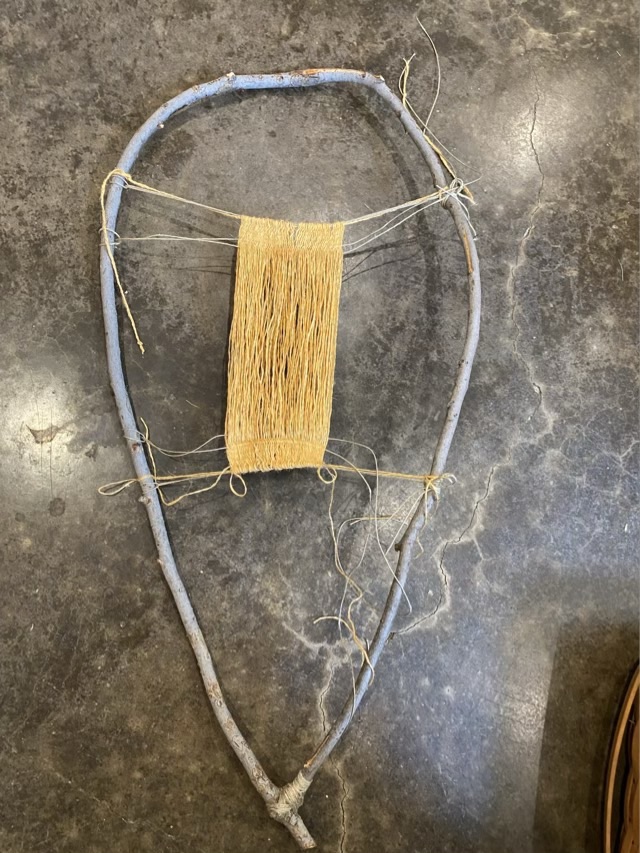
Photo description: Sprang loom made of a cedar elm branch tied with hemp cord and warped with hand spun nettle dyed linen yarn

The number of warp threads on this loom was easily triple what I’ve previously attempted. I intended to do interlinked sprang with some lace holes, and switch twist direction halfway through. Here is where the mistake study starts. I ended up with holes that spanned three or four rows instead of just two, and rows that changed technique midway through. Oops.

Photo description: Sprang hairnet full of weaving errors

I think, to solve the errors, I need to do a check at the end of each row by pulling open the weave and looking at the thread path. The yarn was also loosely plied, which made it difficult to tell what was plied yarn, and what was a single strand. I will add some twist before the next attempt. The happy note on this project is the finishing cord through the middle. This was a much neater way to secure the final twist and also acts as a second tie to secure the hairnet. On one end of the sprang I pulled the cord tight to gather the side together, but I left the middle and other end loose on the cords.

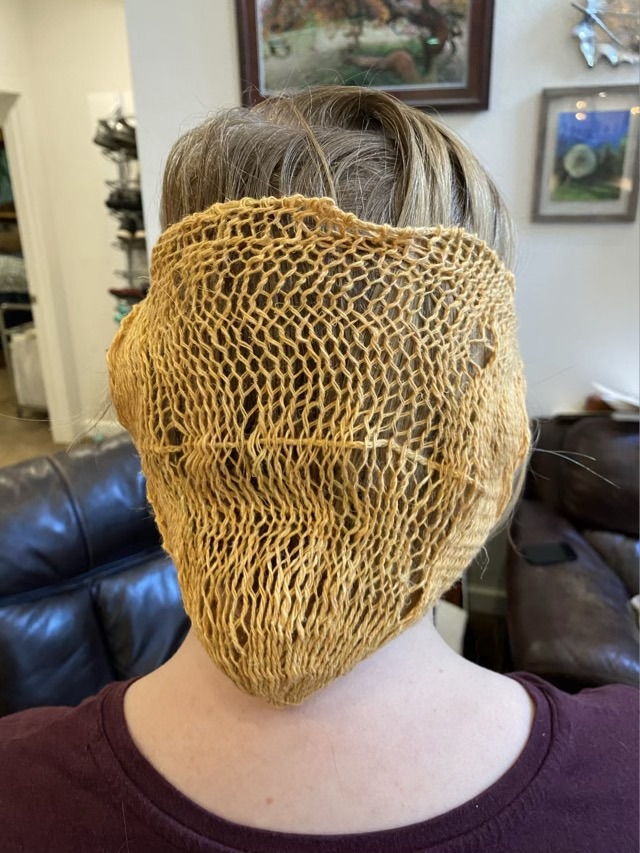
Photo description: Sprang hairnet on my eldest, back view

To wear the hairnet, the top cord ties around the temples, across the front of the forehead. The middle cord comes up at an angle and ties at the hairline. The back of the hair is tucked into the lower gathered section.

I will make another attempt, armed with the data gained from this project.

Flax page

I finally finished my flax page. This is internet-sourced combed top flax, which is an unusual preparation. It is the short fibers left over from processing the long fibers, combed together. This particular sample was also dyed, probably with nettle dye. There was very little information from the seller (buyer beware). I did manage to spin it in on a drop spindle, using a sponge to wet my fingers. Linen yarn needs to be boiled to set the twist and soften the fibers. When I boiled mine, I used tap water, which has traces of iron. The soft green color turned to a soft orange. The picture below shows the color change especially across the paper bobbins.

Photo description: 12×12 page with floral paper binding; the original fiber label top left; paper bobbins holding the yarn as a single, a two ply unset (green), and two ply set (orange) top right; unspun fiber in a paper drawer middle left; plain weave sample middle right; knitted sample bottom left; weft-faced weave bottom right.

I did a knit swatch on size 4 needles. It isn’t precise, probably due to the variations in yarn thickness, and has a bias, probably due to over twist of either the single or the ply. Still, it isn’t as rough as I thought it would be and has some nice drape.

I obtained a Clover brand mini-loom to make the woven samples. The first weaving (bottom right) I followed directions on warping the loom and ended up with a weft-faced weave. Interesting, but not what I wanted. The second time (middle right) I wrapped the warp completely around the loom and doubled the number of warp threads. This brought the epi (ends per inch) up and let me do a plain weave that showed both the warp and the weft.

I swear I did a crochet swatch too, but I must have stashed it somewhere safe. I do still want to spin traditionally prepared flax, but I’m not likely to buy combed top flax again.

Well that was strange

To finish spun flax yarn, also known as linen yarn, author Stephanie Gaustad recommends simmering it for 30-45 minutes in a solution of soap and washing soda. I admit I have been avoiding this step for awhile. The treatment of plant fibers is very different than the handling of animal fibers, particularly those that felt easily. I admit apprehension. I finally did take the time to do the finishing step, and my yarn changed color. What?

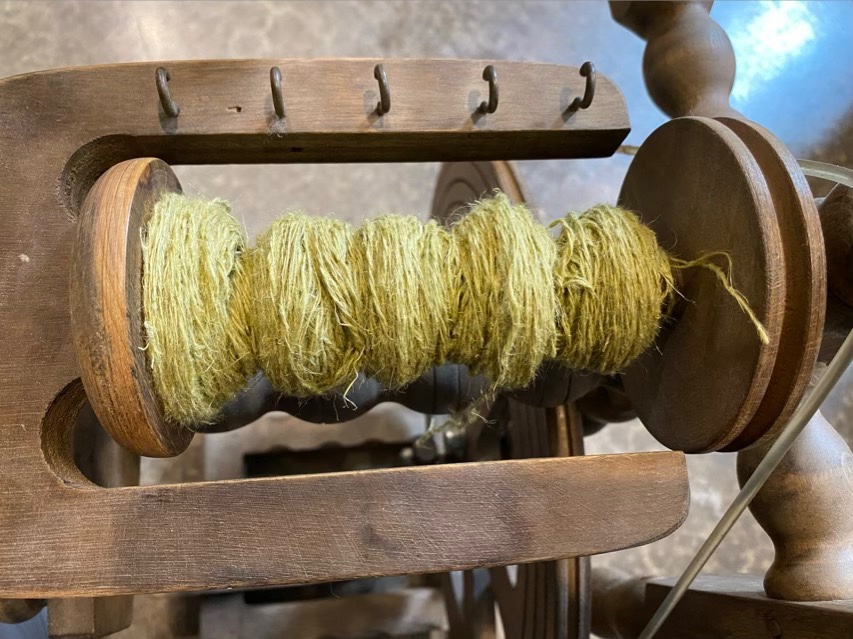
Plied linen yarn (from flax roving)

My flax roving was from a questionable online purchase. Very little information was supplied, when I received it, it was confusingly labeled both “flax” and “nettle”, and I learned later that roving is an unusual preparation for flax, usually made of the combed discards from making the long staple length flax preparation (called a strick). Definitely a flax rookie purchase. Still, I was able to spin it after much trial and error, and ply it using my spinning wheel.

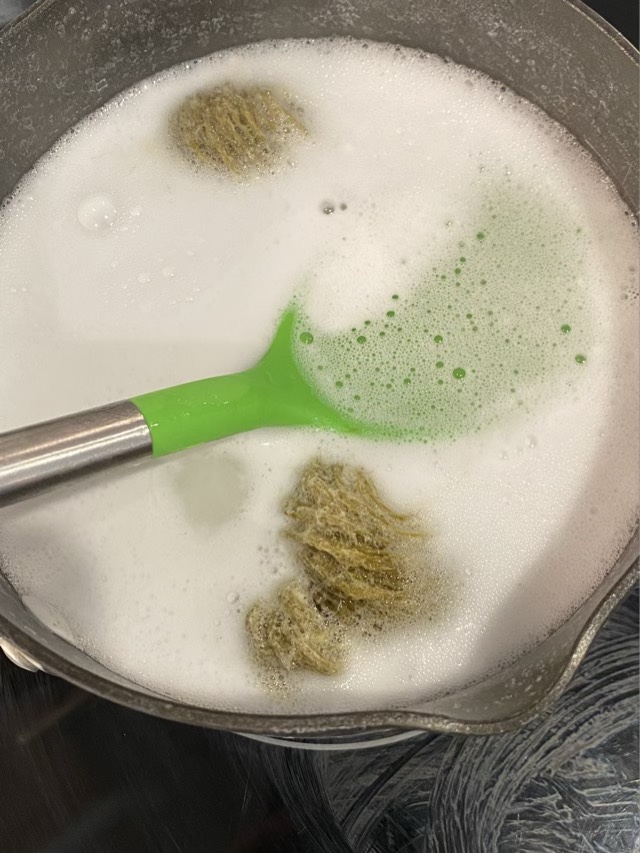
First minute of simmering

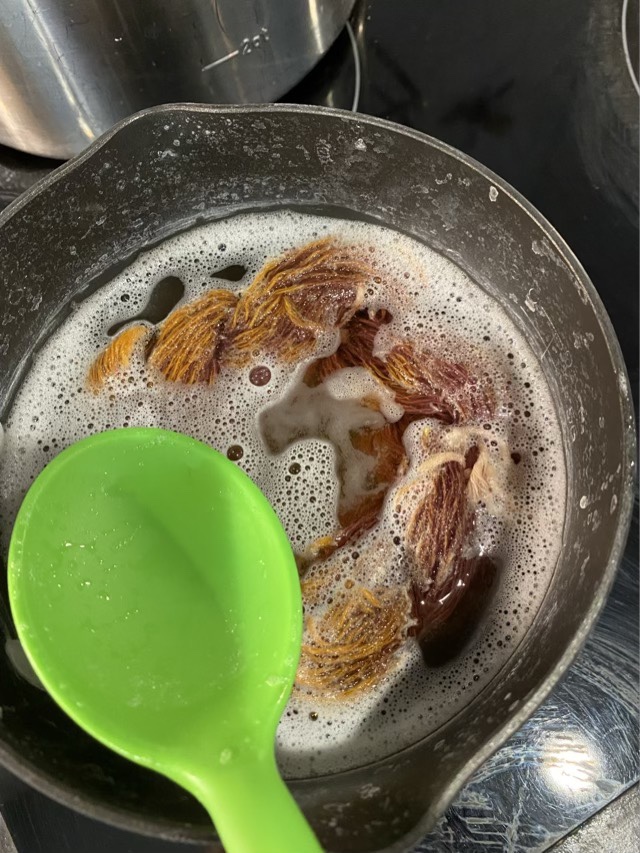
I started the finishing process and as it progressed the greenish yellow color of the yarn turned dark.

Yarn color darkening
Out of the boil and rinsed in cool water, it is purple

After the full boil, my yarn was purple. What? Another rookie learning opportunity. Nettle can be used as a dye, and iron is used by dyers to modify dye colors. I used water from the tap to do my boil, which comes from our well, which definitely contains iron. Hm. I had yet another surprise coming, though.

The dried yarn is orange

After I rinsed and squeezed out the excess water, I hung the yarn up to dry. It turned orange. Really? Really.

There are many lessons learned here. Flax roving is a difficult thing to spin, but possible. Nettle can be used as a dye as well as a fiber source, and natural dyes are sensitive to mineral content in water. I can tell you that I won’t be spinning flax roving again, although I do want to try a traditional preparation. I have never been a fan of dye, and would rather work with natural colors. I like color, but I don’t like color change and color bleed. Dying is a fiddly chemical process.

The next step for this yarn is making sample swatches for my spinning book. All this lovely gained knowledge carefully documented and preserved so I don’t make the same choices again.