I spun and plied angora rabbit hair back in March. I stuck the small ball of yarn in a project bag and promptly forgot about it. I found it again 8 months later and this time made the swatches from it that I intended to do in March.
Photo description: four ply angora rabbit yarn swatches. Top left: nälbound circle, top right: knit, bottom left: double crochet, bottom right: zoom loom weave
These swatches are made from unprocessed 100% angora rabbit fur. I took what was in the bag I bought from the breeder and spun it, no washing, carding, or combing. The yarn does shed a bit, but not significantly, and did fine especially with the abrasive nature of weaving and nälbinding.
I finally mounted the samples from spinning Jacob’s sheep on a fiber page.
Photo description: Jacob’s sheep 12×12 scrap book page with four paper bobbins of spun and plied yarn, unspun roving in a bag, nålbinding swatch, knit swatch, crocheted swatch, and woven swatch
I do like spinning Jacob’s sheep wool. I like the natural color variation, and it makes me happy to see the colors spiral together. The sheep are wicked cool looking too.
My swatches are getting more consistent and closer to my 4×4 inch goal.
I think it took me so long to put this together because my fiber books are undergoing transformation, mostly in my head, but there are things I want to do differently. I have a new cover design coalescing in my brain, and I think I shouldn’t pre-cut my blank pages with my Cricut cutter, but hand cut them to fit each project. Changing that the unspun fiber goes into a bag instead of a box was a great move. Now to implement the rest.
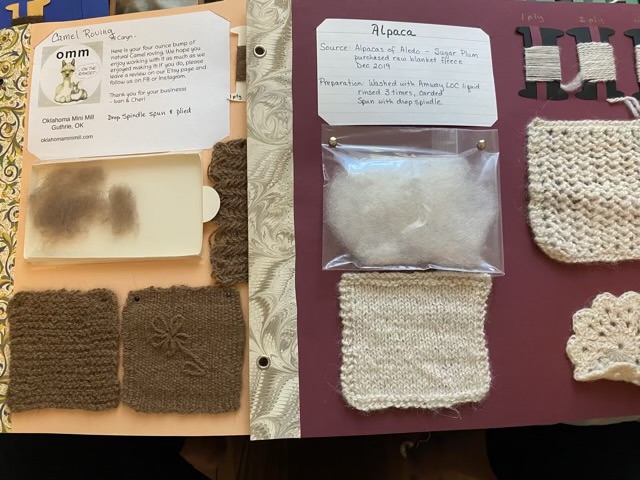
For my fiber study, I’ve been making fiber pages that have a small amount of fiber, then examples of spun, plied, knitted, crocheted, and woven fiber. I designed a small drawer for the natural fiber with the idea that it would protect the fiber from getting flattened and felted, but would still allow access to touch the fiber. It was a neat idea, but didn’t function the way I hoped. The drawer was too tall even at a quarter inch, and the stack of drawers took the brunt of the pressure and crushed, flattening the fiber. Hm. So I switched out the drawer for a plastic bag. The fiber can at least still be seen, and if necessary, the bag can be opened for closer examination of the fiber.
Photo description: two fiber pages, the one on the left shows the original drawer design, the one on the right shows the plastic bag
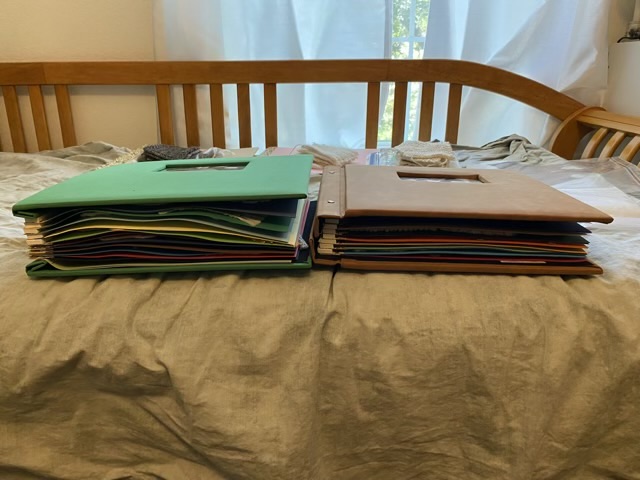
The advantage of the plastic bag to hold the fiber is that the pages lay nicer when stacked. The thickness of all the samples is similar and the pages lay flatter.
Photo description: two fiber pages books, the one on the left has distorted pages from the drawer stack, the right one shows how much neater the pages are when the drawer is replaced with a plastic bag.
I secure the bag to the page with brads. By keeping all the connections mechanical and avoiding glue or adhesive, it should give the pages a longer life.
I kept the foam spacers at the post side, and also added space for a 12×12 sheet after each fiber page, where I plan to put a description of each fiber, and some of the blog posts I wrote when spinning each fiber. This is definitely still a work in progress.
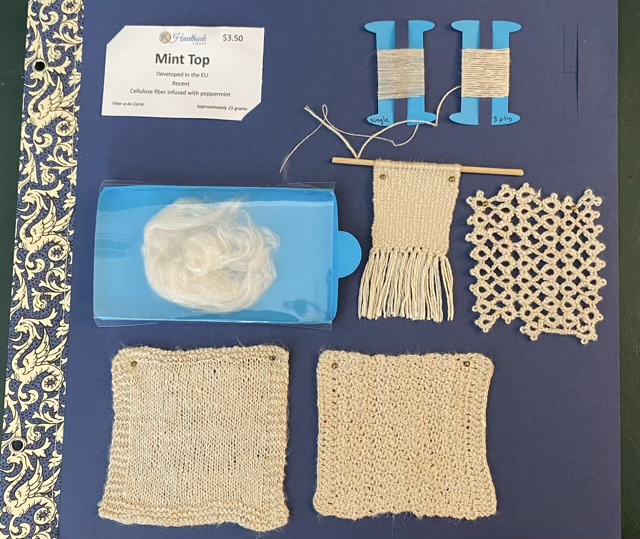
Photo description: scrap book page with card from Hearthside Fiber in the upper left, single spun and chain plied yarn in the upper right, unspun fiber middle left, twined swatch middle, tatted swatch middle right, knitted swatch bottom left, and crocheted swatch bottom right
I think this was my bottle neck for assembling my fiber pages. I had several sets ready for assembly but this one wasn’t ready because the tatted swatch took a long time. I think next time I tat for the book it will be a ribbon rather than a rectangle. Or a small doily. Choices.
My favorite piece on this page is the crochet, because I used an orange peel stitch that alternates between single and double crochet and gives a beautiful texture.
The fiber is cellulose infused with peppermint, according to the description. It is supposed to feel cooler. I do not feel it. It was easy to spin thin, gives a nice drape in the knitting and crochet, is possible to tat with (but has more halo than pearlized cotton), but is not noticeably “cool”, any more than cotton can feel cool.
I might purchase this fiber if I had a light summer shirt I wanted to make, but I would be more inclined to purchase cotton or linen.
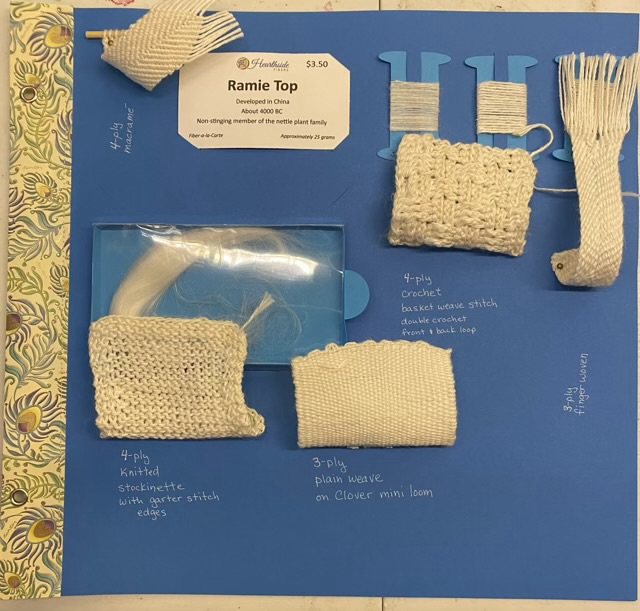
I completed the fiber page for my spindle spun Ramie top fiber from Hearthside fibers. Ramie was pleasant to spin and has a cottony feel but with a long staple length. I experimented with three and four ply yarns.
Photo description: 12 x 13.5 inch fiber page with (clockwise) a sample of macrame on a bamboo stick, the card from Hearthside Fibers that says “Ramie Top Developed in China about 4,000 BC Non-stinging member of the nettle family”, paper bobbins containing single spun, 3-ply, and 4-ply yarn, finger woven sample, crocheted basket weave swatch, plain weave swatch, knitted swatch, unspun fiber in a clear topped drawerPhoto description: sample fiber page with the swatches flipped up to show the descriptions written in white ink on the blue card stock



 Critters and Craft