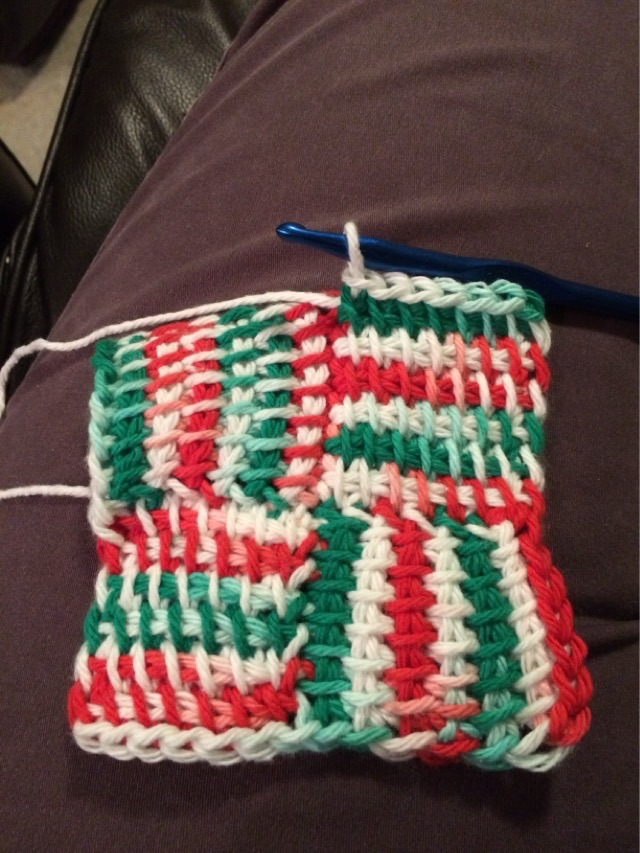
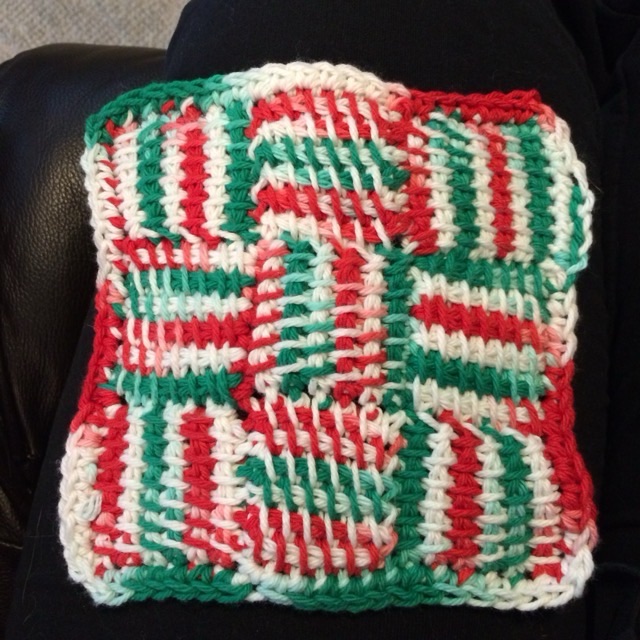
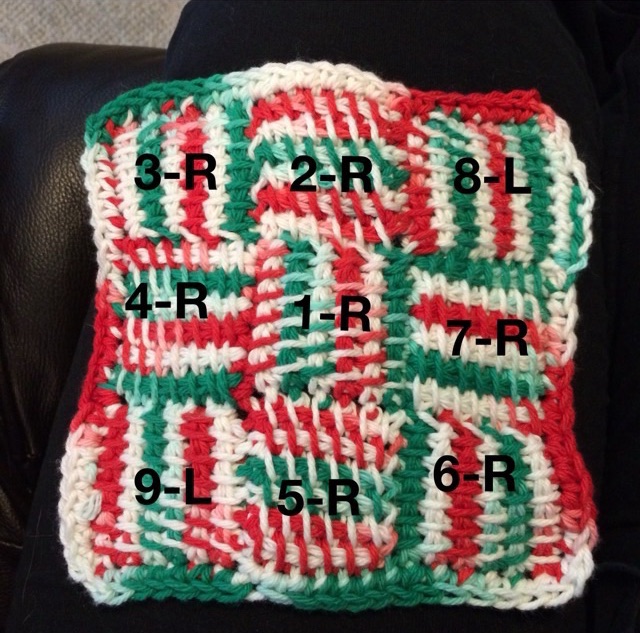
I went into my photo app and searched New Year’s Day for my throwback today. I found a quirky little project I did back in 2016, where I was experimenting with small alternating blocks of Tunisian crochet.
Photo description: four squares of Tunisian crochet connected as stitched, sometimes called “sew as you go”, made with red, green, and white variegated cotton yarnPhoto description: nine square swatch with a crochet borderPhoto description: same nine square swatch, but labeled with the order number and if the rows were done from the right or left
I think the variegated yarn and Tunisian crochet made some interesting pooling variations. When I washed this swatch, though, it puckered and buckled aggressively, so I did not pursue the technique farther.
Happy New Year, may your year be filled with successful experiments!
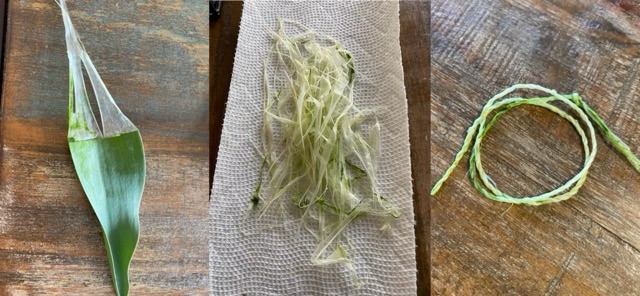
We went to a tulip festival where you could pick your own tulips. We were instructed to grasp the stem at the bottom and pull straight up. We often came away with the whole plant! At home I put the stems and flowers in a vase, and had a whole pile of tulip leaves. Was there fiber there I could harvest? I tried different ways of taking the leaf apart, and found translucent fibrous material on the back of the leaf that I could peel away from the fleshy section. (Many plant fibers are harvested after retting, a process that rots away the non-fibrous material, I wasn’t ready to go that far with these tulips.)
Photo description: from left to right: partially peeled tulip leaf, fibers from leaves on a paper towel to dry, rewetted and twined tulip leaf fiber
I left the fibers to dry for a couple days, then rewetted them one at a time before twining them together. The resulting twine was not very strong, even after drying.
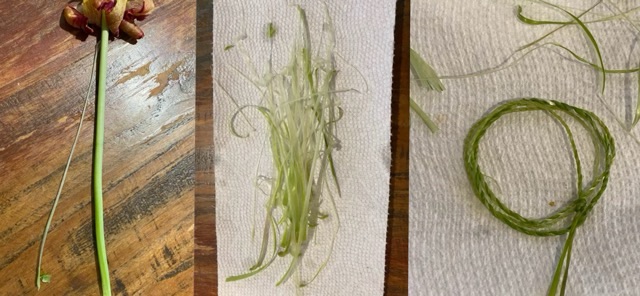
Tulip blooms don’t last long, and I noticed that the stems were starting to curl up at the cut ends. Would the fiber in the stems be stronger? I peeled the outer layer of the stems and let them dry to find out.
Photo description: from left to right: spent tulip with a portion of the stem peeled away, pile of fibers from tulip stems, twined tulip stem fiber.
The fiber from the tulip stems is stronger than the leaf fiber, at least with the method I used to harvest. I can’t imagine a survival situation where I was stranded in a field of tulips and needed rope, but if I were, I’d use the stem fiber, and hope that it didn’t need to bear much weight because it still isn’t that strong. When dry, I can break it with my hands with some pressure. Harvesting the fiber is also tedious and time consuming for small gains, but was an interesting experiment.

 Critters and Craft