One of these things is not like the others

When I switched to the jumbo flyer on my new-to-me Ashford Traveller spinning wheel I noticed the spin was much smoother and quieter, and the flyer fit better. Some further investigation revealed that the socket in the jumbo whorl was different than the socket in the other whorl. Hm. I ordered a high speed whorl that is supposed to fit the Ashford Traveller, and it had the same socket as the jumbo, which leads me to believe that the whorl that was on the spinning wheel when I received it was not original. I ordered a regular whorl, and it fit! I know the previous owner used it as-is, and was frustrated trying to learn to spin on it, and I wonder if the owner before also bought it second hand and gave it up because it was difficult to spin. How many people give up on something they want to learn because the tool is difficult, and because they are beginners, they can’t spot what’s wrong and they think it is their own inability?

Photo description: collection of spinning wheel whorls, clockwise from the bottom left: Ashford high speed whorl, Ashford regular whorl, Ashford jumbo whorl, mystery whorl
Photo description: underside of the same whorls with the mystery whorl on the bottom right with a subtly different socket

I do have to admit that I love spinning for the joy and quiet of it. It is not a fast craft, and there are small moments of immediate gratification (when the fiber takes up the twist), but it is making a supply, rather than a finished wearable or gift-able object. Not everyone loves it. Everyone is different. I’m glad I learned on drop spindles, because it made learning to spin on a wheel easier for me.

Return of the hook

I finally did reunite a metal hook to my favorite drop spindle. I’m currently spinning Ramie combed top from Hearthside fibers. Ramie is a thornless member of the nettle family, and the fibers harvested from the stems are long, strong, and fine.

Photo description: lock of Ramie showing the long fine fibers, held in my hand, asphalt road in the background

I allowed myself to spin fine with this fiber, since on my last fiber I spun thick. I did not try to spin as fine as I could, that will be a later challenge, but just to spin a nice comfortable single.

Photo description: single spun Ramie fiber on a drop spindle, asphalt road in the background

I remembered to grab a cup hook and screw it into the top of the spindle, eventually. It really does make a difference in the spin of the spindle, because the arch of the hook allows the spindle to hang closer to its center of gravity, giving a smoother longer rotation.

Photo description: drop spindle with no hook, hanging from yarn secured with a half hitch, showing the point of suspension at the side of the shaft
Photo description: drop spindle with a hook, with the yarn secured by wrapping a couple times around the hook, showing the point of suspension centered on the shaft

It also helps that I am spinning clockwise again, which does not unscrew the hook. I will have to think on a way to add a hook that is secured without a screw or just glue, that can spin either way with ease.

Making things too hard

I excel at overthinking. I have gone through many contraptions to hold my full spindle so it wouldn’t skitter across the floor while I wound the yarn off into a ball. Before I headed off for a walk, I saw that I didn’t have enough fiber to last the walk, and I would be at the point I needed to wind off mid-walk. Throwing caution to the wind, I stuck a rolled up piece of card stock in my pocket and headed out. Within 10 minutes I had spun all my fiber and was faced with winding a nostepinne style ball without any of my spindle holding devices except my hands.

Photo description: winding camel fiber single ply yarn into a nostepinne style ball on a card stock tube from a drop spindle while walking the neighborhood, asphalt in the background

It turned out brilliant. I could rotate the spindle around the tube, keeping consistent tension by lightly gripping the shaft, and slowly rotating the card stock tube. I had been stuck in thinking that the spindle or bobbin needed to be set down in order to control the tension to wind off. I’m glad I broke through the “I have to do it this way” barrier, for this is now my preferred method.

Plying speed

Plying on a Turkish spindle is satisfying, especially now that I’ve figured out how to get the geometric wrap pattern, but it is not fast. I took the other turtle of yarn and pied it with a top whorl drop spindle.

Photo description: Top whorl drop spindle filled with 2-ply mixed wool yarn, my foot and asphalt in the background because I took the picture while walking.

I plied nearly twice as much yarn in half the time with the top whorl spindle versus the Turkish spindle. I can really get the top whorl spindle going by rolling the shaft along the outside of my leg. The Turkish spindle I have to get spinning with a flick of my fingertips.

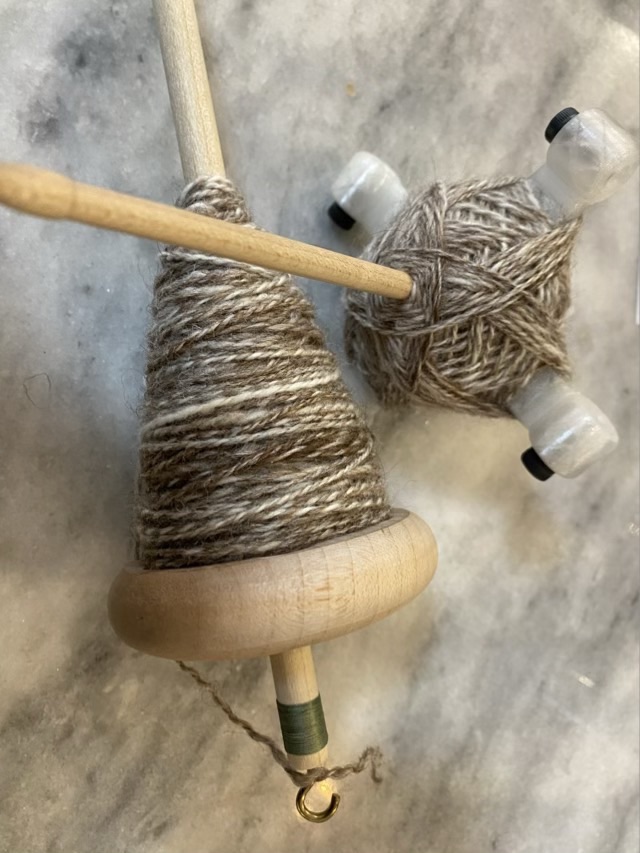
Photo description: Top whorl spindle on left, Turkish spindle on right, both wound with 2-ply blended wool yarn.

Now there is a difference after plying between the two spindles. The top whorl spindle has to be unwound from the shaft and wound into a ball or cake before it can be used. The Turkish spindle shaft and arms pull out of the yarn turtle and leave a center-pull ball of yarn that doesn’t need rewinding. I like to wind my yarn on a niddy noddy and wet set the twist, so did not save time in that area on this project. If I didn’t want to use the yarn right away, and wanted to let time set my twist, and marvel at the pretty geometric wrapping, a Turkish spindle is a way to go.