Chain ply cotton

Since I had more spun cotton single than I needed for my crepe yarn, I tried chain plying it to make a three ply yarn sample. It did not go well. The cotton single was difficult to handle and kept breaking if the strands rubbed together. The resulting yarn is very haphazard with sections that coiled mixed in with the smooth ply.
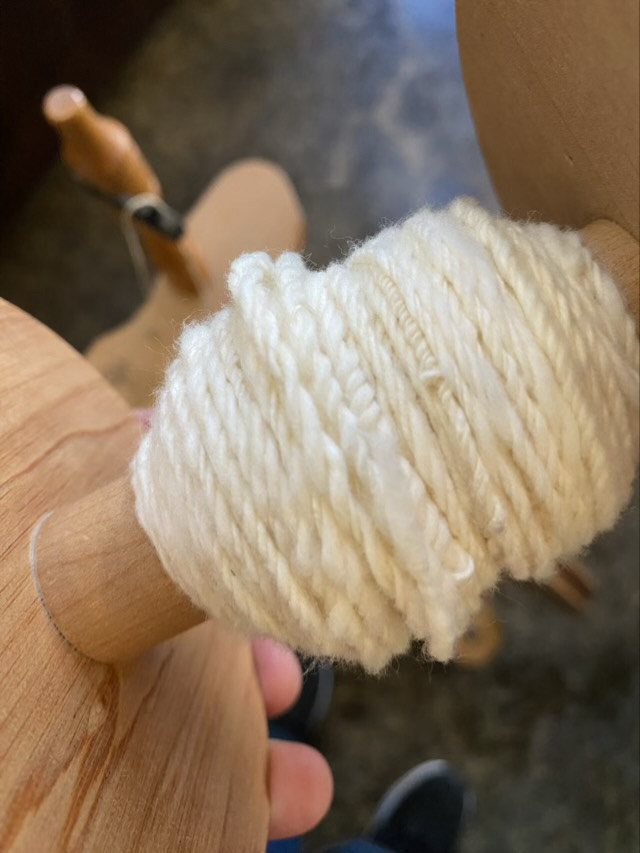
Photo description: three ply cotton yarn on a wood bobbin

The chain ply and the crepe yarn don’t look that different on casual observation because of the irregularity of the single spin. The variations in width cause more visual texture than the plying techniques. I will have to try this comparison with a different fiber preparation.

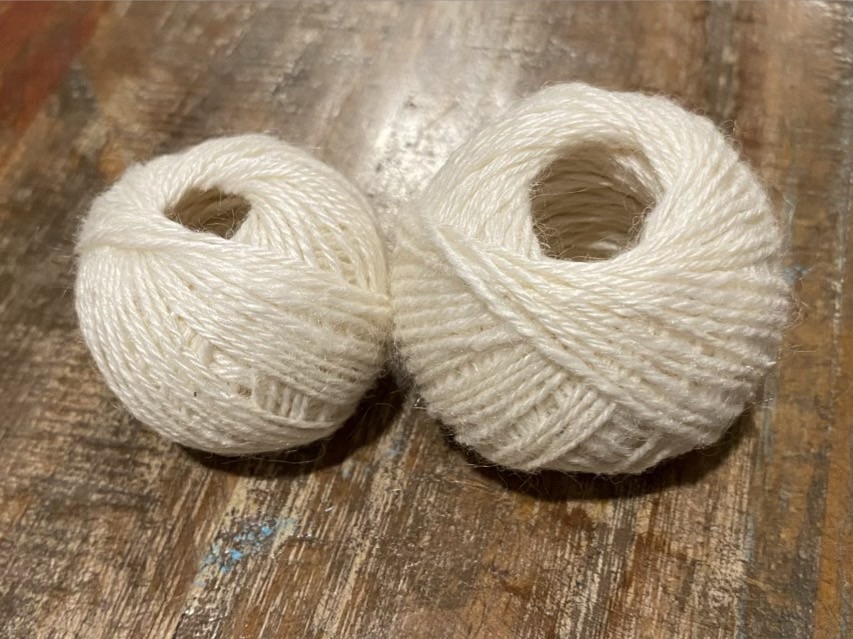
Photo description: crepe yarn (left) and chain plied yarn (right) on a PVC niddy noddy

Chain plying Ramie

I like chain plying single spun yarn because I don’t need three bobbins and a Lazy Kate to get a three ply yarn. I use a center pull ball and make a crochet chain with really long loops. I was unsure about chain plying my Ramie fiber because I’ve read that it isn’t a good technique for bast fibers like flax because flax doesn’t like the sharp bends which happen at the ends of the loops. Flax is not as flexible as wool. Ramie is also a bast fiber, taken from the stem of the plant, but it chained plied quite well; the chain loop ends disappeared into the ply twist without little stubborn loops.

Photo description: three ply yarn (chain plied) on the left, four ply yarn (not chain plied) on the right

For chain plying with a drop spindle, I prefer to sit and park my spindle by my leg, then pull a loop as long as my arm. I keep the end of the loop open with a finger and the yarn ball in the same hand, then I can suspend the spindle and give it a spin in the opposite direction of the single.