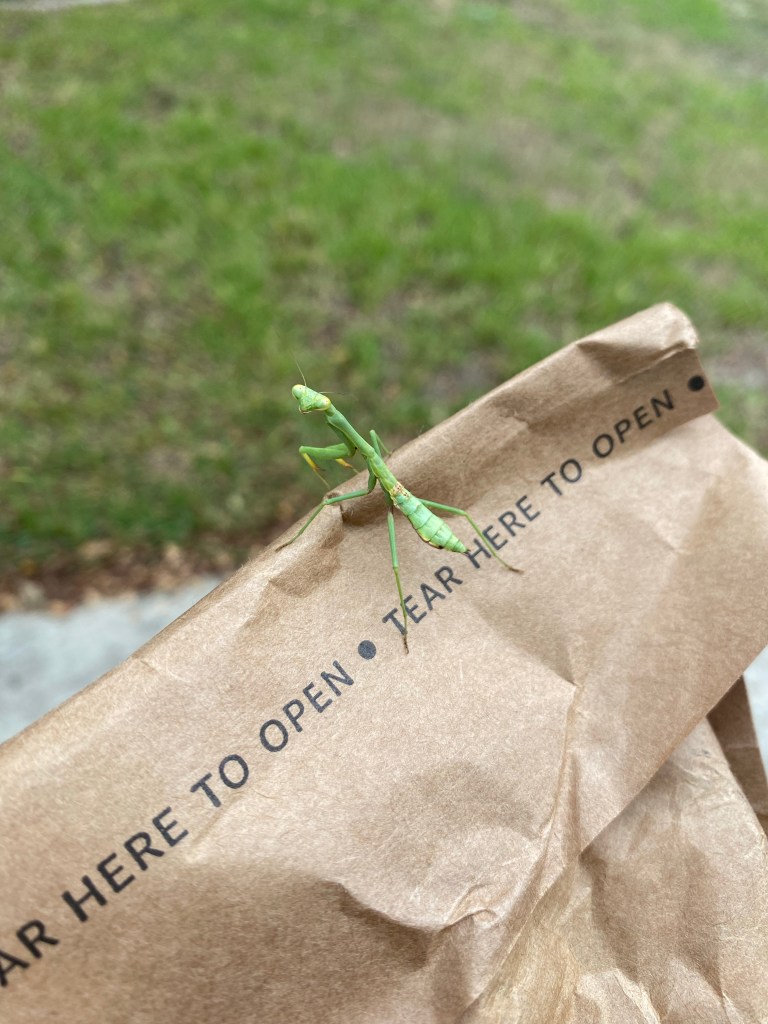
Talking ebbs and flows again. We saw two praying mantises in one day about 17 miles apart. One on the outside of the doctor’s office, and one on the wall on our front porch. We don’t see many of these a year, and two in one day is remarkable.
Carolina Praying Mantis on windowCarolina Praying Mantis on brick
The mantis on the house was missing the lower half of both middle legs, which didn’t stop it from easily scaling the wall.
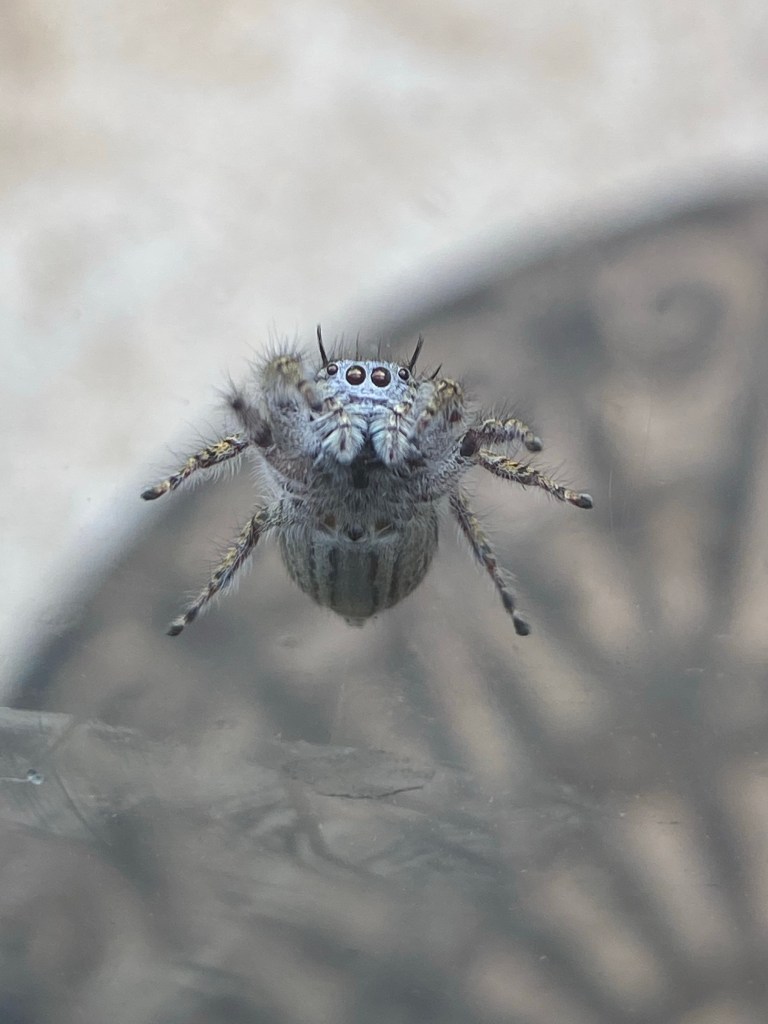
I am working on the weaving, really. Bits here and bits there, but apparently this little spider thought I needed more assistance, or maybe a model of an efficient productive weaver, as she set up shop right behind my loom. Saucy.
No, we didn’t add one of those clear boxes full of ants to our household menagerie, but I did find the ants themselves farming aphids on my melon vines! I have heard of this symbiotic relationship between ants and aphids but have never knowingly witnessed it. The aphids produce honeydew, which the ants eat. The ants protect and herd or move the aphids to the juiciest parts of the plant, then stroke the aphids to “milk” them to produce honeydew. This is information from searching the net. Most of the articles were enthusiastic but not very scientific, and give the same information I just gave you. The end point of all the articles was how to treat the garden plants to make them not good for ant farming. The result is probably from my chosen search terms “ants and aphids”. Ah, add “symbiotic” and you at least get to a Brittanica article eventually.
The bugs found the ripe melon. I’m not sure if the earwig dug the hole, or the caterpillars dug it and the earwig was hiding out, but the chickens really enjoyed both the insect and the fruit. I sprayed the remaining melons with diluted Neem oil and Castille soap. Maybe we will get another melon before the bugs do; there are currently two melon candidates for bug roulette.
Chickens preparing to tuck into a melon (the earwig was the first to go)
The wasps found a hidden area between the rafters in the overhang in the run to build their nest. I’m not sure how I didn’t disturb them before this, but when I went to fill the far hanging water for the chickens, they certainly let me know they were there now. (There might have been some hollering on my part as I ran.)
Looking up at a large wasp nest
Here is another good reason to have multiple watering stations. I abandoned the far water containers near the nest, knowing the chickens have access to water at three other spots. I waited until dusk, when the chickens were up for the night and the wasps were quiet, then soaked the nest with wasp spray. Thoroughly. In the morning the spray was dry and the wasps were gone. The instructions on the can recommend waiting 24 hours before removing the nest, but I’m going to wait until it falls down on its own. I’ve read that wasps are territorial and won’t nest where there is another nest. Some people even put up fake nests to deter wasp activity. I had an old nest up on the other side of the run for nearly a year and while it was there, no other wasps nested in the area.