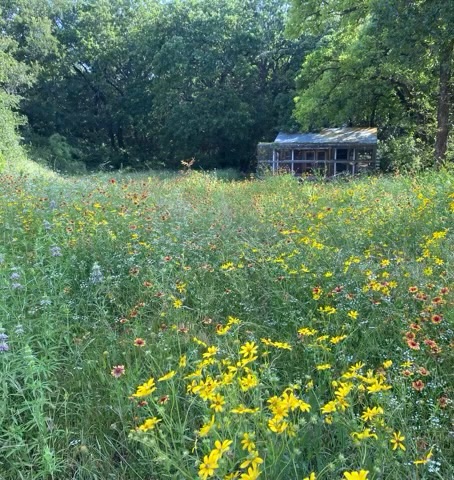
The Spring wildflowers are showing off in our meadow.
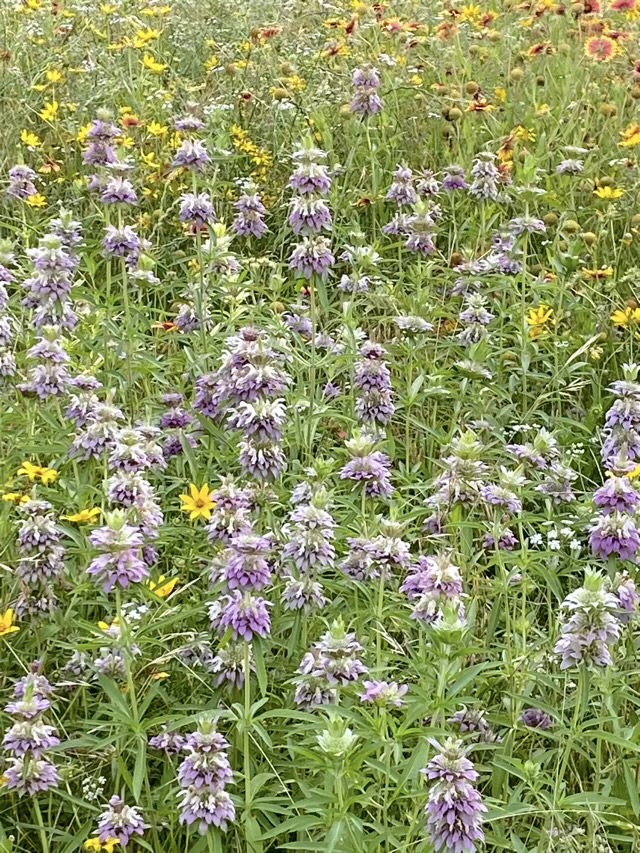
Photo description: horsemint, cutleaf daisy, and Indian blanket in the foreground, our coop and deer ornament in the mid ground, and the post oak and cedar elm of our wood in the backgroundPhoto description: closeup of horsemint with a scattering of cut leaf daisy and Indian blanket flowers
Now, down the hill, hidden by those flowers is mostly grass. I’m not sure what happened to the flowers that used to come up there, although it could have been the heat, or the freeze, or the wet, or a grass roots take over. I might throw some extra seeds down back there and see if we can’t get something more started.
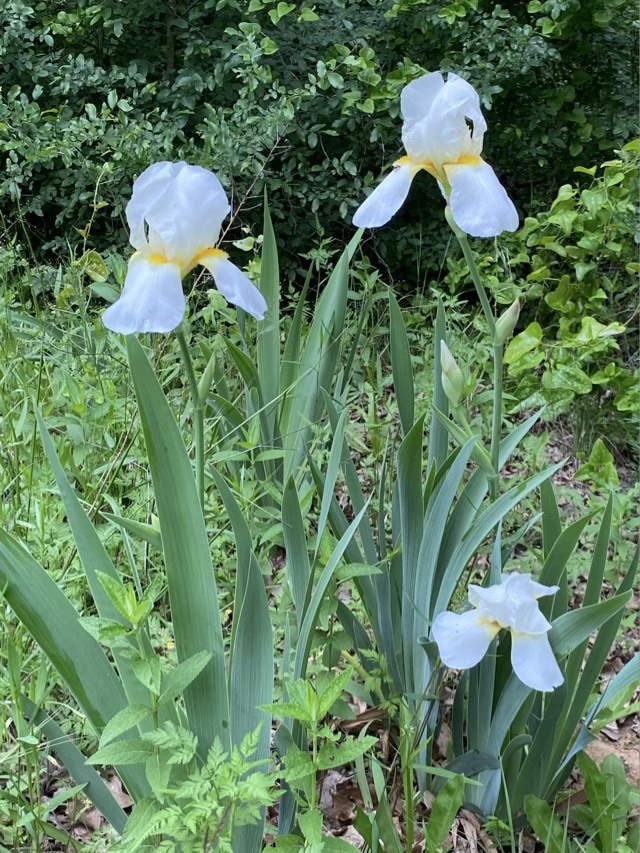
Photo description: three white bearded iris blooms
Iris that my Dad replanted at the back of our meadow three years ago or so have bloomed! The rest of the meadow is filled with tall grass, but we are only mowing the edges in hopes that our Indian blanket and basket flowers come up again.
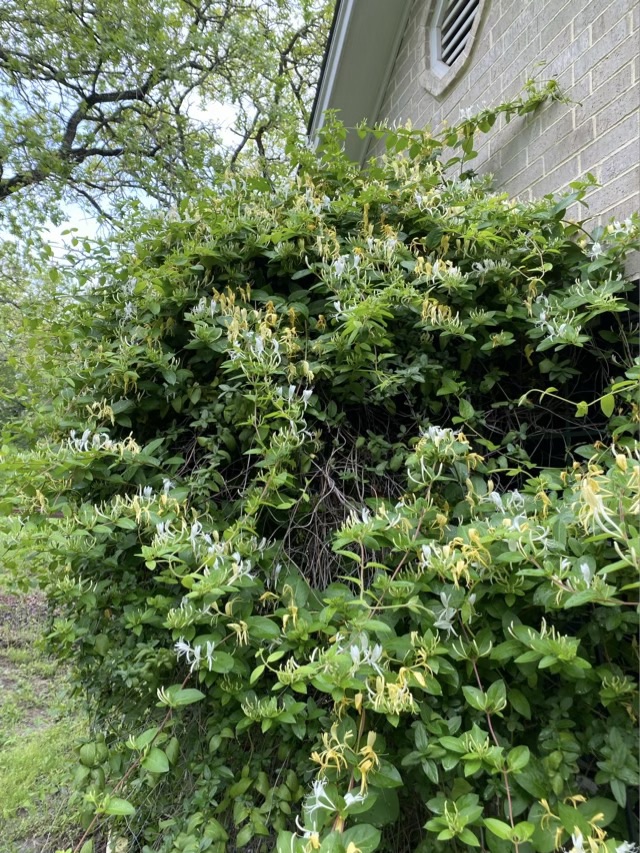
Photo description: Japanese Honeysuckle mound with yellow and white blooms growing about 8 foot high
Once again I lament that I can’t provide you with smell-o-vision with the Spring honeysuckle blooms. Although, you might not be happy with me if I did assault your senses with this; it is more like being kicked in the nose than a gentle waft of perfume. The smell in Spring is nearly overpowering and very sweet. It smells great from the road, but going out the front door gets you an olfactory ambush.
Currently the Japanese Honeysuckle is the only visible plant in the mound (there is a metal arbor under there somewhere). There was, and may still be, some native honeysuckle lurking in the shadows that has yet to bloom. The native on the corner of our fence did not fair well and has not come back after the heat of last summer and the freezes of winter. Japanese Honeysuckle is considered invasive and grows very, very well here. It was planted on the property before our purchase, and does have medicinal and craft use, so it is allowed to stay. I do need to rein it in though.
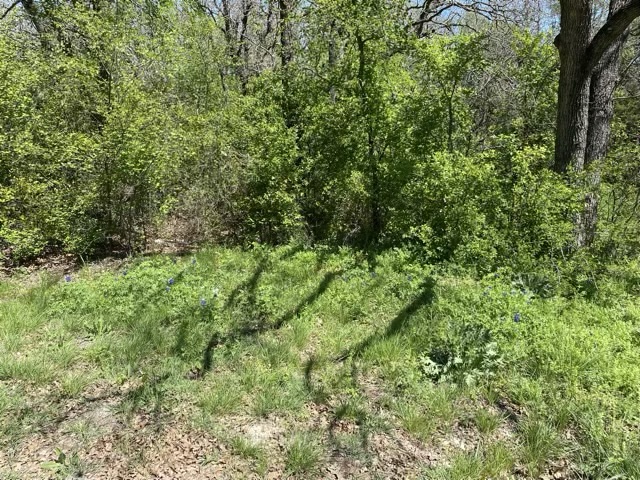
Photo description: grassy clearing with leafy trees in the background.
It looks like an April Fools joke, but it really is a bluebonnet patch. Here is a photo taken from another angle:
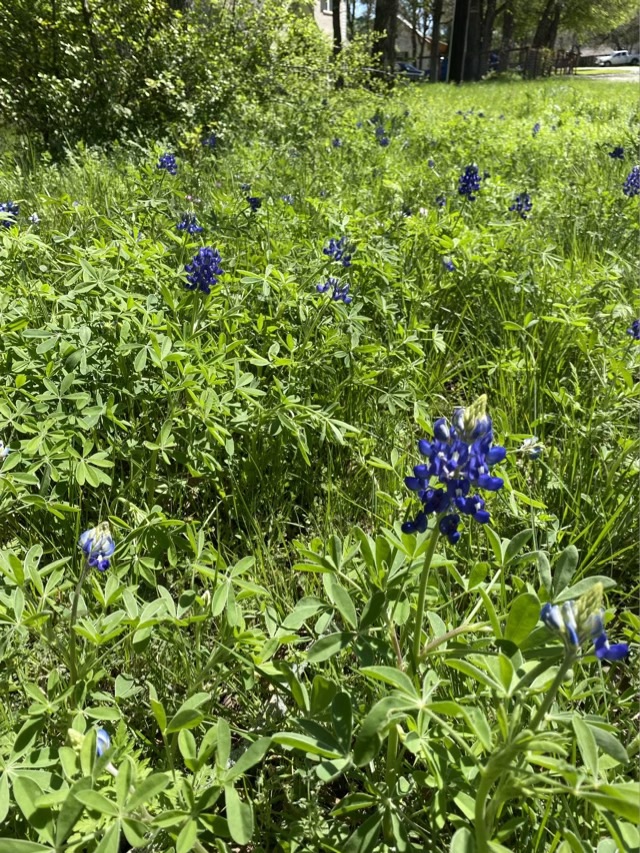
Photo description: sparse bluebonnets in a field of green, taken at a ninety degree angle from the first picture.
There are more bluebonnets in this area than last year; we’ve had a wet spring. Some of my neighbors’ yards are breathtaking with their bluebonnets. I’m hoping this patch continues to thrive and expand. We won’t mow it until late summer, when the state starts to mow its wildflower filled roadsides.
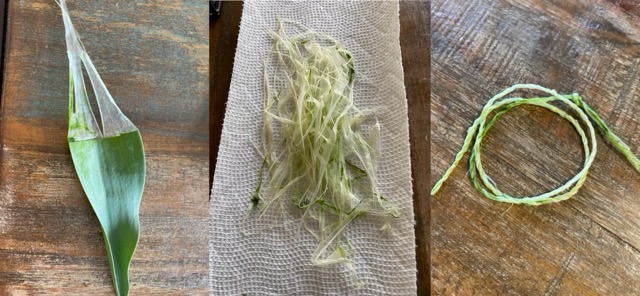
We went to a tulip festival where you could pick your own tulips. We were instructed to grasp the stem at the bottom and pull straight up. We often came away with the whole plant! At home I put the stems and flowers in a vase, and had a whole pile of tulip leaves. Was there fiber there I could harvest? I tried different ways of taking the leaf apart, and found translucent fibrous material on the back of the leaf that I could peel away from the fleshy section. (Many plant fibers are harvested after retting, a process that rots away the non-fibrous material, I wasn’t ready to go that far with these tulips.)
Photo description: from left to right: partially peeled tulip leaf, fibers from leaves on a paper towel to dry, rewetted and twined tulip leaf fiber
I left the fibers to dry for a couple days, then rewetted them one at a time before twining them together. The resulting twine was not very strong, even after drying.
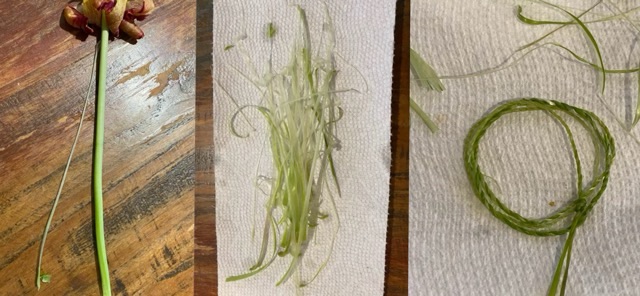
Tulip blooms don’t last long, and I noticed that the stems were starting to curl up at the cut ends. Would the fiber in the stems be stronger? I peeled the outer layer of the stems and let them dry to find out.
Photo description: from left to right: spent tulip with a portion of the stem peeled away, pile of fibers from tulip stems, twined tulip stem fiber.
The fiber from the tulip stems is stronger than the leaf fiber, at least with the method I used to harvest. I can’t imagine a survival situation where I was stranded in a field of tulips and needed rope, but if I were, I’d use the stem fiber, and hope that it didn’t need to bear much weight because it still isn’t that strong. When dry, I can break it with my hands with some pressure. Harvesting the fiber is also tedious and time consuming for small gains, but was an interesting experiment.