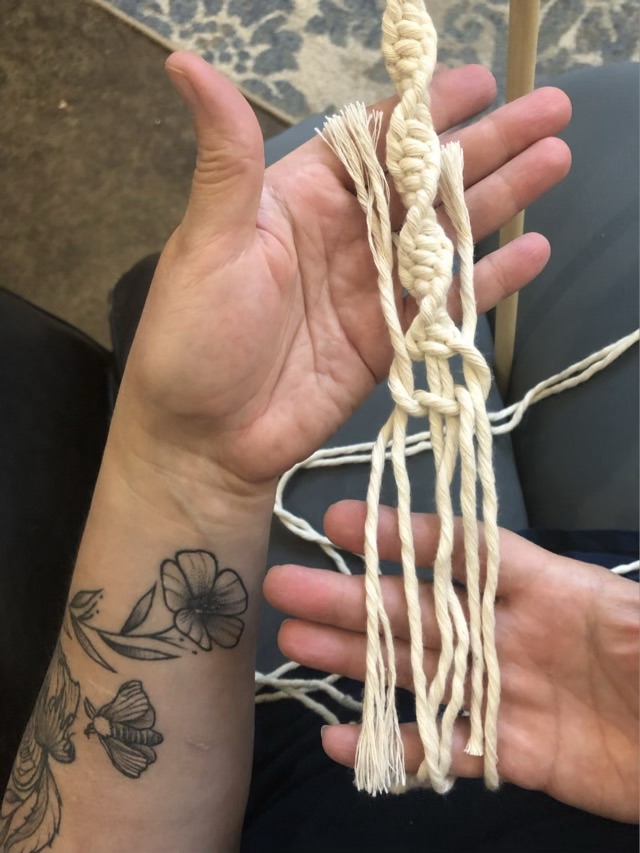
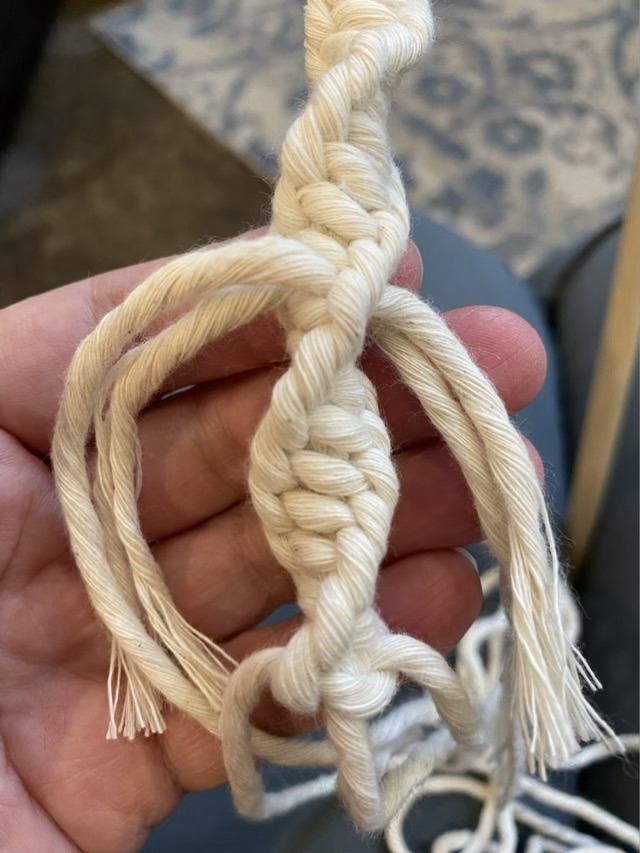
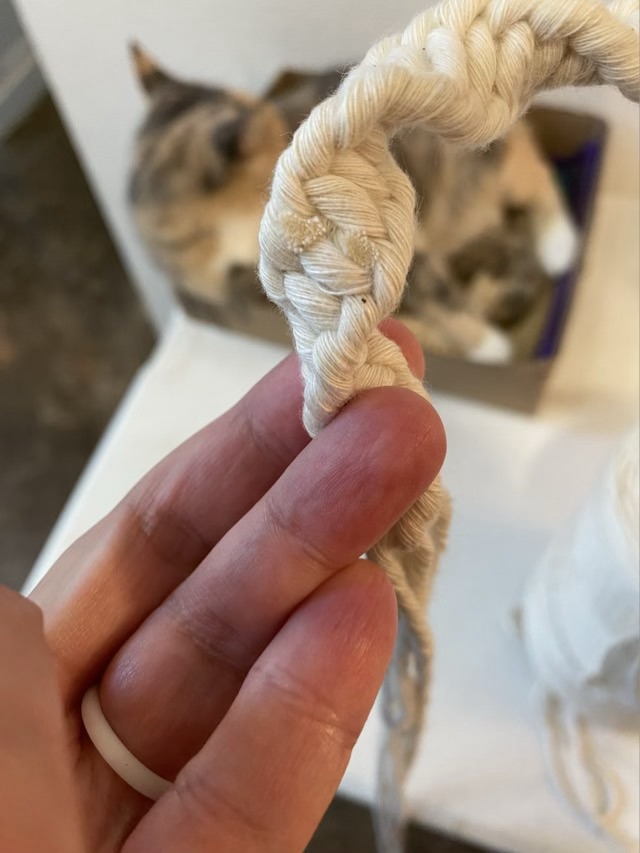
I wanted to make a macrame twisted rope with precut pieces. My center strands were long enough, but the decorative outside strands ran out after about a foot of knotting. I found that laying new strands into a knot in the same direction as the old strands then tightening the knot, trimming, and sealing with white glue made a near invisible join.
Photo description: half macrame knot shown open with new strands laid in, the ends pointed up are the new strands, the ends pointed down are the old strandsPhoto description: knot tightened and several more half knots added, the four ends are shown sticking outPhoto description: same join area with the ends trimmed flush and secured with white glue (I used Elmer’s school glue). Calico cat in her favorite box on the table in the background.
Since the knots are decorative and the un-spliced center strands bear the weight applied to the rope, I’m not concerned about the ends unraveling.
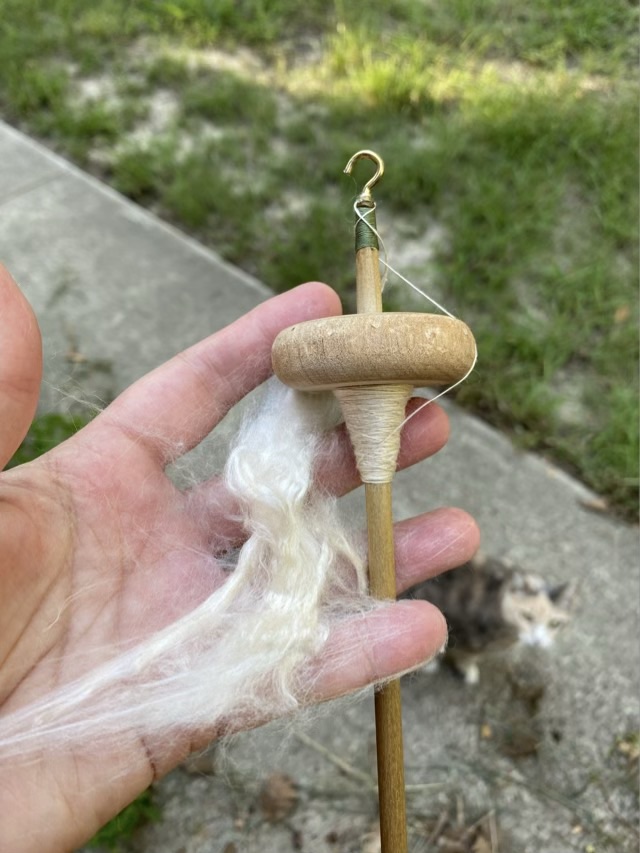
When picking a new fiber to spin as I walk, I wanted something easier to spin than Tencel. I had a “Mint Top” sample in my stash, gifted to me by my sister that looked like it had some nice texture. I started spinning it on a drop spindle and it is dreamy, and the descriptive word “toothy” keeps coming into my head. The fibers grab each other with the help of the twist, but don’t clump up, and it drafts nicely.
“A very new Biodegradable cellulose fiber which is infused with Mint powder extracted from Peppermint Leaves. Contains natural cooling and antibacterial properties. This is a very soft and lustrous fiber that is a natural off-white/golden color. The fiber gives a natural smooth and cooling feeling with excellent moisture absorption.”
Photo description: mint infused cellulose fiber sticking to my hand, spinning into fine single spun on a wood drop spindle, calico cat in the background waiting for pets
It doesn’t smell minty to me. It will be interesting to see if the products made with the yarn feel cool.
When I switched to the jumbo flyer on my new-to-me Ashford Traveller spinning wheel I noticed the spin was much smoother and quieter, and the flyer fit better. Some further investigation revealed that the socket in the jumbo whorl was different than the socket in the other whorl. Hm. I ordered a high speed whorl that is supposed to fit the Ashford Traveller, and it had the same socket as the jumbo, which leads me to believe that the whorl that was on the spinning wheel when I received it was not original. I ordered a regular whorl, and it fit! I know the previous owner used it as-is, and was frustrated trying to learn to spin on it, and I wonder if the owner before also bought it second hand and gave it up because it was difficult to spin. How many people give up on something they want to learn because the tool is difficult, and because they are beginners, they can’t spot what’s wrong and they think it is their own inability?
Photo description: collection of spinning wheel whorls, clockwise from the bottom left: Ashford high speed whorl, Ashford regular whorl, Ashford jumbo whorl, mystery whorlPhoto description: underside of the same whorls with the mystery whorl on the bottom right with a subtly different socket
I do have to admit that I love spinning for the joy and quiet of it. It is not a fast craft, and there are small moments of immediate gratification (when the fiber takes up the twist), but it is making a supply, rather than a finished wearable or gift-able object. Not everyone loves it. Everyone is different. I’m glad I learned on drop spindles, because it made learning to spin on a wheel easier for me.
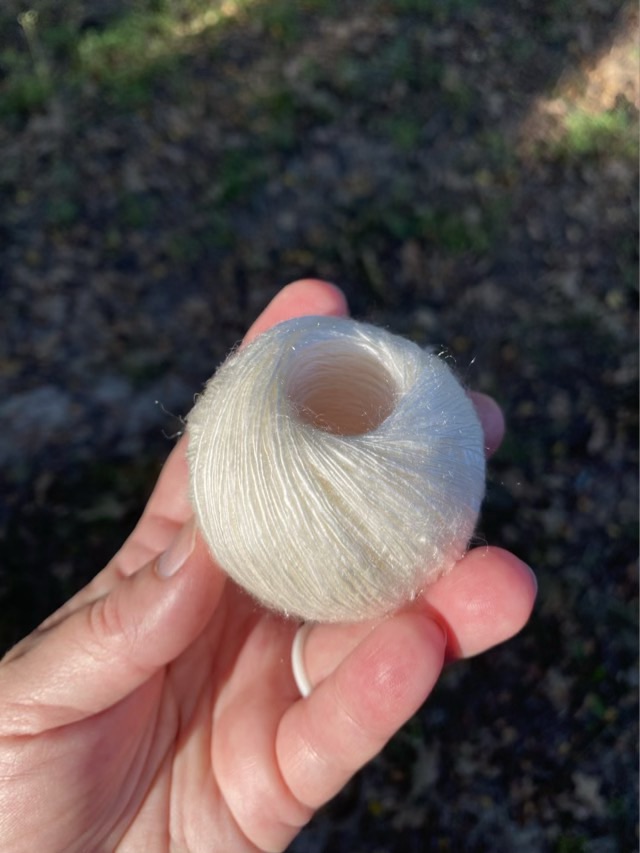
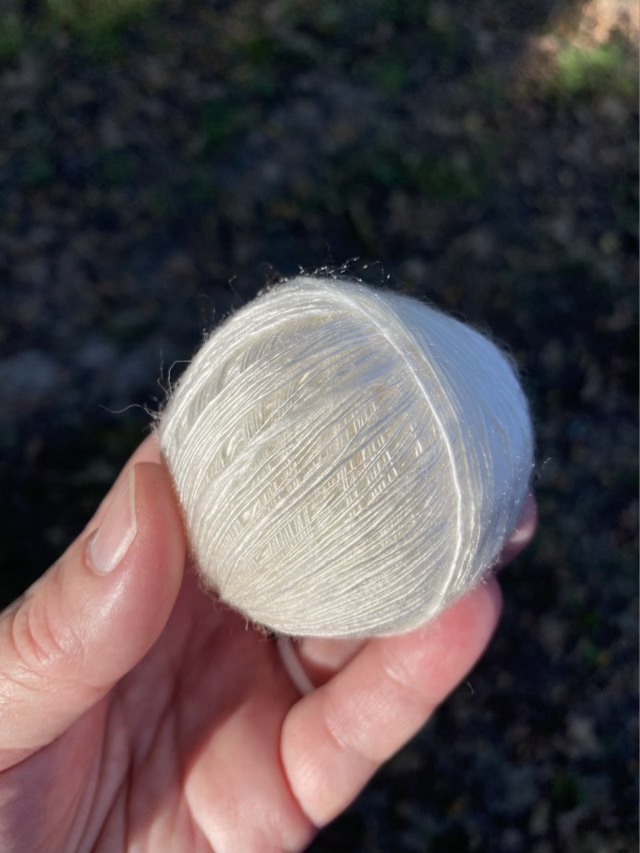
It is shiny, sleek, and has a little sparkle, but I had a rough time spinning the Tencel fiber sample. I think I dropped my spindle more than with any other fiber. The fibers like to clump, but did not like to evenly draft, and my single spun yarn came out uneven with thin and thick randomly spaced.
Photo description: single spun Tencel fiber on a wood drop spindle in the sunlight, asphalt in the backgroundPhoto description: notepinne style wound ball held in my hand in the sunlight to show the luminosity Photo description: the side of the ball of single spun yarn held in the sunlight to show the shine
I chain plied the single from the center of the ball and added twist using my Ashford Traveller spinning wheel.
Photo description: chain plied Tencel yarn on a wood bobbinPhoto description: three ply Tencel yarn on a PVC niddy noddy, which really shows the unevenness of the spin
As much as I love the idea of using fiber made from waste tree products, I would not choose to spin Tencel again, the frustration wasn’t worth it. I was glad it was a 25 gram sample.
I stopped knitting and bound off my rainbow brioche scarf months ago, but there were errors at the beginning when I was still getting used to the brioche knitting with multiple colors techniques. I thought I needed to rip out the first few inches and rebind, which is daunting, so I stuck the project in a bag and tucked it into the back of the closet until I was ready.
Months later, when I was on a finishing kick (see yesterday’s post), I figured I was ready to work on the scarf again. I pulled it out of the bag, in all its squishy soft amazing length, and couldn’t find the spots that bothered me before. I looked again and did eventually spot the small errors, but it definitely took over 10 seconds. I have a 10 second rule, that if you can’t see the mistake in 10 seconds, the item passes. If someone else wants to examine an item that closely, they deserve to find something.
I wet the scarf to block it, and noticed that the colors bled.
Photo description: rainbow scarf in blue tinted water in the sink
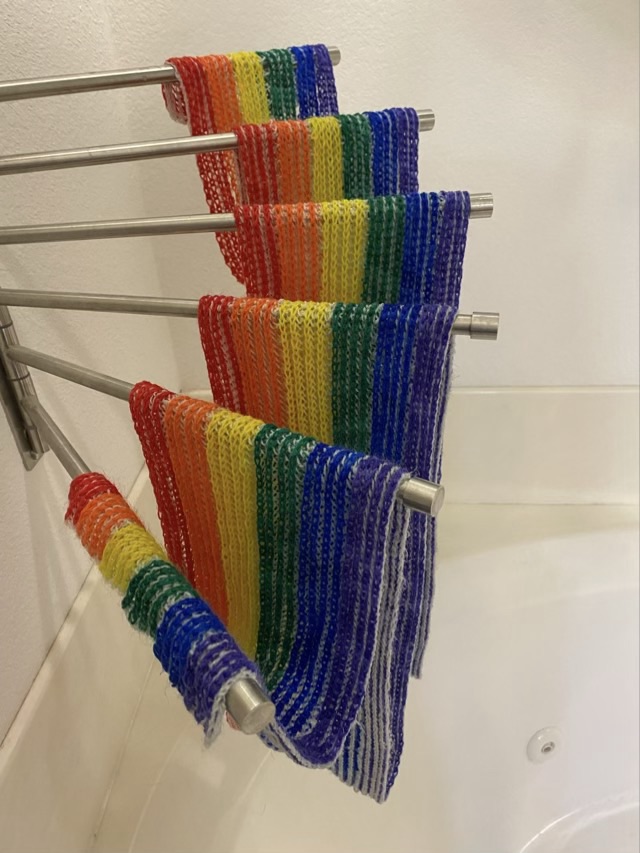
I rinsed the scarf until I could not see any dye in the water, and hung it up to dry.
Photo description: rainbow brioche scarf hanging from multiple towel racks
The dye colors were taken up by the white yarn as the scarf dried, but it doesn’t distract from the piece. I’m glad I didn’t add fluffy clouds to the ends, they would not have stayed white.
Photo description: finished scarf laying artfully on a leather chair
The scarf now has a happy home, two years after I started it.






 Critters and Craft