I have stated before that this blog is a collection of rabbit holes, a written account of my exploration of craft related warrens. I have never been a frilly kind of person, not into ruffles and ribbons, but that might change as I have found a reason to be interested in lace.
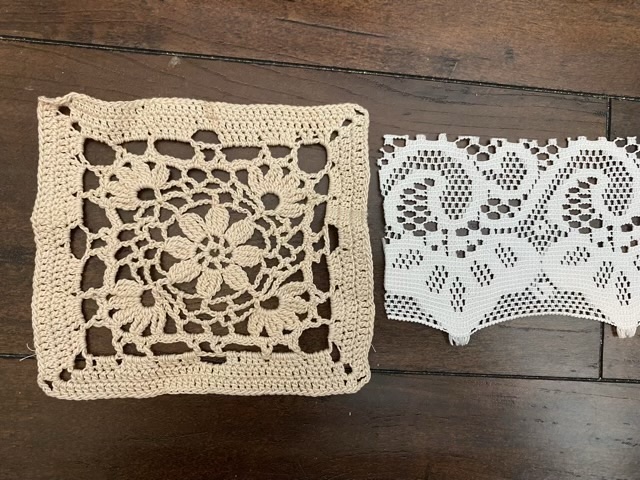
Photo description: two pieces of lacy fabric, on the left a crocheted square made from natural colored cotton yarn, on the right a section of machine made lace curtain made from white synthetic thread
I have a few pieces of inherited lace in my craft room. Mostly crocheted doilies and machine made lace. My husband and I went antiquing and I found a couple new-to-me kinds of lace examples. It made me want to know how to tell hand made lace from machine made lace. Here is the rabbit hole. I was lumping machine made lace into one big discardable pile, but not only are there varying ratios of hand/machine made, there are different machines that produce different lace, and ways to tell them apart. Ooo, craft identification: lace edition. I see the rabbit hole, have taken a peek, and there are more tunnels. I need to do more reading, but hope to scratch the surface enough to share my findings.
I have a side hobby of spotting fake crafts. Either AI generated photos or machine made items pretending to be hand crocheted. Hand knit is harder to tell apart from machine made, since knitted fabric can be produced rapidly by a series of hooks and knitting machines have been around for a long time. I have heard of crochet machines that do make single loops with a single thread, but they are used to edge blankets and not make intricate lace. I was surprised then, when I was crawling a garage sale, to find a large crocheted throw.
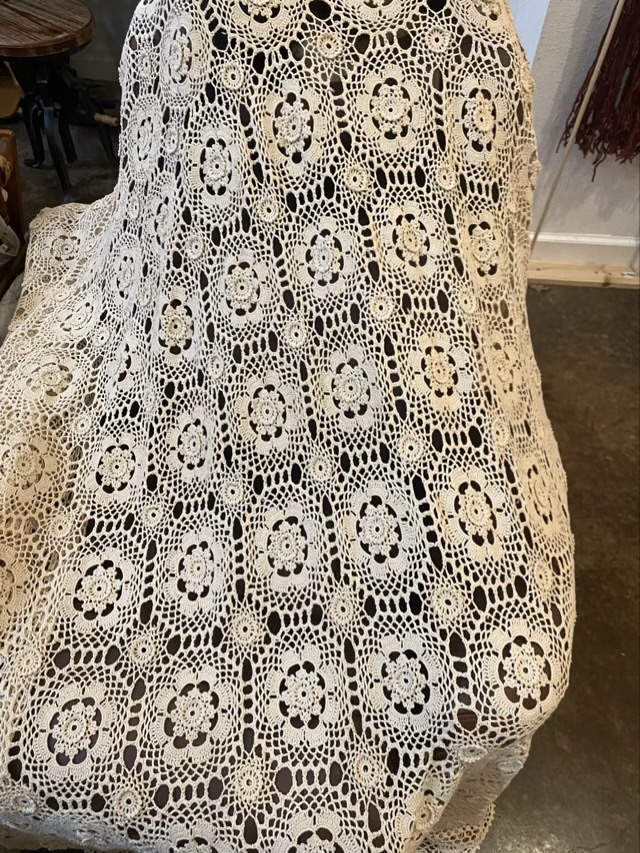
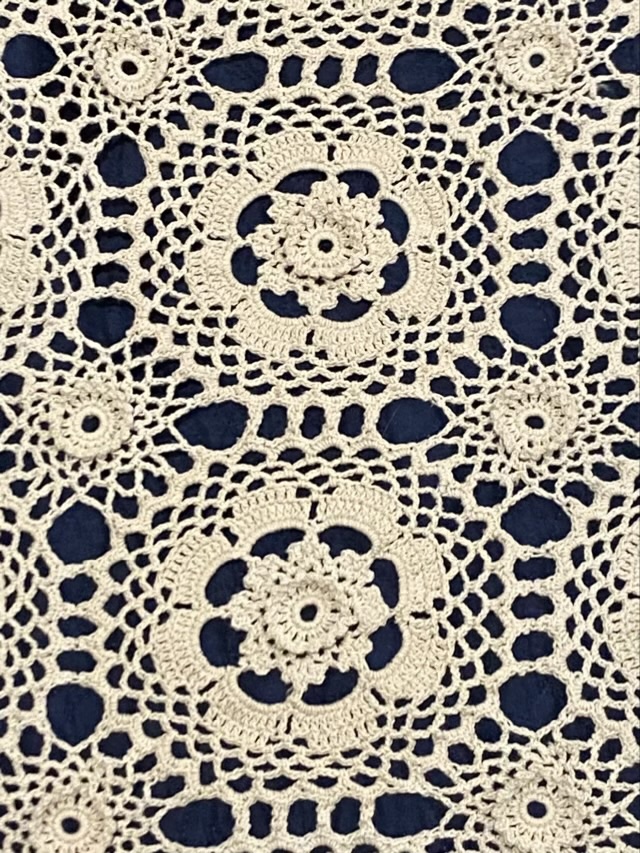
Photo description: king-sized cotton crocheted lace coverletPhoto description; closeup of two motifs of the cotton coverlet, showing the stitches, all of which I can identify and recreate.
I asked the sellers for historical detail, but it was a multi-person sale and the person who owned it wasn’t there. I bought it for $8. It smelled like moth balls and time in a closet.
When I got it home, I found a tag: made in China. Oh. So this was not an heirloom blanket sold at a garage sale. This was an item bought commercially and not used. I suspect the “flat dry” was the problem. Not many people have room to flat dry a king-sized blanket.
Photo description: tag found on the blanket that reads: 100% cotton, machine wash, cold water, gentle cycle, no bleach, flat dry, made in China RN 59757
The only way to produce this large and intricate work cheaply is by using many poorly paid people. I know the original owner didn’t pay $8, but to sell it for that tells me that they didn’t pay much.
That it is in pristine condition tells me that it was barely used, if used at all. There are no stains and no tears. But it is definitely hand crocheted. I can identify each stitch and see the progression of the work. Each motif was worked with a crochet hook then connected and I can see the connection stitches. I can tell how the border was worked and what stitches were used. I washed it and dried it both by machine on the delicate and gentle cycles, and it came out fine.
That the skill to make the coverlet is so casually discarded and undervalued is a sad state.


 Critters and Craft