Great Wheel Accelerator

The Double Nut New England Great Wheel, that lives in Mansfield Texas in the Man House, has an accelerator wheel.
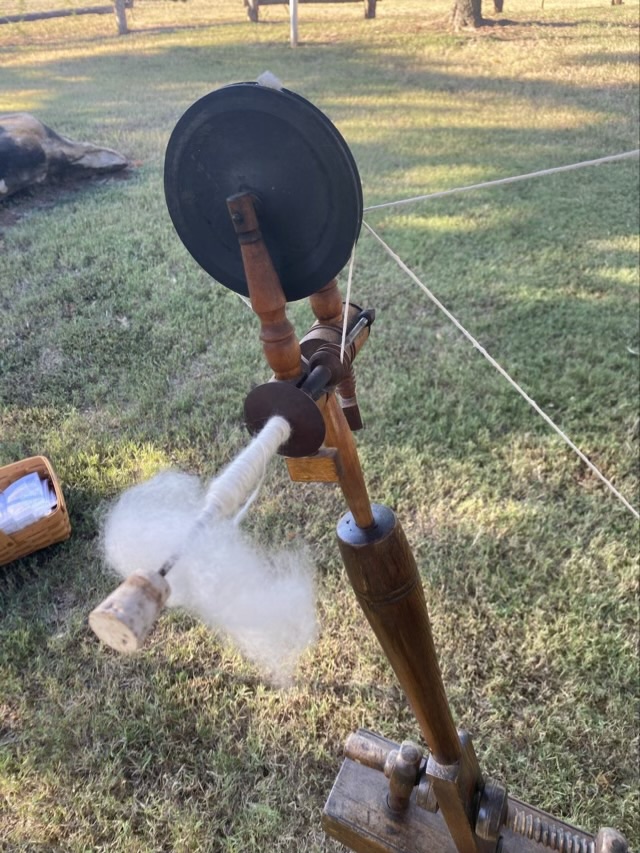
Photo description: spindle post, spindle with cork protector, and accelerator wheel at the top
Photo description: opposite side of the accelerator wheel showing the drive band going around the grooved whorl on the accelerator and a different cotton band going around the perimeter of the accelerator wheel and the grooved whorl on the spindle. Note the wood screws with rectangular heads below the spindle.

The accelerator increases the spin speed of the wheel, which indicates that the wheel was used for cotton, which needs more twist than wool. This matches the history of the area, where they grow cotton. To tighten the band from the accelerator to the spindle, the wood screws in the mother-of-all turn to raise or lower the maiden posts holding the accelerator.

It is interesting to note that the grooves in the whorl on the accelerator and the spindle are all the same diameter. On a treadle wheel, the grooves on the whorl are different, allowing for different spin speeds. On the Great Wheel they are for alignment. The drive band goes in the groove that lines up best with the center of the wheel. I spent quite a bit of time adjusting the wheel position and trying the drive band in different grooves.

This post is part of a series about my experience demonstrating spinning on a 1860s Great Wheel in Mansfield Texas.

Great Wheel Double Nut

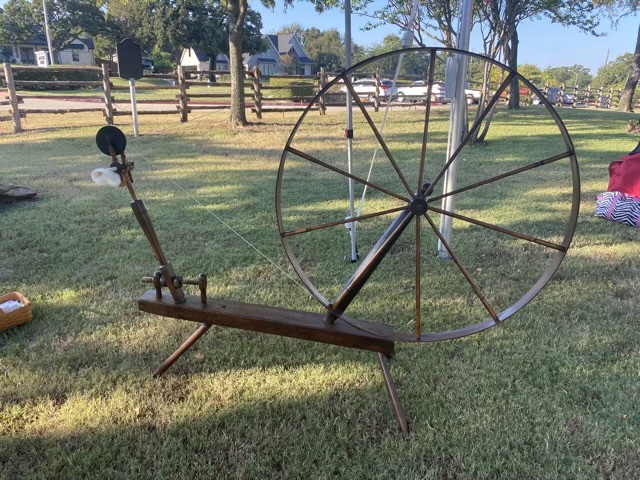
The Double Nut New England Great Wheel is called a “double nut” because of the two wooden nuts on the wood screw that allows for adjustment of the position of the spindle post.

Photo description: close up photo of the double nut assembly for the spindle post of a New England Great Wheel. The cork in the table is used to protect passers-by from the iron spindle when not in use. I just put it there so I didn’t lose it.

To increase the tension on the drive band that runs on the outside of the wheel, the spindle post can be moved farther away by backing off the left nut, and tightening the right nut. A properly tensioned drive band on a well-aligned wheel will keep the spindle turning without slipping or falling off the wheel.

Photo description: Double Nut New England Great Wheel set outside for a Founder’s Day demonstration. The cotton drive band runs around the wheel on the right then to the spindle post on the left.

All the wood screws on the wheel were in working condition, which is remarkable for 165 year old carvings. I was able to move the spindle post position in my quest to find the right alignment to keep her spinning for longer periods of time.

This post is part of a series about my experience demonstrating spinning on a 1860s Great Wheel in Mansfield Texas.

Spinning on a Great Wheel

I had the absolute privilege of spinning on a Great Wheel from the 1860s.

Photo description: double nut New England Great Wheel dated to the 1860s and brought outside to demonstrate spinning for Founder’s Day in Mansfield Texas

The wheel is older than the house she lives in (any item that is 165 years old deserves a pronoun upgrade, in my opinion.) The wheel was used to spin cotton, which was a primary staple in Texas at the time. She was in a private collection for many years, but was placed in the Man House as an honorarium to her former spinner. It is an appropriate placement historically and a valuable display for visitors to see this wonderful piece of human-powered engineering. I was the first to spin on the wheel for ten years, if I have my stories straight, and it was a joy. I did spend an equal amount of time spinning, adjusting the wheel with field-expedient fixes, and talking about the wheel. I took with me Texas Coop cotton sliver and spun two cops of yarn over six hours.

I like to keep these posts relatively short for this blog, so I’m going to spread the deep dive into my spinning experience out over several days!

Where there is prey…

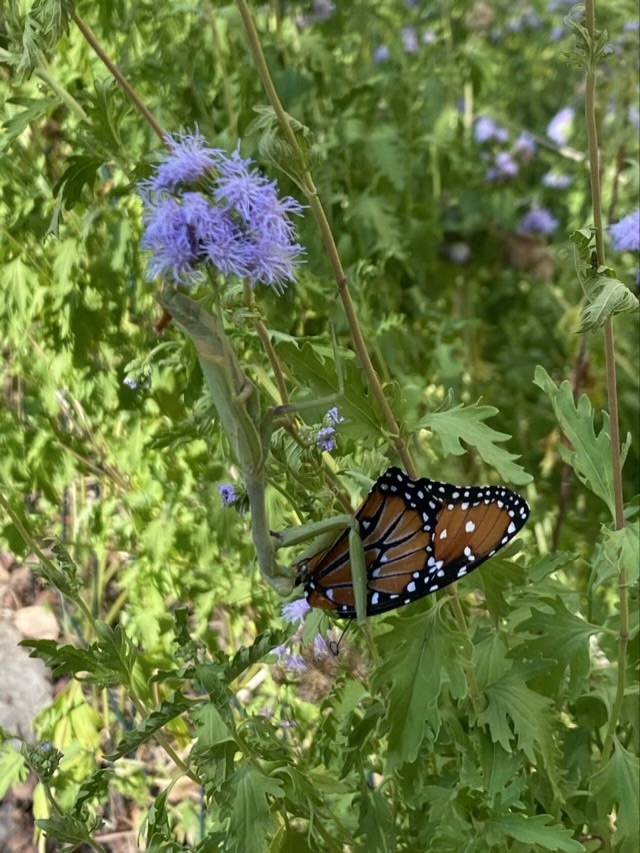
I was quite confused when I saw Queen butterfly wings caught in the foliage of the Gregg’s Mistflower as I walked by.

Photo description: Queen butterfly wings at an odd angle surrounded by Gregg’s Mistflower plants

I stopped to look and saw that the butterfly wasn’t just haphazardly hung up, it was in the grip of a large Praying Mantis the exact color of the leaves. I had stumbled upon the predator mid-meal. Here is a video short.

The Carolina Mantis was completely unconcerned how close I was with my phone. If I had passed by a minute later, I would have only seen the butterfly wings on the ground, and not the camouflaged mantis.

Sock progress

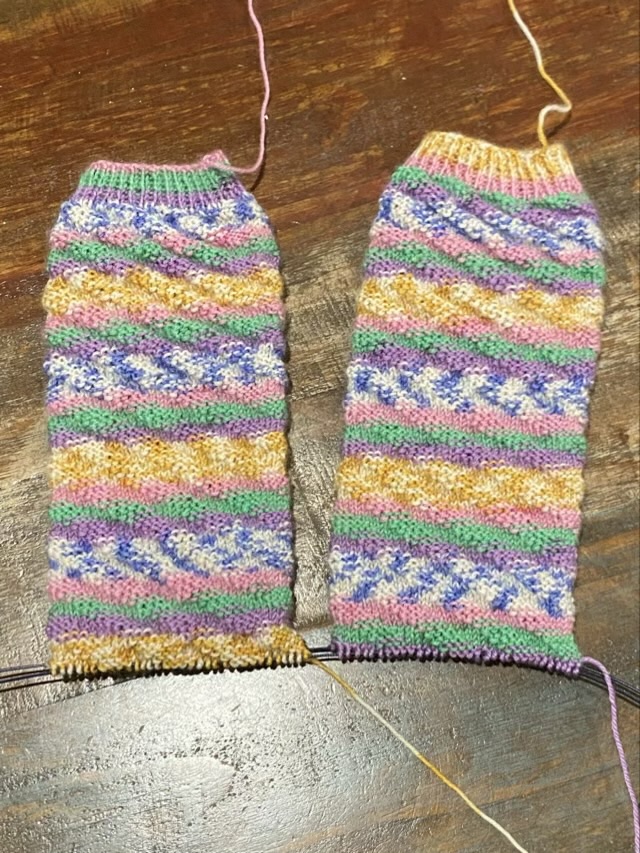
I’m trying a new-to-me sock pattern that dates from the World Wars and was distributed to help with war relief efforts. The spiral pattern creates a stretchy fabric that conforms to the heel without having to stitch a heel. For soldiers this meant a longer wearing sock, since the heel rotates and takes longer to wear out than a designated heel. For my family, my youngest has trouble lining up a heel on her foot, so this is a potentially frustration-saving accommodation. The stitch pattern is easy, but does require paying attention. The body of the sock is a 4×4 rib, but offset one stitch each row, which is what forms the spiral. I’m using Cascade Heritage Prints yarn, which is self striping.

Photo description: spiral socks in progress, knitted as a pair on two 2.5mm cable needles with Cascade Heritage Prints yarn, with a 1×1 rib cuff

My spiral is not forming the tight twist that I have seen in vintage pictures, and I’m hoping that when the socks are finished and blocked, I’ll get the right structure. If this does work for my youngest, I see many, many spiral socks in my future.