House spider for the win

My youngest told me there was a large bug in the bathroom, so I went to look. It was indeed a large bug, a bark scorpion, but it had been taken care of by our friendly neighborhood house spider. I have no idea how the scorpion became entangled in the web an inch off the floor, but the spider definitely had the advantage.
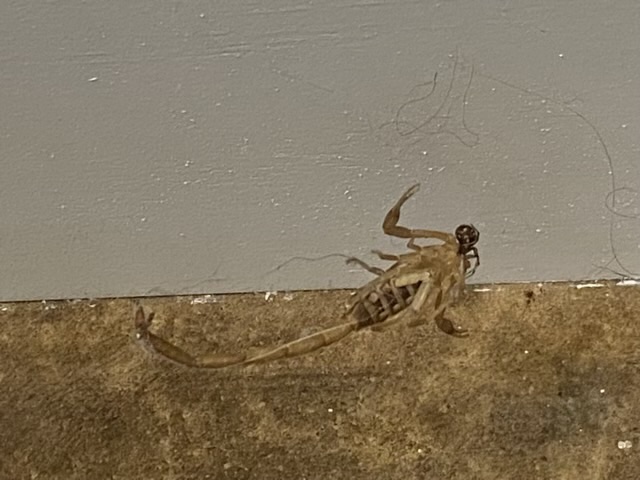
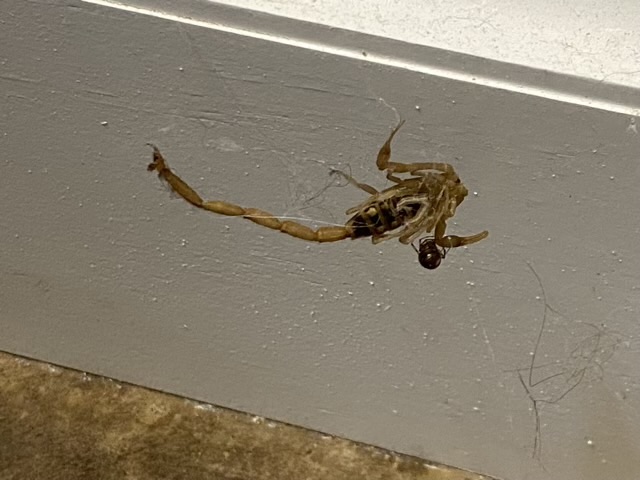
Photo description: house spider feeding on a bark scorpion vastly larger than the spider, day one
Photo description: same spider, same scorpion, day three, the scorpion is looking decidedly desiccated

The spider is certainly eating well, and we find it revisiting different parts of the scorpion as well as taking breaks from feeding. I’m going to leave the scorpion until there is nothing left, then clean up the web and let the spider rebuild. Go spider go.
Autowash

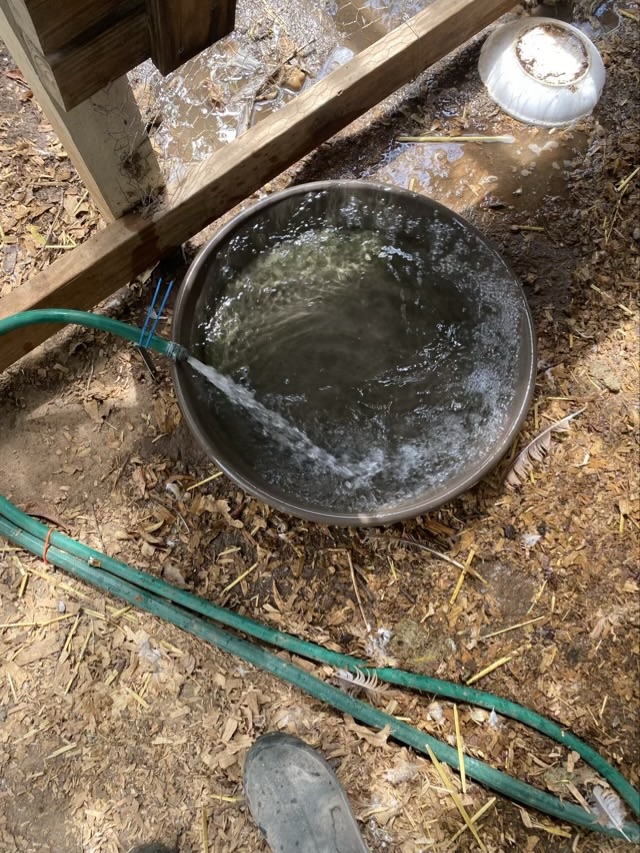
In the summer I put out a chicken foot bath to help my hens cool off in the Texas heat. Yes, they tend to drink from the same water they stand in, but I haven’t yet lost a chicken to heat stroke. To keep the water relatively clean, I set up a hose on a timer to rinse the foot bath twice a day. I’ve hammered the hose end down to a slit to give the water spray some power, and it only takes a minute for the bath to do a water exchange. By putting the hose on the high side of the bath at an angle, the water swirls around the shallow dish, and floating materials, like pine shavings and feathers, spill out on the opposite side.

Photo description: chicken foot bath made from a large plant tray and a hose set up to autowash

Bag progress

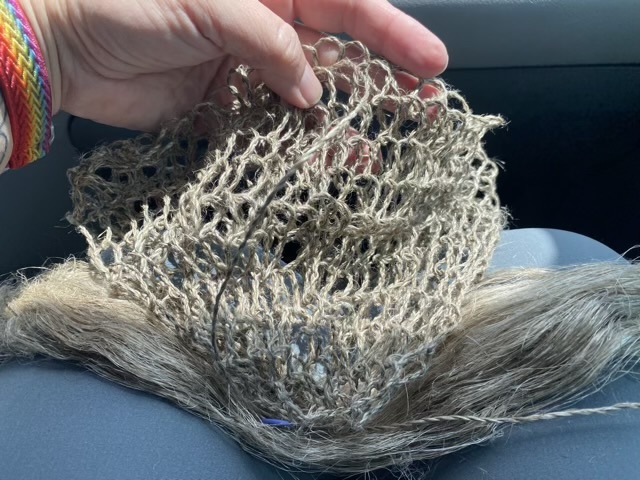
Photo description: loop and twist bag in progress next to flax fiber

After about 14 hours of riding in the car, I figure I have put about 12 hours into my loop and twist bag that I am twining from flax fiber as I go. I like the work because I can enjoy the scenery as we drive. I can both twine and loop mostly by feel (I do look when I join in new fiber.) I’m drawing my fiber from the center of the bundle, which I don’t think is the best way, because I’m getting tangles that have to be pulled out. I tried from one end, but the tangles were worse. I should lay out the fibers like flax spinners do, but space in the car is limited, and flax fibers can be over three feet long. The plan is to continue to twine until I run out of untangled fiber, then clean up the tangles and twine the string for the closure.

Moist extremes

When working with flax or plant fibers in general, it helps to have a little moisture. When I first started twining my flax bag on a car trip, I was using saliva. Traveling and licking fingers didn’t seem like a prudent plan, so on the next trip I made a sponge ring by cutting off the end of an inexpensive curler and trimming the hole with scissors.

Photo description: sponge ring to use to wet fingertips as I twine flax, made from a hair curler

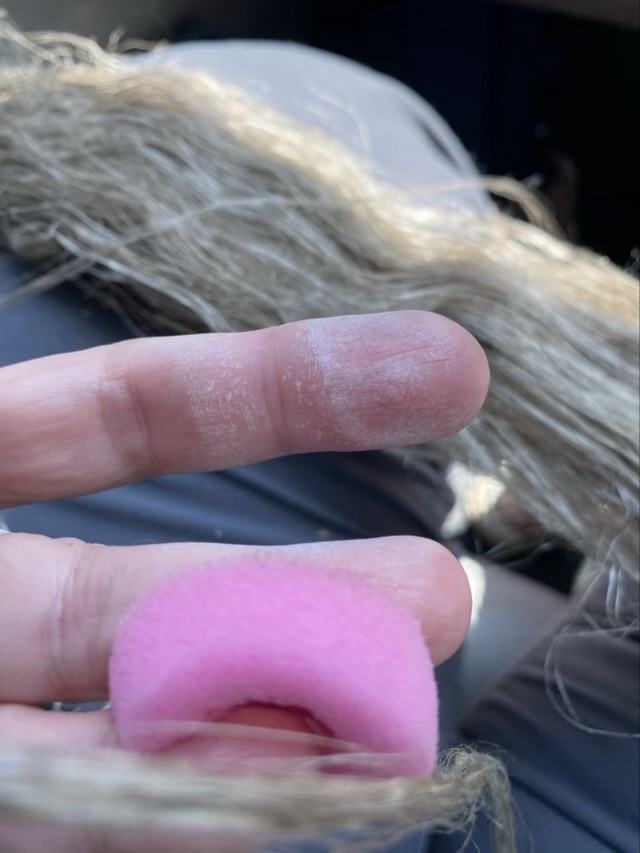
As I twined, I noticed the skin on my finger was turning white. Weird.

Photo description: white marks on my finger

I looked again at the small spray bottle I grabbed as I madly packed for the trip. It wasn’t labeled “H2O”, it was marked “H2O2”. I had been moistening my finger with hydrogen peroxide. At least it was sanitized. Sheesh.

Photo description: small spray bottle with pink sponge ring and “H2O2” written in Sharpie ink

Throwback Thursday: ruffle scarf

Today is a throwback with a current twist. As I was going through pictures from 2015 I found one in April of my first ruffle scarf. These scarves are knit from machine made lace. The lace comes wrapped like chunky yarn, and if you knit 6 stitches wide, just picking up one edge of the lace, the lace spirals out and around the central knitted core.

Photo description: red ruffle scarf from April of 2015
Photo description: purple ruffle scarf from July 2025

I just made another of these from yarn my Mom sent as packing material for a package. They can be a bit tricky because the lace needs to be fanned out to find the edge, but once I get the groove, it goes pretty quickly.