Jewelry repair: bracelet

My mother-in-law asked me to take a look at a broken bracelet. It is a lovely piece with metal beads and a metal focal, that was strung with elastic. The elastic had been knotted and fitted with knot covers that then connected to jump rings, and those knot covers were where the elastic failed. Knot covers are risky jewelry components. They work well for silk strung lightweight beads with a large solid knot that will hold inside the knot cover. Elastic is hard to knot securely, especially at the end. Metal beads are also hard on both elastic and silk, and tend to fray the stringing material faster than smooth beads.
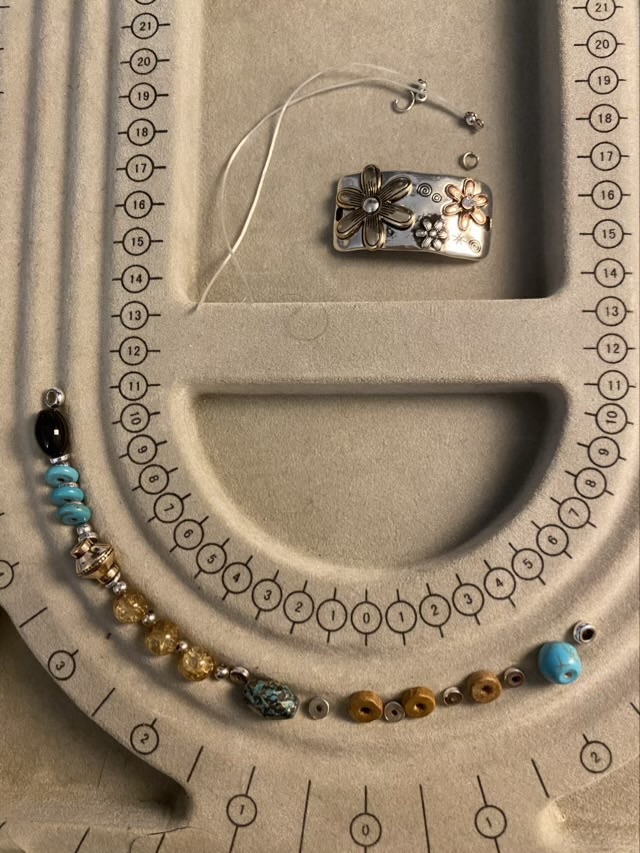
Photo description: broken bracelet laid out on a bead board with remaining components

Rather than risk another elastic mishap, I switched the bracelet to a clasp style. The focal actually works well to receive a lobster style clasp. I used 49 strand beading wire with double crimp beads for durability and added some coordinating metal beads to make enough length that the bracelet is loose when clasped.

Photo description: repaired bracelet on a bead board
Photo description: bracelet shown clasped

I can’t guarantee the bracelet won’t break again. It is one of the reasons I don’t make and sell jewelry anymore: even well made jewelry wears out and is prone to breakage. I don’t mind this kind of fixing, though.

The other reasons I don’t make jewelry: over a third of booths at every craft show I’ve been to sell jewelry, and I don’t wear necklaces and rarely bracelets so I’m not even advertising my own work.

Camel hat

I crocheted my hand spun camel yarn into a beanie style cap with ribbed band. I used a 2.25mm crochet hook and a double crochet for the fingering weight yarn, but found switching to a 3.25mm hook for the single crochet ribbing of the band made it feel more flexible and soft.

I thought I had plenty of yarn for a hat, but the yarn chicken squawked a challenge as I made the band. After I sewed the band together, I had only a few inches of yarn left. So there, yarn chicken.

Photo description: about 5” of yarn left after finishing off the camel yarn hat

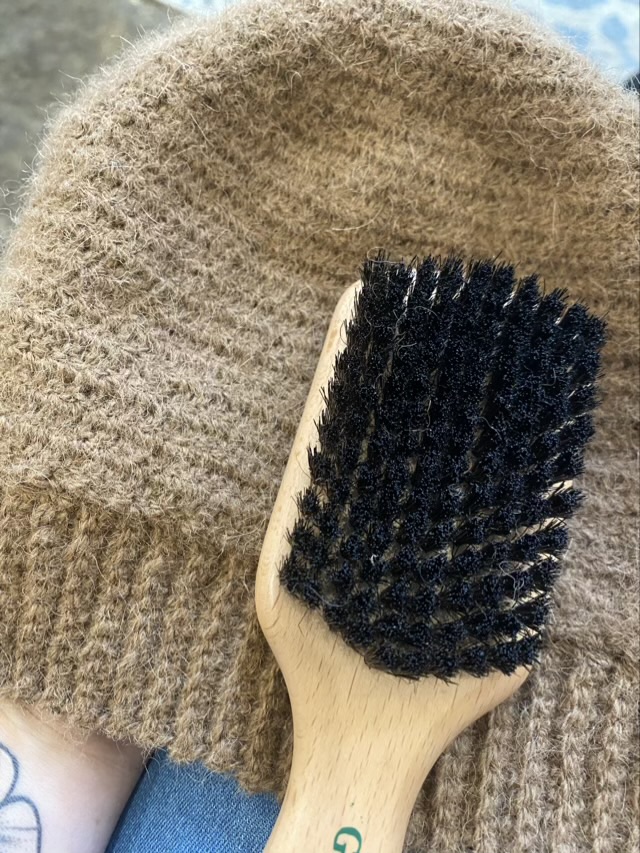
Camel is a soft fiber, but my preparation still had some guard hairs and vegetable matter, so to make sure the inside was scratch free, I brushed it with a boars bristle brush. The brushing brought the soft fibers to the surface and gave it a lovely surface feel.

Photo description: bristle brush with the brushed inside of the crocheted hat
Photo description: finished hat crocheted from hand spun two ply camel yarn

I made this for my father in law, and I did make it a larger size. My Dad has reported that my wool hats shrink with wear (a natural fulling effect, I believe), so I didn’t want it to get too small. I may have gone too large though.

Accessory Roulette

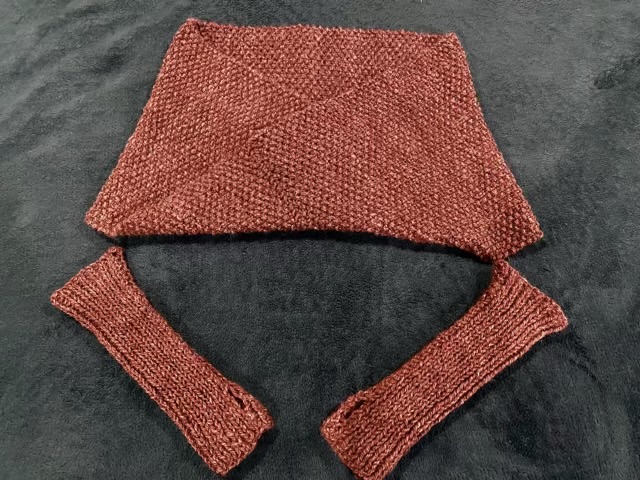
When I started knitting with my three-ply hand-spun merino/alpaca yarn, I wasn’t sure how much I would have. So the plan was to go a flexible route. I intended to make a wrap around scarf with sleeves, but rather than start with the sleeves, which locks me into the pattern, I started with a moss stitch on the body of the scarf (sleeves can be added later). When I knit the scarf long enough to go around my shoulders, it was obvious that I wouldn’t have enough to knit the additional third and have sleeves, so I made the scarf section into a shrug by sewing it into a Möbius ring. The Möbius shape allows the shrug to fit the wearer both at the shoulders and the elbows. A straight tube has less adjustability.

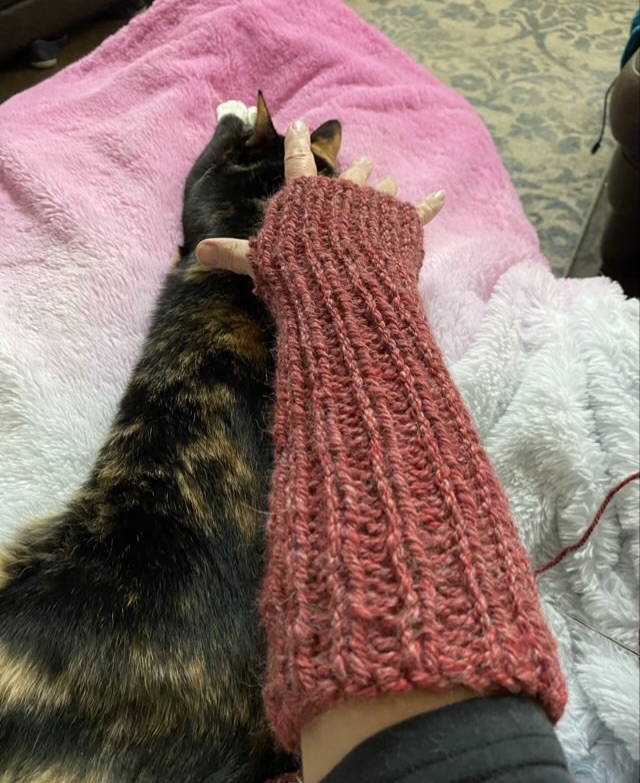
I then knit two long fingerless gloves in a rib stitch. To keep the gloves even, I worked from both ends of the yarn cake with size 11 circular needles, working both gloves flat at the same time. When they were long enough (I didn’t run out of yarn this time), I sewed up the sides and left a thumb hole (many thanks to my crochet friend for the suggestion!)

Photo description: hand spun, hand knit shrug and long fingerless gloves
Photo description: trying on one fingerless glove, calico cat for scale

The shrug and gloves have the same aesthetic as a scarf with sleeves, but with more flexibility for styling. And if you run out of yarn, at least there is one finished useable item.

Plethora of Potholders

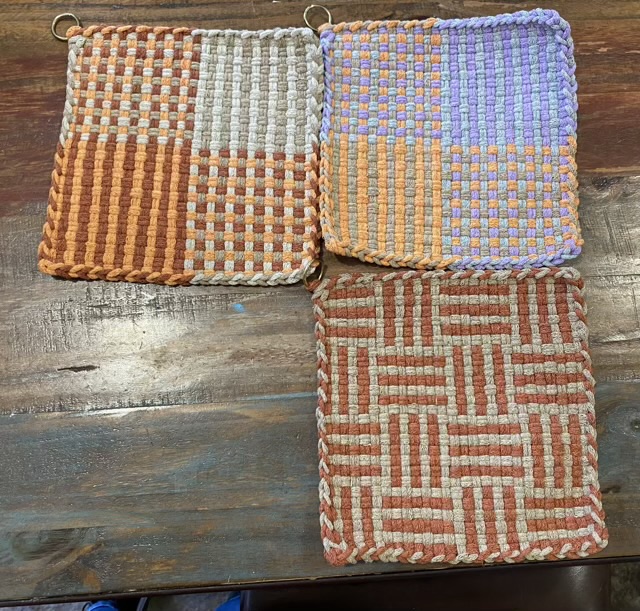
So I admit, I didn’t just get one set of potholder loops, but several, and experimented with color and weave pattern for weeks using a Pro Friendly Loom. This isn’t the smaller sized loom usually given to kids (which, if you want to give your kid the experience of weaving, wrap yarn around some cardboard and give them a blunt needle, then go to potholders). The Pro Loom produces large thick squares that are ideal in the kitchen. A nice touch is adding a metal or wood ring to the final loop, which is aesthetically pleasing and secure. Piglet’s Potholder Patterns has more ideas than you can make with 10 bags of loops, and is a lovely rabbit hole. Since the potholders are cotton, they are washable. Friendly Loom recommends washing them in a washing machine and hanging them up to dry.

Photo description: eleven pro sized potholders in purples and oranges with various patterns
Photo description; three more potholders in different colors

I still have a few odd loops left, which is OK, they might find their way into a potholder eventually, or be used in a different way.

Angora rabbit fur

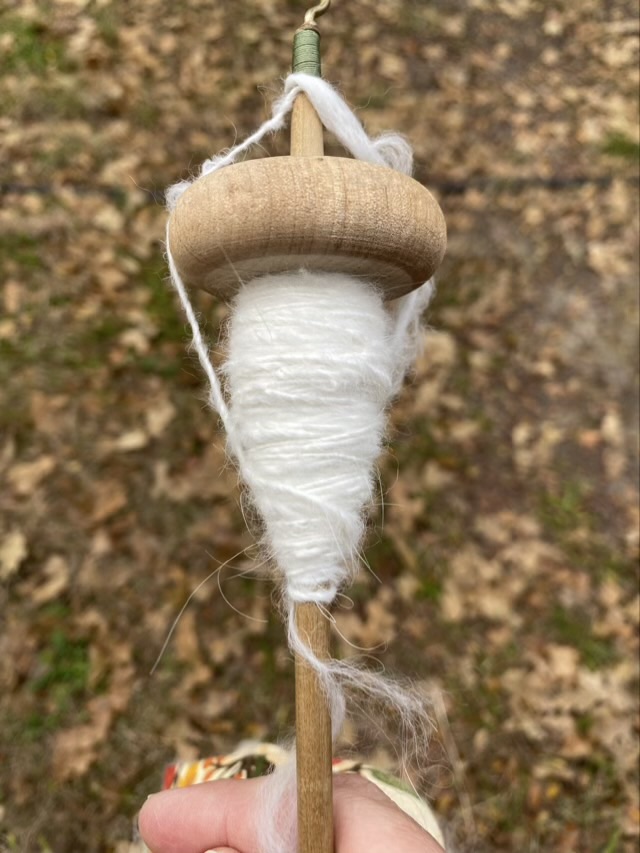
My next spin-and-walk project is with angora rabbit fur. I didn’t card it, comb it, or wash it, I just grabbed handfuls straight out of the bag where the farmer placed the shorn fibers. I wasn’t expecting the short second cuts, but I’m rolling with it and making it into an experiment.

Photo description: handful of white angora rabbit fur with short second cuts (where the shears passed over already cut fur and cut short sections) and guard hairs (thicker longer hairs in the fur)
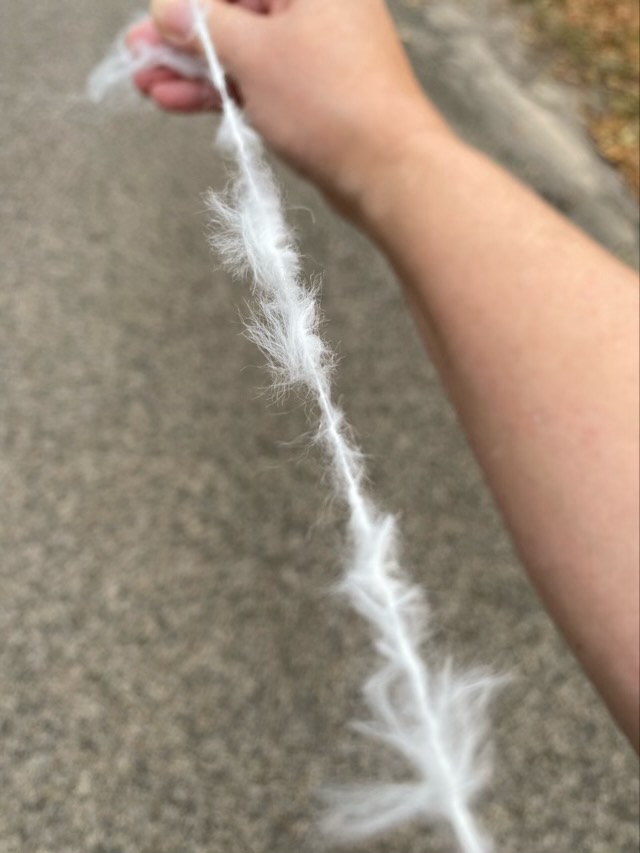
Photo description: single spun yarn with the second cuts caught in the twist sideways, making it very fluffy

Some of the shorter lengths of fiber get caught sideways when I’m spinning, like a bottle brush. I don’t think all of these will stay embedded in the yarn, but it will be interesting to see what does. It does make the yarn fluffy in a sporadic way.

Photo description: first walk’s worth of spun Angora rabbit fur

Angora is usually blended with other fibers so this is also an experiment on how pure rabbit fur behaves both in the spinning and in fabric.