RIP Magnet

And then there were four.

Magnet the Black Star hen that has been with us since May passed away. I found her in the coop in a quiet dark corner, cool, but rigor mortis hadn’t fully set. The day before she was fine. There were no signs of mites or outward disease or trauma and she was still at a healthy weight, so I expect something when wrong in her reproductive tract. Both Black Star hens had a hiatus from egg laying for the last month while they were in molt, and I’ve heard that the time when the processes starts up again has a higher mortality rate. I did not do a necropsy. Although I have done a couple in the past, it is intense and takes some uninterrupted time and space, which I didn’t have.
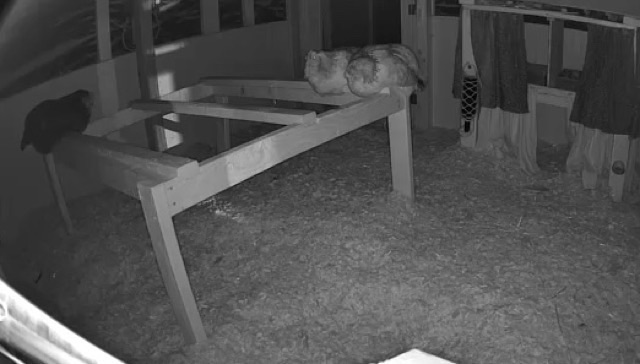
Photo description: three hens on the roost, one hiding in a nest box at night

We’ll keep an eye on Wing Ding, the other Black Star hen. She and Magnet had been coop companions before the move to our flock. They didn’t really hang out together at my place, especially at night, but they were the top two in the flock. Magnet was a sweet hen and coexisted well with my Faverolles.
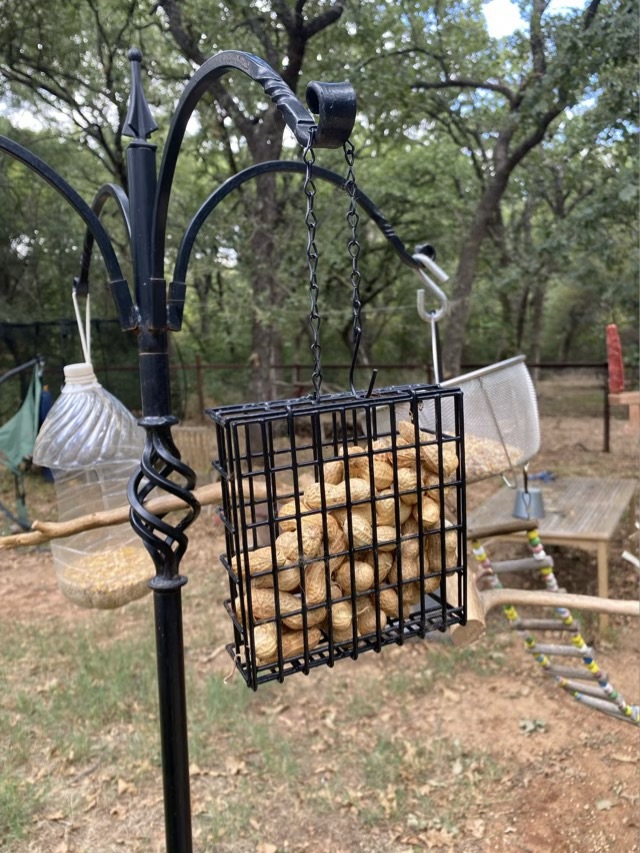
Peanut cage

Squirrel challenges continue, this time I cleaned up a suet cage and put shelled raw peanuts inside.

Photo description: wire suet holder filled with shelled peanuts

This was a big hit. The squirrels went bonkers getting the peanuts out and running off with them. It was challenging, but not impossible. I even saw a small bird swoop in, pluck a peanut from the side, and fly off. Not a coconut, but still the peanut was larger than I thought a bird that small could carry! On day two I had to wrap the chain around the hook once because the squirrels figured out how to get it down and dragged it halfway across the yard.

Jumbo flyer

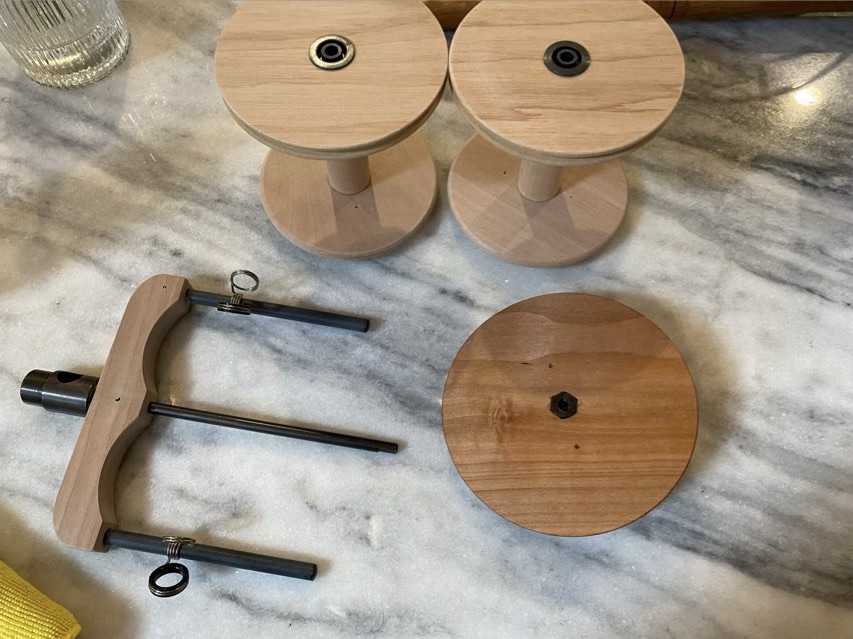
The new-to-me Ashford Traveller spinning wheel came with a jumbo flyer that hadn’t been assembled. I finished all the wood parts with Howard’s Feed-n-Wax. (See? I love this stuff.) Ashford wood products typically come unfinished.

Photo description: Ashford jumbo flyer with sliding hooks and two bobbins, the whorl (bottom right) has had an application of Feed-n-Wax

After a few applications and some drying time, I finished the assembly by screwing in hooks and tried it out on the spinning wheel to ply my three singles. It occurred to me that three full bobbins will not all fit on a single bobbin of the same size, but a jumbo bobbin could hold it all. The flyer came with a new end bracket to fit the larger end of the flyer, but it also came with grommets to fit the original flyer so I don’t have to change the bracket to switch back and forth. Nice.

Photo description: jumbo bobbin and flyer mounted on an Ashford Traveller, bobbin is half full of three plied yarn
Photo description: to ply, I hold the single spun yarn leading from the lazy kate bobbins between my fingers to keep tension between my hand and the flyer orifice. This keeps the pigtails of twisted yarn from catching in the ply.
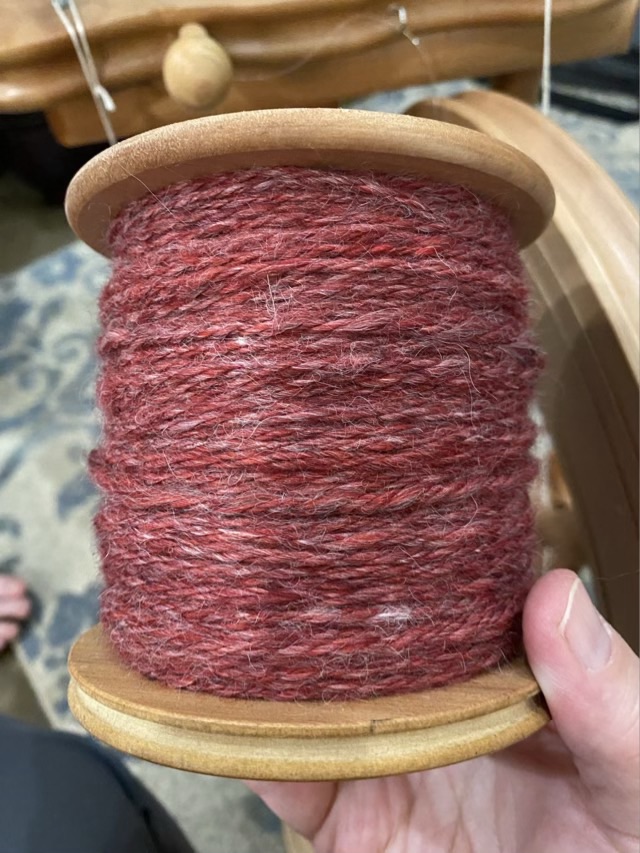
Photo description: jumbo bobbin full of three ply alpaca merino yarn

The jumbo flyer is marketed as an aid to make bulky art yarn, but I think it does a lovely job of plying as well.

Just keep spinning

I’m developing my skills with the Ashford Traveller spinning wheel. I’ve found it helps me evenly distribute the yarn on the bobbin if I separate up my roving into thinner strips and switch hooks on the flyer after I spin each strip.

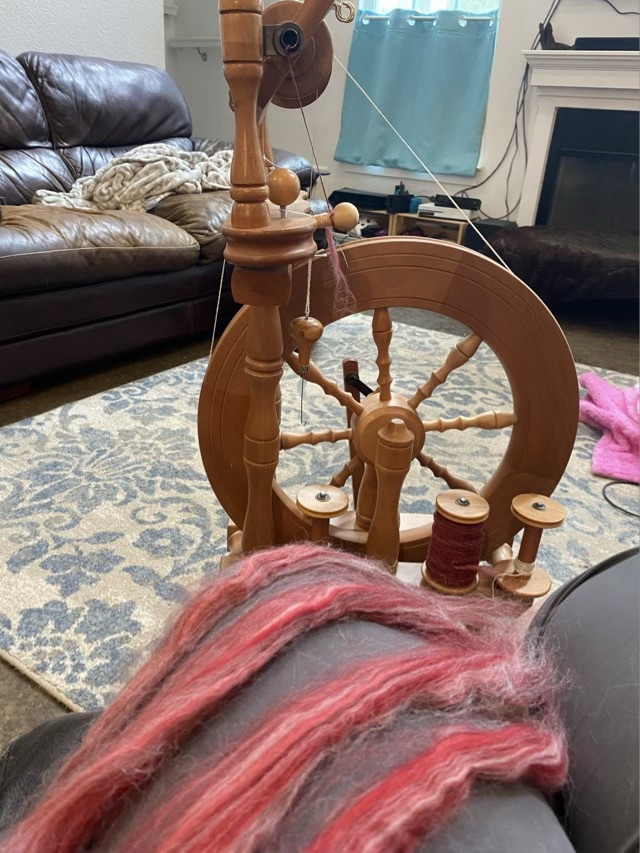
Photo description: four strips of roving laid out on my knee as I prepare to spin

Some spinners pre-draft their roving to make spinning easier, I find tearing off about 8-10 inches, then separating out sections has a similar function. Commercial roving is quite thick, and when spinning directly from a large bundle of fiber there is a tendency for the fibers to tangle, making it harder to spin consistently. Joining in a new strip is easier for me than untangling a mess of looped fibers, or managing a thick bundle.

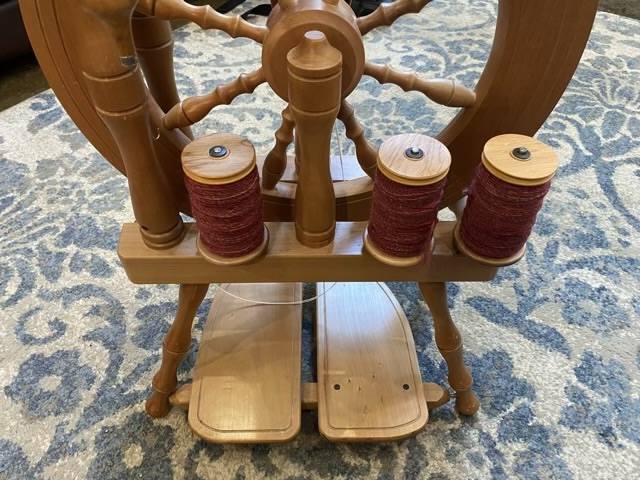
Photo description: Ashford Traveller built-in Lazy Kate holding three evenly filled bobbins of single spun yarn

I now have three full bobbins of yarn and am ready to try plying with the wheel!

Ashford Traveller

My neighbor was looking for a good home for her Ashford Traveller Double Treadle Double Drive spinning wheel. She bought it used from another crafter, but has her hands full of other projects and doesn’t have time to spin wool. She gave it to me and I took it home and gave it a good once over, wiping down parts and oiling bearings. I set it up as a single drive, Scotch tension, because I can with this wheel. As we get to know each other better, I’ll try out the double drive mode.

Photo description: back side of an Ashford Traveller Spinning Wheel with double drive and double treadle, produced between 1996-2012, drive band shown with tension released

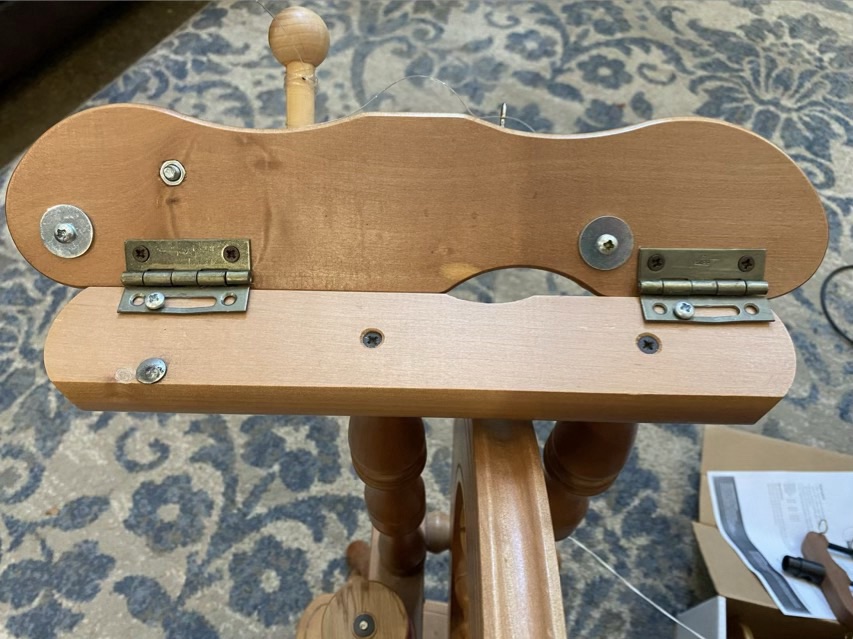
I did make some adjustments to the drive path, which is super easy with two screws and slotted hinges inside the mother-of-all, which is the bar that holds the bobbin, flyer, maidens, and tensioners. This aligned the drive string with the wheel and made it easier to treadle. I tried out a bit of merino and alpaca blended roving, then found some more, and proceeded to spin on the wheel all day. (I did get up to take breaks, and actually address things in my to-do list.)

Photo description: mother-of-all opened to show the adjustable hinges on an Ashford Traveller spinning wheel

My Befra Willy spinning wheel has Irish tension (the brake is on the flyer instead of the bobbin), so the two wheels can live harmoniously together producing different kinds of yarn. My drop spindles are not jealous because they get to go on outings and are not dependent on a stable floor. Every item gets to keep its given name because that is the way I roll (I haven’t renamed a pet in over 20 years.) I know some spinners give their wheels individual names, as do some treadle sewing machine owners, as do boat owners if we get down to it. I’m rubbish at naming.