Fiber art tattoo

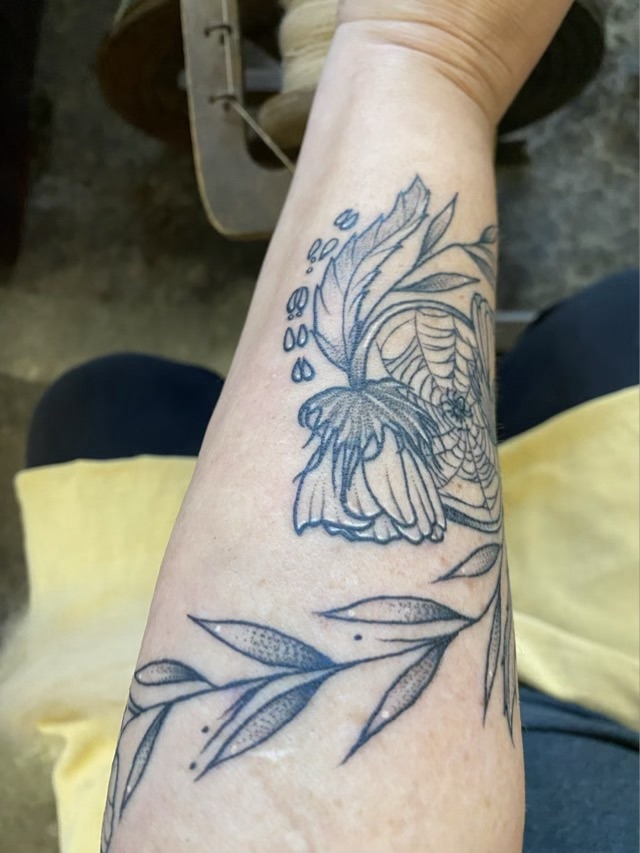
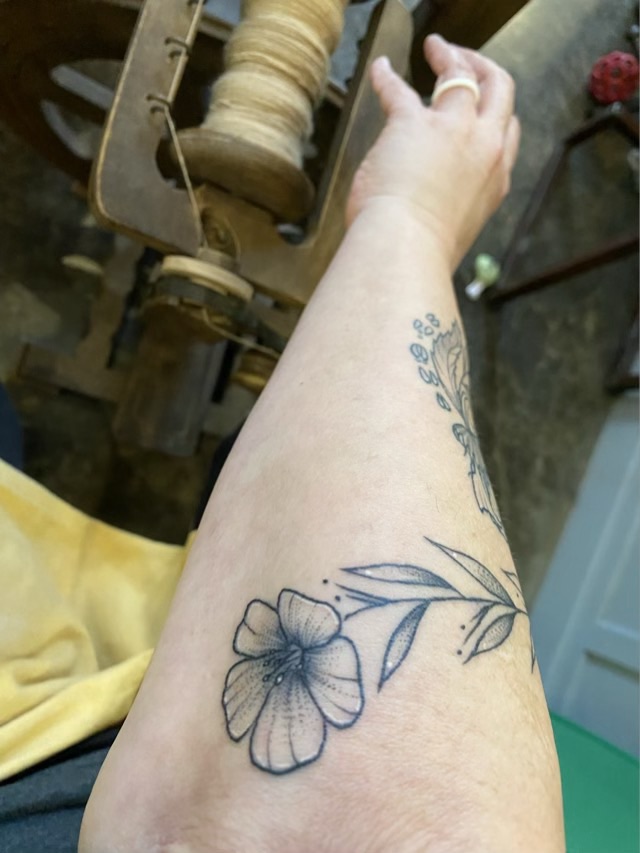
I’ve been wanting a tattoo wrapped around my forearm for a while, and I made the plunge! I worked on ideas for over a year, found a tattoo artist locally that does phenomenal floral work, and took my rough sketches to her. I’m very pleased with the outcome! In the tattoo are flax flowers (flax is the fiber used to make linen), cotton flowers (which occur before the formation of the iconic cotton boles), hemp (used to make rope and nets historically), a silk moth (the modern kind that has been bred for silk production), and a footprint each of several fiber producing animals: sheep, rabbit, bison, alpaca, goat. Then in the middle, in homage to the original spinner and weaver, a spider in a web.
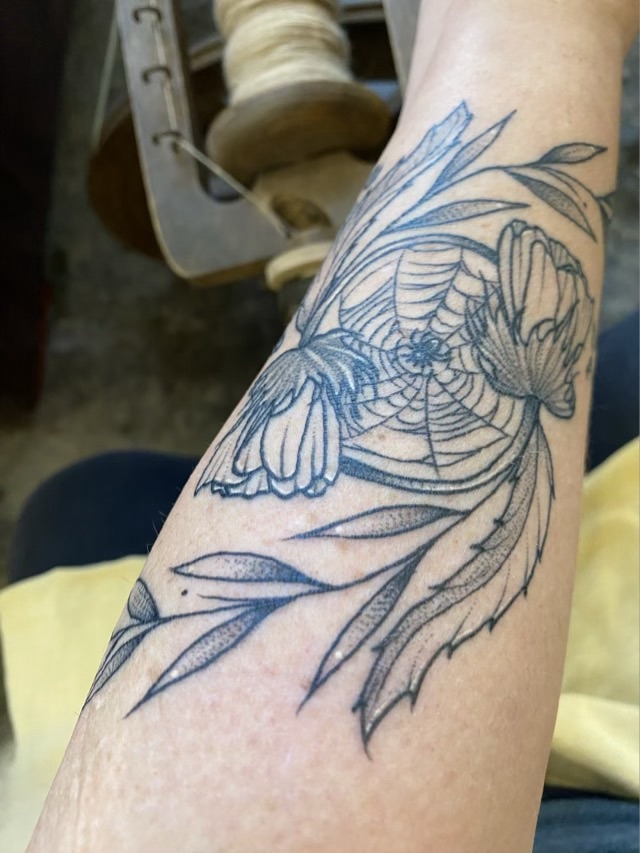
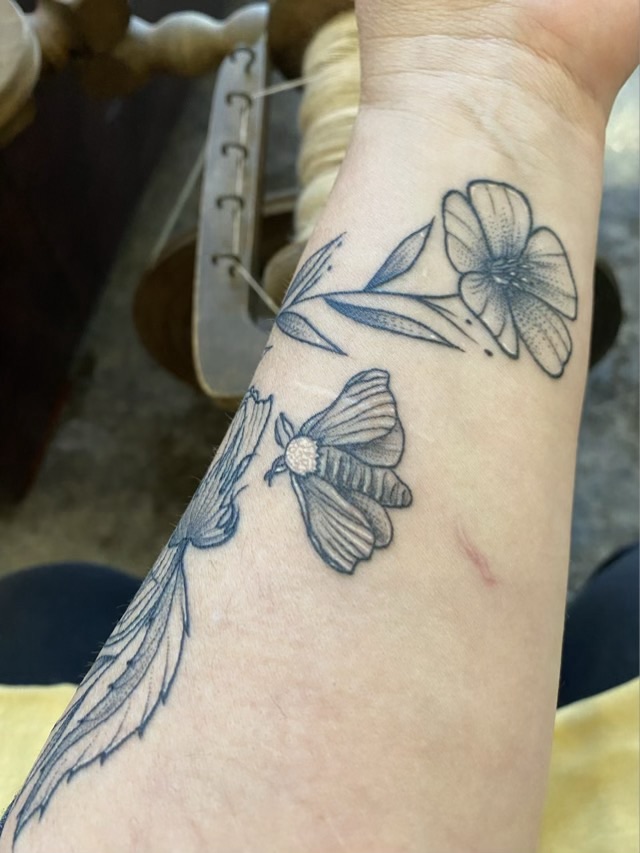
Photo description: The central part of the design with the spider web and cotton blooms.
Photo description: Inside my forearm showing the flax bloom and silk moth.
Photo description: Outside of my forearm showing the animal prints.
Photo description: My elbow with the second flax flower.

The tattoo artist is Paige Parman at Old Souls Ink in Weatherford, TX. I waited to take pictures until the tattoo was fully healed, and took them while I was spinning alpaca fiber on my Befra Willy spinning wheel (in the background of all the pictures).
Random but not surprising

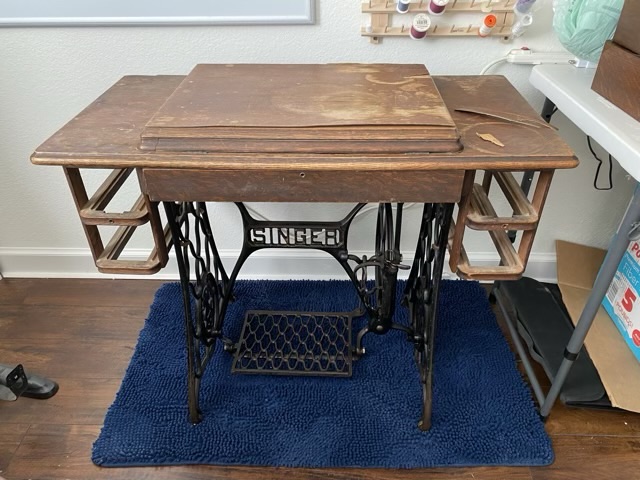
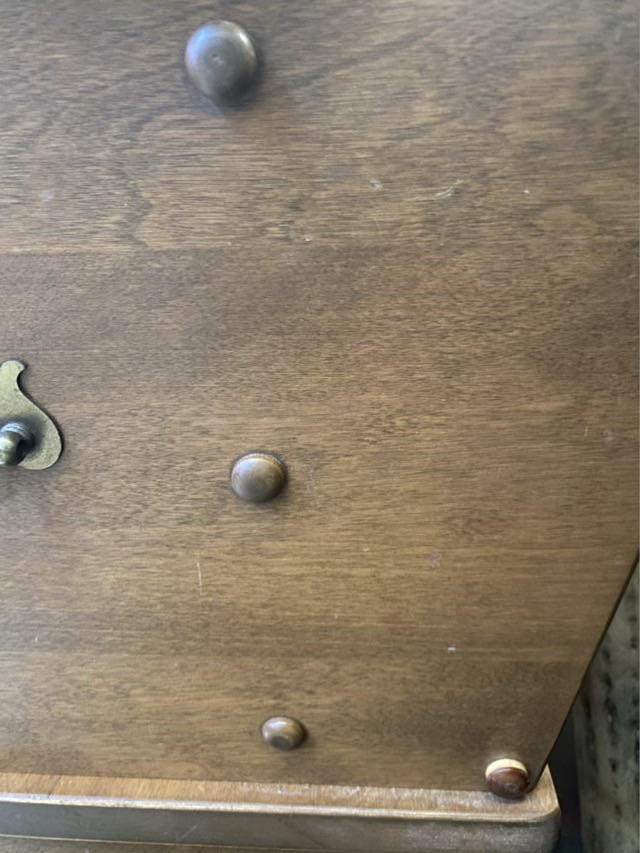
In the drawers of the Singer Model 66, that just recently came from my husband’s aunt’s house 206 miles away, I found wood plug that looked very familiar. I popped it into the open hole in my vintage side table. It fit and is a near color match. I purchased this table at an antique store in Houston TX, but my grandmother had its twin in South Dakota, and that one now resides at my Mom’s house. So it was a popular piece of furniture in the mid-1900s. Wood plugs are also common screw hole covers and furniture manufacturers would use the same size wood plug on various pieces.

Photo description: The side of a wooden end table showing four wood plugs, the bottom right is the “new” plug, not fully inserted.

So it is random but not surprising to find a plug that fits the hole in a cabinet that was around at the time this furniture was in vogue. It also shows that those devilish fat pegs like to fall out and go a-hiding across the nation. Although this one has found its home. I put it in the hole lightly, but it stuck tight, so the only thing to do was tap it all the way in. Serendipity is the word I’ve been trying to find.

Singer model 66

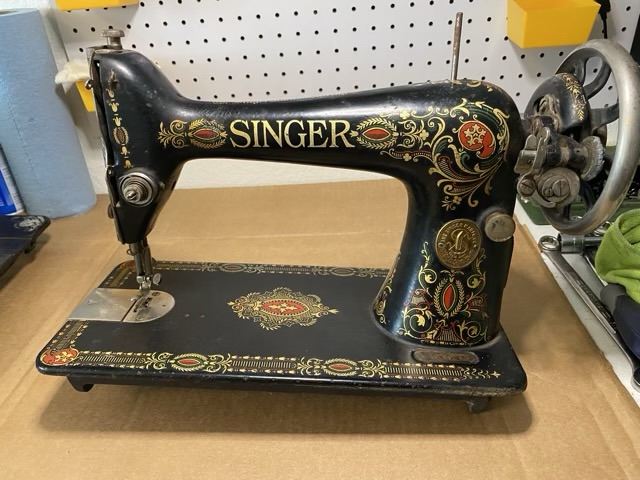
Here is my big news to start off the year: I have another treadle sewing machine! This one is a family heirloom. It was my husband’s great-grandmother’s, a Singer model 66 from 1916 with the “red eye” or “red scroll” decals. The decoration on this machine is in much better condition than my model 27, which is only 9 years older than the model 66, but saw considerable barn time. The 66 only saw some garage time and was mostly in normal household conditions.

Photo description: Singer model 66 “Red Eye” sewing machine head, sitting on cardboard on my work bench.

Ironically, the treadle base is almost identical to the other base, except it hasn’t been painted over (thank goodness).

Photo description: Singer treadle base cabinet, the four drawers are on the table just off camera. I had just scrubbed down the cast iron parts with PB Blaster and a wire brush. I have not started on the wood parts, but have taken some broken laminate from the back to use on the surface chips.

My goal is to get it back to working condition. It is pretty, but seized. The model 27 I’ve almost completely disassembled except for the main shaft, but with this model 66 I’m going to only take apart what I need to.

Tension

There are many ways of doing most things. Finding what works best for you is usually a series of trials and errors. I have been knitting with fingering weight yarn the same way I knit with thicker yarn, but have been having trouble keeping even tension because the thinner yarn slips through my fingers more. I tried wrapping it three times around my pinkie, but it had more tendency to bind. I recently tried a new finger wrapping method, going clockwise around my pinkie, the counterclockwise around my ring finger. Bingo. I have more control of the yarn without binding or excessive yarn drop.

Photo description: In process knitting photo showing the working yarn wrapped around the fingers of my left hand.
Photo description: view of yarn wrapping from the top of my hand.

This little change helped increase my knitting speed as well as reduced frustration with what seemed to be uncooperative yarn.

Honored

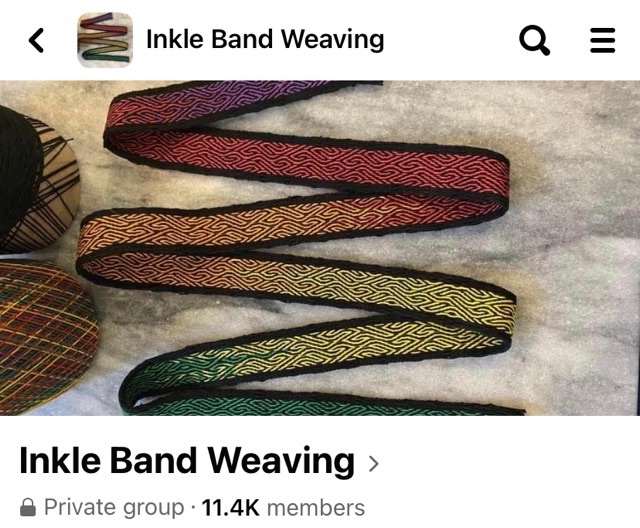
I follow an Inkle band weaving group on Facebook that is under new administration, who are trying to clean up the site and get it back to Inkle weaving (and not a repository for spam). They asked for submissions for a new banner image, and my rainbow tablet weave won by popular vote!

Photo description: Private Inkle Band Weaving group on FB with my rainbow band as the banner image.

They said they would change the image frequently, which is also good. I’m excited that mine was the first picked!

This band went on to become the strap for my ukulele.