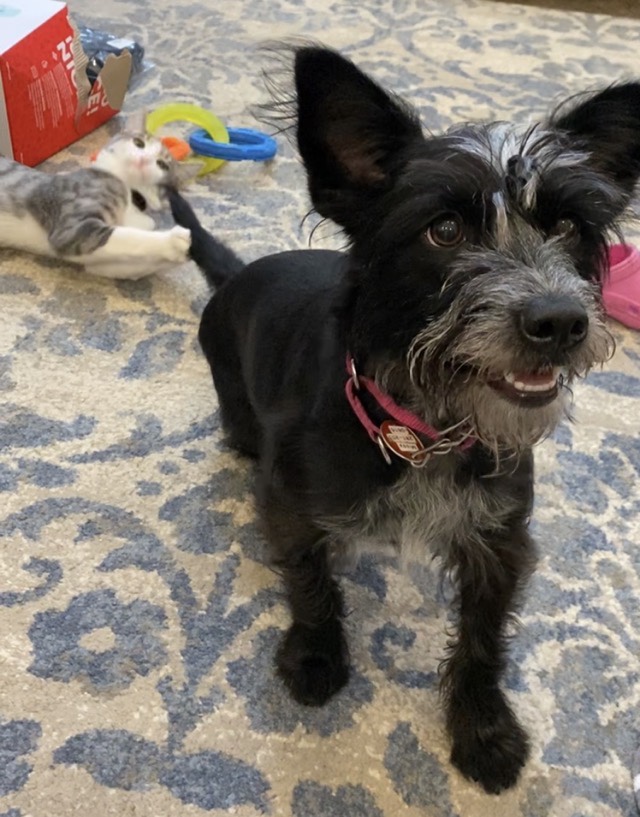
We’ve been working with Missy the dog for a long time on letting people touch her tail without her growling. Apparently we did our work well. Here is a video of Thor the kitten playing with Missy‘s tail, and she doesn’t even care.
Thor playing with Missy’s tail as Missy waits for the ball to be thrown, still from video
I have also decided to promote barbershop as the background music to my shorts, because everyone needs to hear a chord ring.
I ordered a blend of white and gray Corriedale wool from Mohair and More for my spinning class. Corriedale is an easier fiber to spin, and the mix of natural colors makes it easier to see the twist, which makes it a great fiber for learning. This is my first time spinning Corriedale as well (I started with difficult fibers, because I didn’t know), so I spun up my own ounce of fiber for my fiber book. I used some passenger time on the road to get it finished up on one of my new student spindles.
Corriedale singles spun on a top whorl spindle with the road stretching ahead
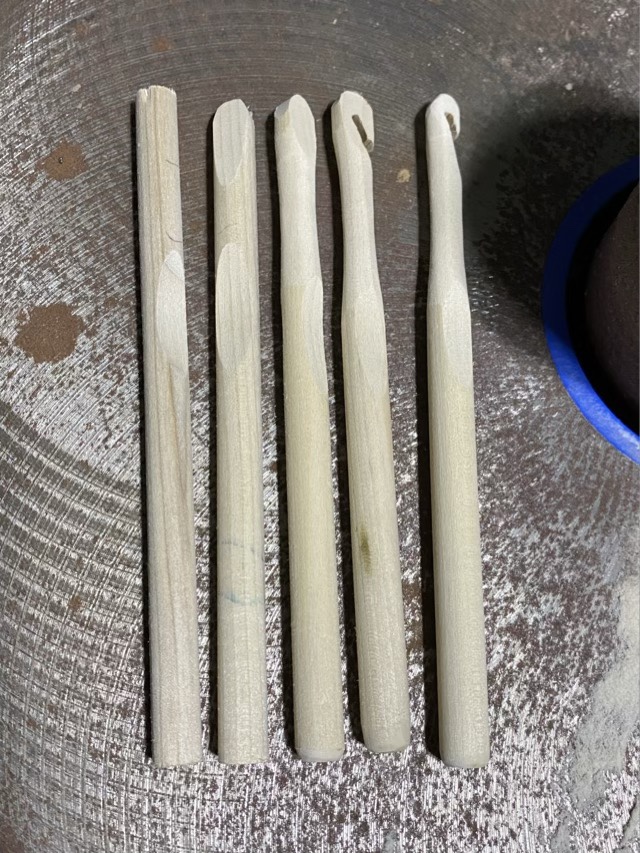
I have discovered a new method for making wood crochet hooks that I quite like. I flatten the middle of a dowel using a spindle sander, and flatten the end perpendicular to the middle with a band sander. This sets up the grip and the head of the hook at a comfortable angle. I then thin the neck to the size hook I need, and shape the head.
Stages of crochet hook shaping
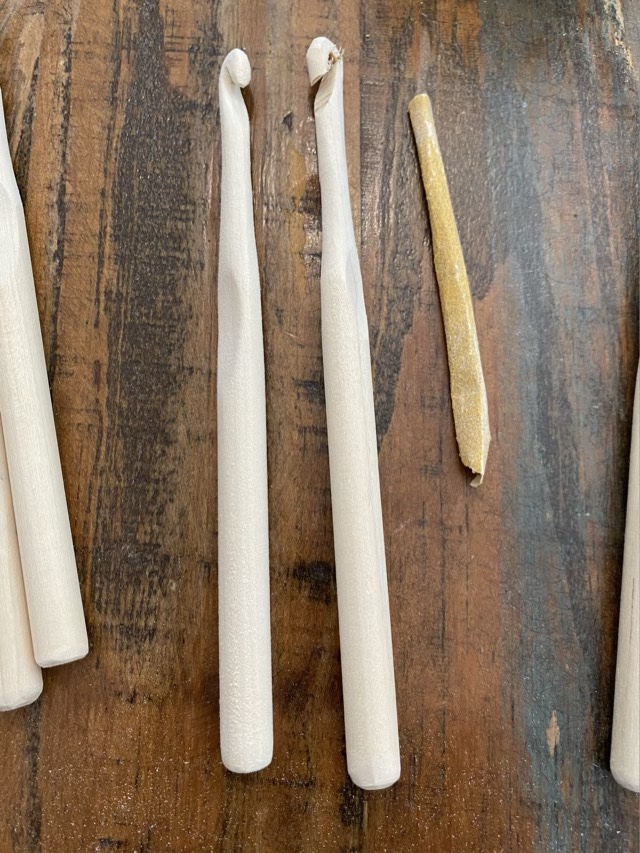
The bulk of the work goes into hand sanding the final shape. I use sandpaper rolled into tight tubes to access the inside of the hook, and flat sandpaper to smooth the outside shapes. I then use several grades of sandpaper until I’m down to 600 grit.
Hand-sanded crochet hook (left), raw shape (right)
I’m teaching an amigurumi class that uses blanket yarn to make marshmallow animals. The blanket yarn calls for a larger hook than is in most hook sets, so I’m making the hooks the students will use. The next step is to finish and make them nice and shiny so they slide through the yarn loops.



 Critters and Craft