
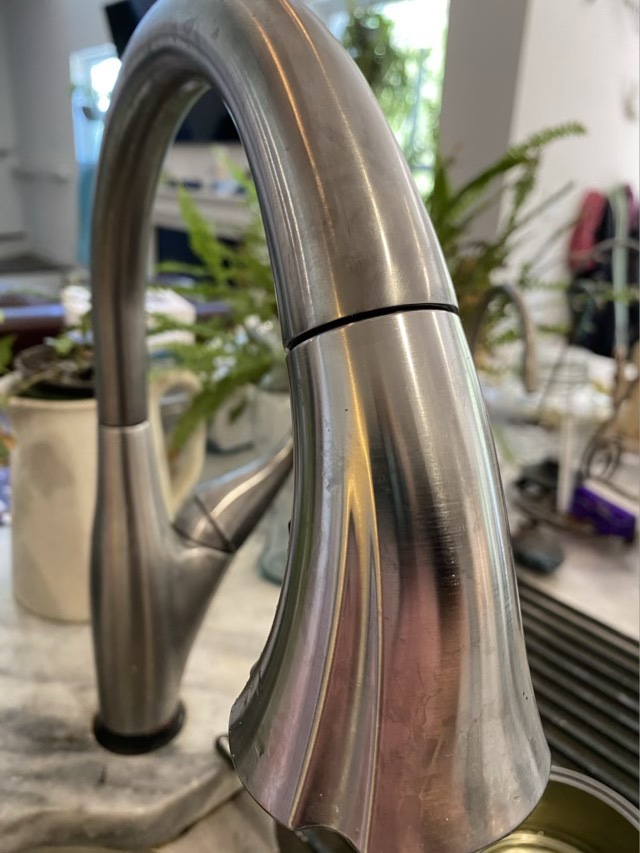
I was cleaning the kitchen faucet when I noticed flakes of rust around the top of the wand (where the sprayer attaches to the neck). I cleaned it up, and kept cleaning, until the rust and chunks where gone. Then I went to put the wand back and it wouldn’t snap back into the neck. Hm. Apparently the part that was the second half of the magnetic clasp rusted completely and I had just wiped it all away. The wand was still magnetized, but the neck wasn’t. Well that’s frustrating. My husband did some research, and we couldn’t get the part that rusted, and couldn’t buy the neck separately, and a new comparable faucet would be around $500. (I’m sure that is not what we paid over four years ago.) I decided to do some experiments.
I tried to put a neodymium magnet in the handle, which was not the right shape. I tried using bits from a roll of magnetic tape, but it was too thick and wedged it in. I tried some bare floral wire, which is steel, and had some luck, but couldn’t secure it inside the neck. Then I realized that the recessed indent in the faucet neck was about an inch in diameter. Keychain rings, the split rings made of stainless steel, come in about that size. I raided the junk drawer and found one. I was able to slip it around the wand hose (yay for split rings), and the steel hoop fit perfectly in the recess of the neck. I mixed up some five-minute, two part epoxy and glued the ring in place. Some tape held the ring while the epoxy cured, and kept the hose from gluing in as well.
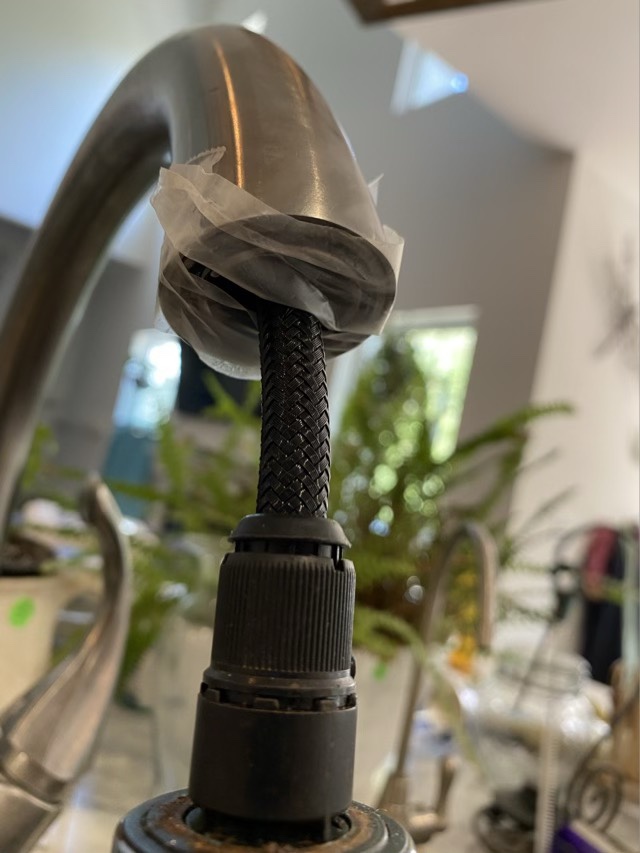

When mixing two part epoxy, I always keep the waste mixture out until it is cured. If the stuff in the cup is cured, then the stuff holding the part is cured. I removed the temporary tape and tested the wand against the neck. Snick. Oh what a wonderful sound! It works! The faucet wand pulls easily away from the neck, but when replacing it, the magnet sticks to the steel keyring and keeps it in place. Neat.
 Critters and Craft