
I know this is a craft and critters blog, but I’m going to sneak in a music post. I’ve started singing with a women’s barbershop chorus, and I’ve been learning about barbershop chords. Actually, before I get into barbershop chords, I need to learn about triads, or chords with three notes. It is amazing how complicated things sound when you combine two languages and two numerical systems. I was awash in Roman numerals, and tonics and subdominants until I wrote it all down. My first attempt, I used the note letter names (ABCDEFG), which did not help my chord understanding. Then I was told about numbering the scale. Lightbulb moment. In the image below I have labeled and laid out the chord progressions in the first four measures of “Canon in D” by Pachelbel. The D scale is under the music notes, labeled with numbers 1-7. Triads built on scale degrees is another way to say “the three note chords that go with the scale”. Musicians use Roman numerals for these chords, which correspond to the numbered scale. Oh. One, four, and five are capitalized in Roman numerals because these are important chords in the progression. Oh! Chord progressions make the song interesting to listen to. Familiar chord progressions make songs easier to sing along with. OH!
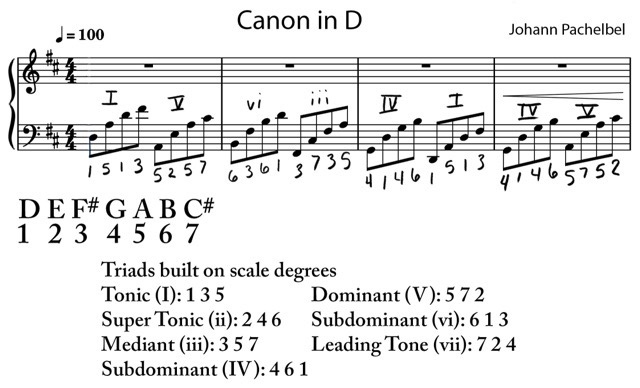
Thinking of the notes as numbers on a scale, rather than by the alphabetical name also makes it easier to change the key. I’ve been practicing Canon in D, but in the key of C on my Kalimba, which has the keys helpfully numbered as well as named.

I promise you a critter post tomorrow!
 Critters and Craft