Oh my goodness, we have reached a new level of tolerance. Our two cats still don’t care for each other, but the circles of personal space are growing smaller. Enough so that they will both occupy the catio at the same time. The catio is not fancy, but it is a good size with plenty of perches. It has only taken five years for it to hold two female cats.
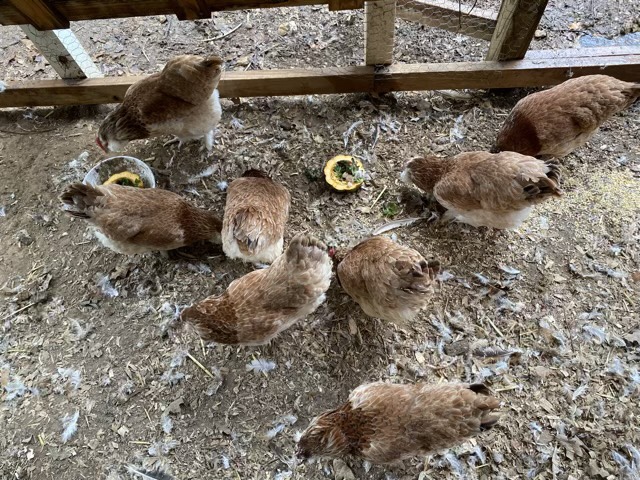
We’ve been having some rain. We need the moisture, but because it is November, it is a cold rain. Rather than scattering the scratch out in the muddy runs, the hens get their treats under the overhang.
Hens enjoying scratch
I sliced a pumpkin in half and filled it with strawberry tops, but they were more interested in the scratch and dried fly grubs. They’ll get to the veggies later. Much like children.
I’m continuing my quest to spin all the things, and I grabbed my purchased prepared flax roving and set out on a walk. Hm. Flax does not spin like wool.
Loose roving and a short drop spindle is a difficult way to spin flax.
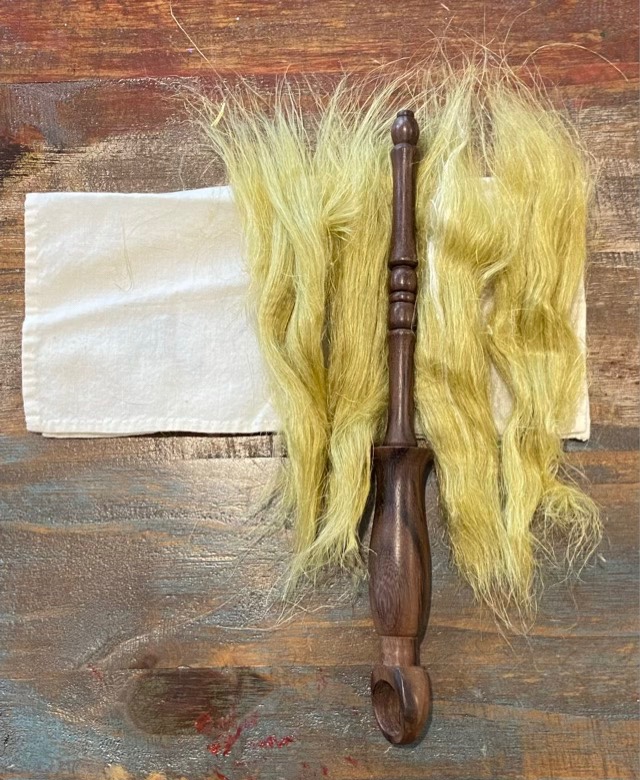
After the initial (abysmal) trial, I pulled up a book on spinning flax (and yes, I often do my research after trying on my own). There are several different preparations of flax. I did not have the yard-long fibers, I had combed top roving, which has a staple length of about 5-8 inches. The Practical Spinner’s Guide – Cotton, Flax, Hemp recommends using a distaff to hold the fibers. My sister gave me a distaff, but I hadn’t successfully used it yet. So I separated out sections of roving, pulled out the distaff, a handkerchief (also from my sister), and some cord, and “dressed the distaff”.
Flax fibers aligned on a handkerchief with distaffDressed distaff with flax and long shaft top whorl spindle
I changed up spindles as well. The freshly spun flax single is stiff, and the book’s author (Stephenie Gaustad) recommends wrapping the yarn at a low angle along the shaft to minimize bend. So I pulled out one of my top whorl student spindles with a long shaft. Drafting is different too. I tend toward worsted draw (short draw, keeping fibers aligned) but do rely on a little twist to draft out the fibers. Most spinners fall somewhere on the worsted to woolen draft spectrum as a default. Spinning flax I need to pull out the fibers, hold them, then let the twist in. It is a two handed operation (or at least a four opposing digit task). Flax also doesn’t need or want as much twist. If I spin the spindle too vigorously the thread snaps. I have dropped my spindle many, many times. I’m learning to give a gentle spin. It is enough.
Current progress on flax spinning
I am gaining a deep sympathy for the miller’s daughter in Rumpelstiltskin. If it was flax she was spinning (which honestly looks like straw and is spun into valuable linen), and her Dad had a tendency to the poetic embellishment, and the king was literal minded and greedy… well. Stuck in a room full of the wrong kind and preparation of straw with a spinning wheel (that was also probably the wrong kind), I can see her despair. It is still too bad that her cleverness didn’t extend to explaining metaphor, but not all of us are quick with the spoken word.
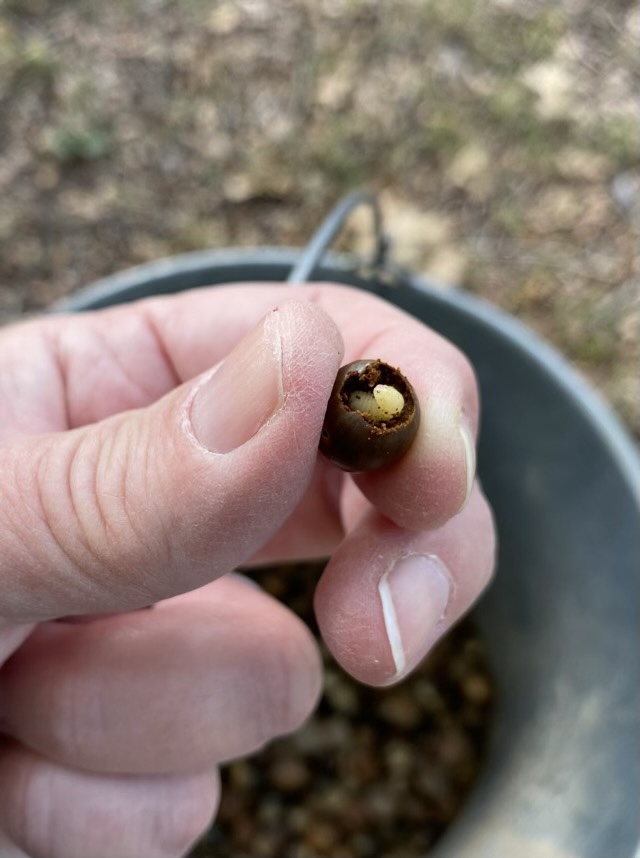
We had a moderate harvest of acorns this year. Some years you can’t step outside without crunching a foot full, but this year it was a hunt to find whole nuts. The squirrels have been busy too, and they leave the grub infested acorns and take the sound ones. As I’m collecting, I check the nuts for grubs. The acorns with a hole have had at least one grub leave, so the nutmeat inside has already been mostly consumed. If there is no hole, I pop off the cap. If the cap end of the nut is whole and solid, I collect it. If it looks like “dirt” collected at the end, I leave it; there is a grub actively at work consuming the nutmeat.
Post Oak acorn with grub
Adult female acorn weevils bore a hole into the developing acorns when they are still on the tree (TAMU). The grub develops inside, feeding on the acorn. When the acorn falls, the grub bores a hole out of the shell then burrows into the dirt to develop into an adult. I don’t need a reference for the second part. When my eldest was about 4, we made an autumn decoration with play dough and acorns. Later I found a grub happily munching through the dried play dough and a hole in one of the acorn. Did we throw it out? No, of course not. We filled a mason jar half full of dirt, put the grub inside, and capped it with a metal screen (for air flow) so we could see what it developed into. The next Spring, there was an adult acorn weevil, which we released back outside.
If you are collecting acorns for decoration, I’ve heard freezing them will kill the grubs, if you don’t want surprise inhabitants.
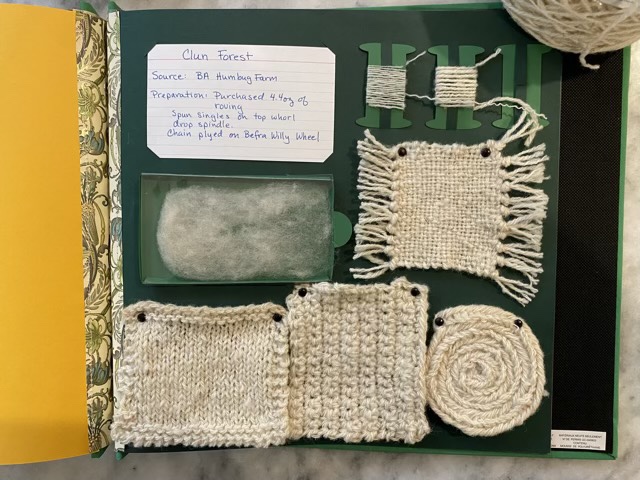
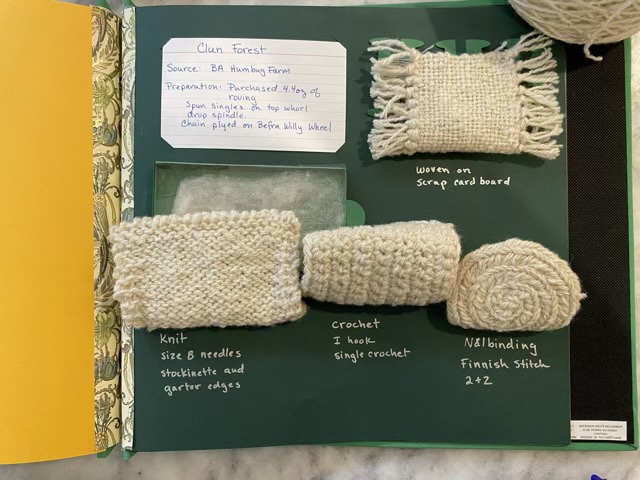
I have finished my Clun Forest hand work samples and mounted them on a page in my fiber book. I made swatches by knitting, crochet, nålbinding, and weaving.
Clun Forest wool fiber pageWith descriptions
I would not make a garment out of this yarn, a rug, yes, or basket maybe. I think though that I overspun the singles. This article talks about how Clun Forest is the best for hand-spinning and produces a “very soft yarn”. My yarn sneers at “very soft” with its fists up. Perhaps on a spinning wheel with low twist some loft would be obtained, but my drop spindle spinning produced a sturdy single. Sturdy, not soft. Hm.
Nålbinding produced the squishiest swatch, and with a liner would produce a respectable hat which could potentially deflect plummeting white acorns. I just noticed that I mounted my nålbinding round wrong-side up. Hm. Easy to fix with the brads. Easier than taking a new picture. Ha.





 Critters and Craft