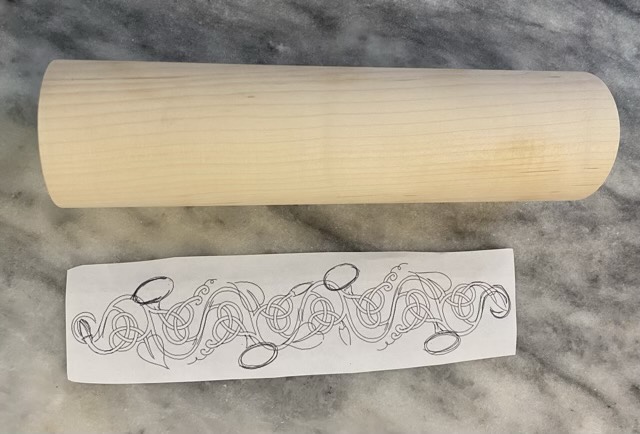
After the disastrous incident with colored pencils (see yesterday’s post), I redrew my Celtic knot morning glories using digital tools (iPad, Adobe Fresco, Apple Pen). Eventually I will make a clean graphic, but for transferring onto my rolling pin, a printed rough sketch works fine.
New design sketch, printed then cut out
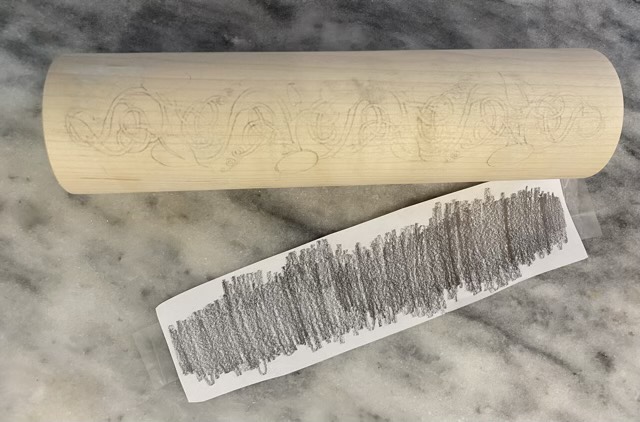
My transfer paper was rather worn out, so I rubbed a #1 pencil across the back of the design to do the transfer.
Pencil lead rubbed on the back of the paper does a fair substitution for tracing paper
The transfer wasn’t as clear as I’d like, so I went back over the design directly with pencil, using my sketch as a guide.
Transfer clarified with direct pencil marks
This design pleases me, and I quite like the look of the pencil lines. Painting directly with acrylic is still quite intimidating. Hm.
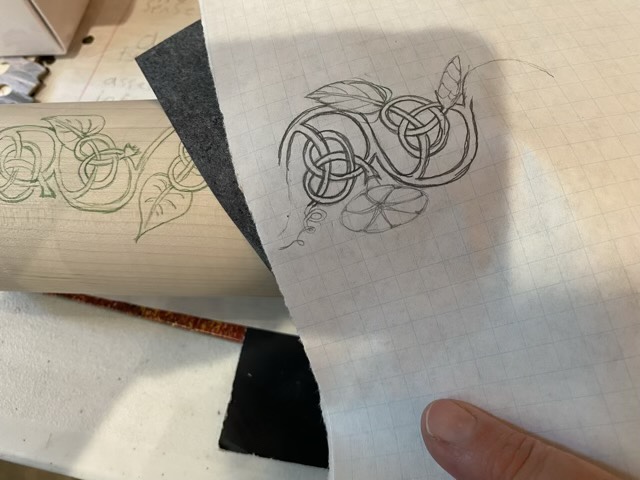
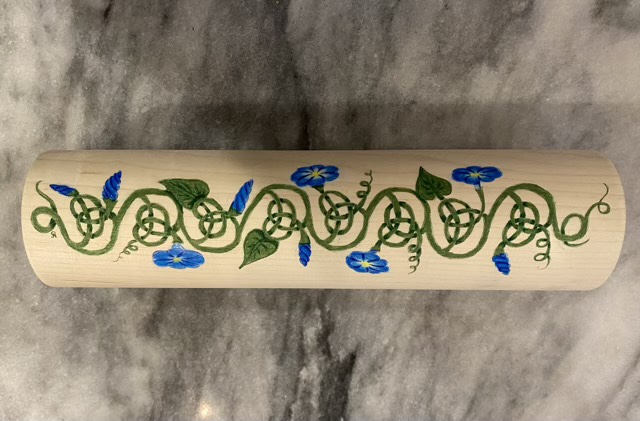
I love morning glories and Celtic knots. Years ago I started on a Celtic knot style morning glory vine drawing. For my refurbished rolling pin, I wanted to add art, so pulled out the sketch and transferred it to the wood with tracing paper.
Transferring a Celtic motif to a rolling pin
Even though I’ve had success with acrylics on wood in the past, I was leery of trying to paint such small precise lines with even a small paintbrush. So I used Primacolor colored pencils instead. The color was gorgeous and the pencils were so nice!
Prismacolor pencils on wood
I was so excited to have my rolling pin done and back in use that, as soon as the drawing was done, I rushed off to start the tung oil sealing process. Tung oil is a food safe sealant and even though it takes some time and many applications, it is my first choice for wood sealant. The first coat of tung oil is diluted 50/50 with mineral spirits to help the tung oil soak deep into the surface of the wood. Mineral spirits dissolve wax. Colored pencils are made with wax. My intricate drawing turned into a heartbreaking smear across the wood. Sigh. I took the rolling pin to the sink and scrubbed off the color with soap and water, then when it was dry, sanded it down again. Though this was a rookie mistake, I did learn (as you do) if I want to seal with tung oil, I can’t use colored pencils. Also, looking at the finished design, I was not happy with the knot orientation. Since I have to redo the art anyway, I will use the opportunity to improve the design. But not today.
I’m working on replacing the center part of my broken rolling pin. Marble is such a delicate and hard to repair material, so I am replacing it with maple (plus, I already have maple on hand). I cut a section of a 3” round maple blank (which is marketed as a baseball bat blank) to 15” in length, which is about 2” longer than I need, so after I turn it, I can cut off the marred ends. I used my center finder (that I blogged about yesterday) to find the centers of both ends, and made 1/4” pilot holes on my drill press. I was hoping to drill the center hole on my lathe, but my lathe isn’t that fancy.
Making pilot holes with a drill press
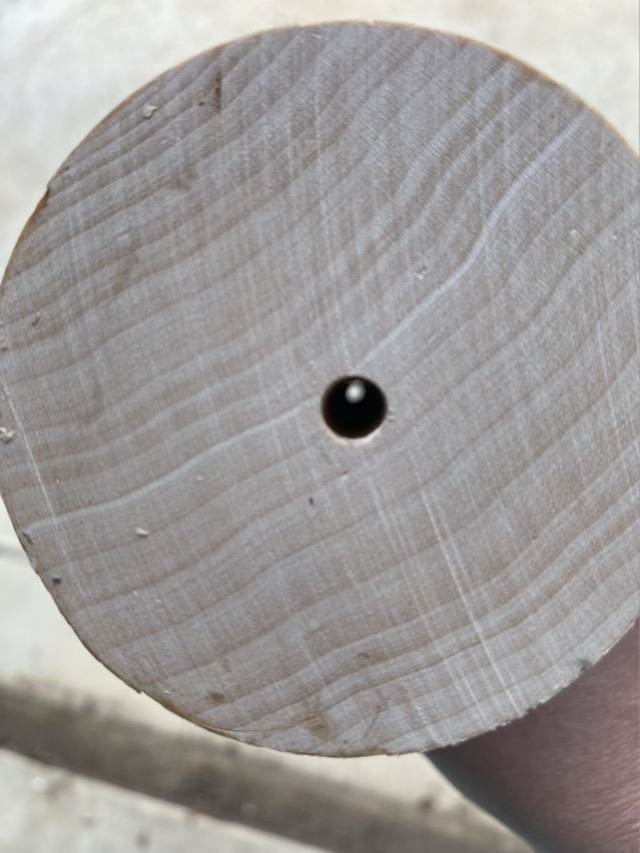
The drill press did well to start the holes, then I used a long 1/4” drill bit to drill halfway through on both ends. Miraculously, the two holes matched up in the middle with barely a jog.
Light at the end of the … rolling pin
After getting the hole drilled, I mounted the blank on my lathe. It was amazing how much work needed to be done to get the blank into round. It took me around two hours to get it roughed in and smoothed down. “Simple” straight cylinders are not simple to turn! I sanded down to 400 grit, then cut off the ends with the chop saw.
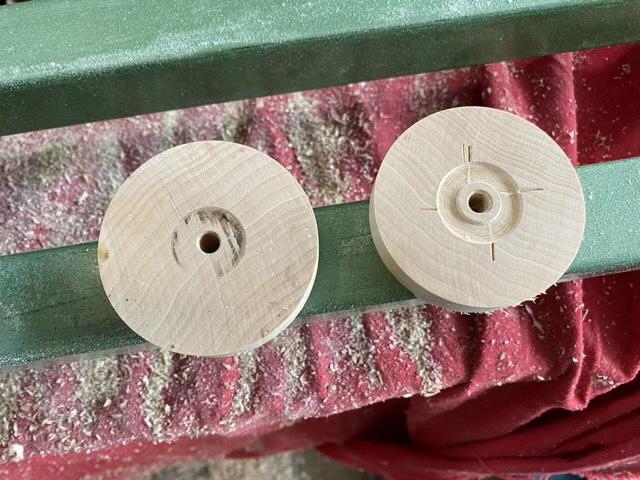
Cut off marred ends (but may turn into whorls for spindles eventually)Broken marble pin compared to the new maple pin
I cleaned up the steel rod and nylon flanges from the old rolling pin and tried them out. The fit was a little too tight, so I reamed out the hole with a 3/8” bit, and indented the ends about a 1/4” with a 1/2” bit to accommodate the flanges. It assembles and works! Now to “art” it, as my husband says.
(Part 3 of 8 in this blog series)
Happy Mother’s day to all those that mother! I’m trying out a new format with this series of posts, and didn’t plan for holidays. Oops. Live and learn. This too shall pass. Fussy babies go ni-night. (Getting in my Mom quotes.)
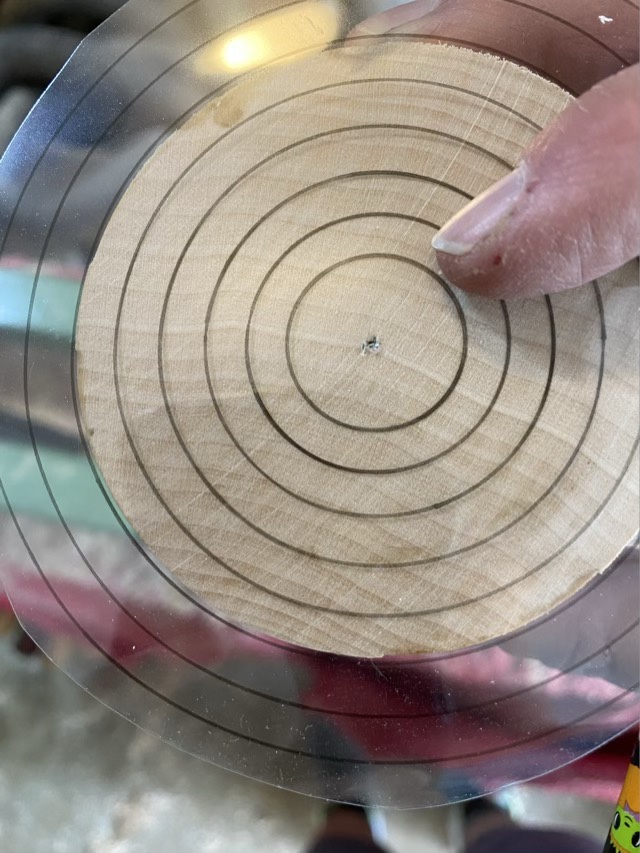
I made a simple center finder for drilling holes and turning round stock. I drew concentric circles with a fine-tipped Sharpie mounted in a compass on the inside layer of a lamination sheet. (I recommend practicing making circles on some scrap paper before going to the clear sheet, especially if it has been awhile since you’ve used a compass. Yup, personal experience.)
Circles drawn on the inside of a lamination folder
I then sent the lamination folder through the lamination machine to seal in the drawing and make it more rigid, used the sharp point of the compass to poke a hole in the center, and scissors to cut out the circle. By lining up the edges of the circle with the wood, I can mark the center.
Using the center finder to find the center of a maple turning blank
There are commercially prepared center finders, but this is an easy and cheap way to make one if you have transparent material available.
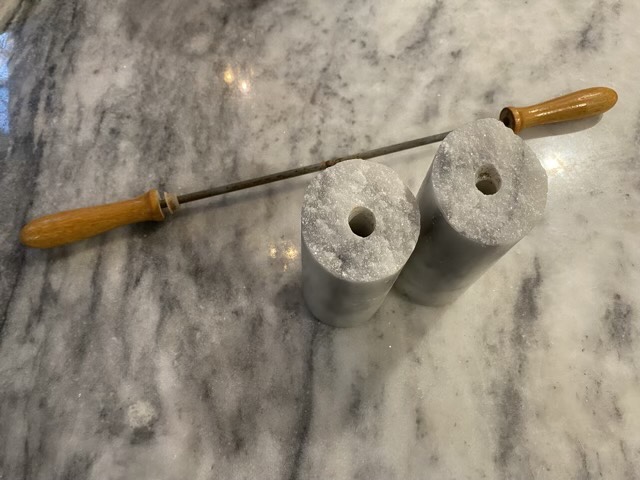
25 years. I’ve had this marble rolling pin for 25 years. I was making crackers and dropped it off the side of the counter onto the concrete floor. Crack. sigh.
Broken and disassembled marble rolling pin
I contemplated gluing it back together, but the crack would have to be filled, or I’d forever have a ridge on whatever I rolled out. It could be that there is a material that is suitable for filling a crack in marble that won’t potentially dislodge and become one with the dough, but I don’t have it on hand. I do, however, have wood and a lathe. Oh by the way, I’m going to draw this story out.





 Critters and Craft