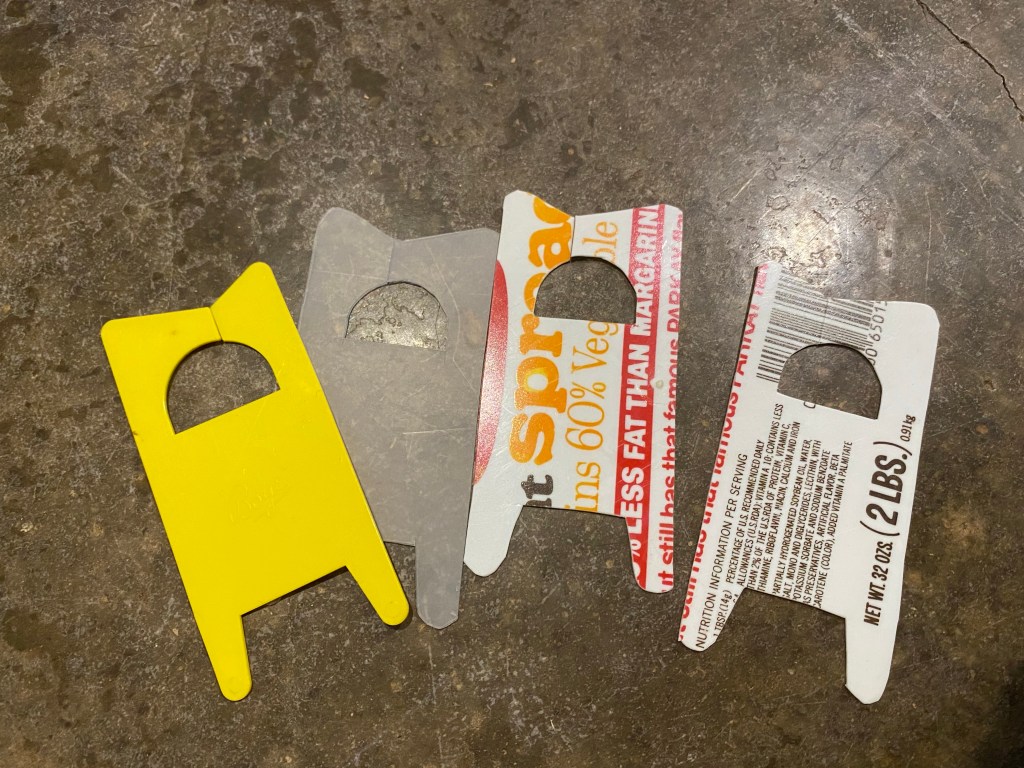
The apple doesn’t fall far from the tree. I was going through my Grandma’s knitting tools (I have inherited quite a few craft tools from both sides of the family), and found some home made yarn bobbins. My Grandma was an avid knitter and very skilled. It looks like Grandma used the commercially produced bobbin (yellow one on the left in the photo) as a template, and cut the others out of margarine tubs and other thick plastic. Very nicely done.
Three yarn bobbins made by my Grandma probably 30-40 years ago on the right, commercial bobbin (yellow) on the left
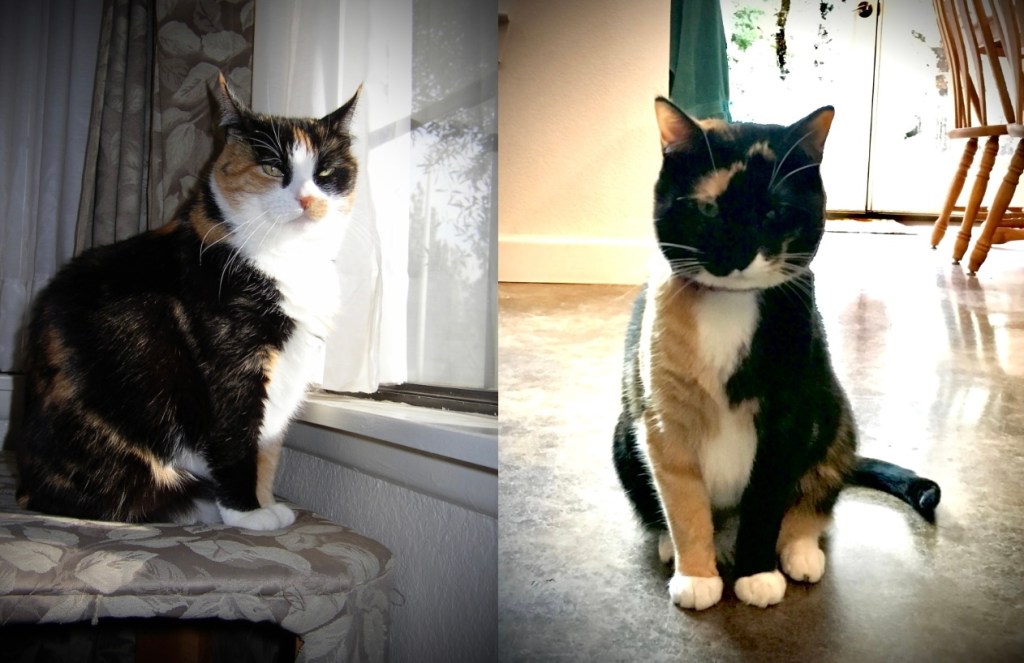
Pulling up old pictures of Shadows had us wondering how close in coloring our current cat Izzy is to Shadows. The answer: pretty close. Both had/have one orange leg and one black with white paws, they were just mirrored. They both had/have a mostly black back, Shadows just had more white on her tummy. The biggest difference is in their size. Shadows was a small rolly polly cat, while Izzy is a large sleek feline (not that you can tell in these particular photos). The dates are adoption dates, as we added both to our family when they were adults.
Is this a case for reincarnation? Or just that I really like calicos.
After making the baby hats from the rainbow acrylic yarn, I was left with a skein and a half of the stuff. Hm. The yarn has very short sections of color that repeated, could I knit it to make vertical stripes? The answer is: sort of. The color sections were not precise, so as I knitted I decreased or increased on the edges so the teal color lined up with the row before. I could then knit straight across without puckering the center of the fabric (although this might have been an interesting experiment as well). The resulting stripes undulated in interesting ways. Keeping the increases and decreases on the outside made the edges curl and pucker, but not entirely unpleasantly. It does help the edges curl in and hide the strange tan color the manufacturer threw into the mix.
Variegated yarn knit by lining up color
Since I did not have enough to make a long scarf, I opted to join the ends to make an infinity scarf. I used the Kitchener stitch and a section of the rainbow repeat to join. I had to undo the foundation row and slip the loops onto a needle, then use a yarn needle to perform the steps of the stitch. There is a learning curve to the Kitchener stitch, but it is well worth the effort! I can see the join, because the colors don’t match up as well as I hoped, but the fabric is solid and smooth at the join, not a bulky seam. (There are many online tutorials for the Kitchener stitch for those interested, so I won’t repeat them here.)
There is benefit in being up when the sun rises, as I was able to take this picture off my back porch. Now time to go make things.
P.S. For those of you looking at the post time in confusion, this photo was taken this past week. I schedule my posts for 2am because it seems the internet traffic is slower at that time and there is more regularity in posting. I tried scheduling for 8am and it sometimes took hours to post. I am an early riser, but not that early.
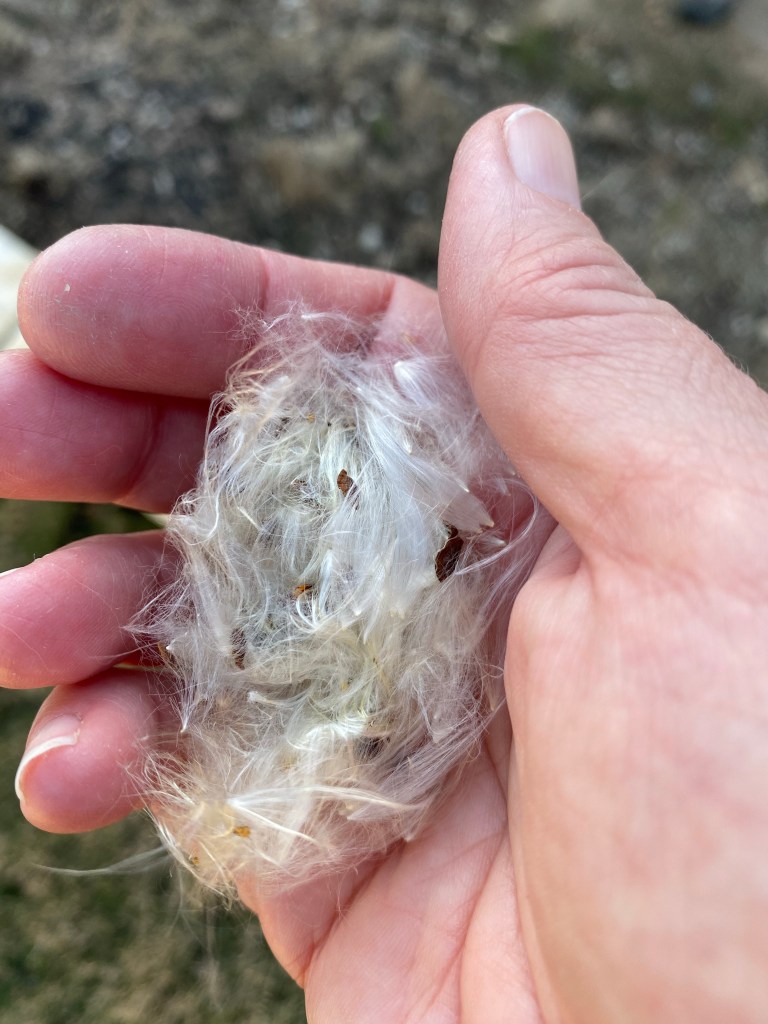
My father-in-law has tropical milkweed growing around his house, and when we were visiting, it was going to seed; putting out lovely fluffy seeds. Hm. Can I spin it?
Tropical milkweed seeds
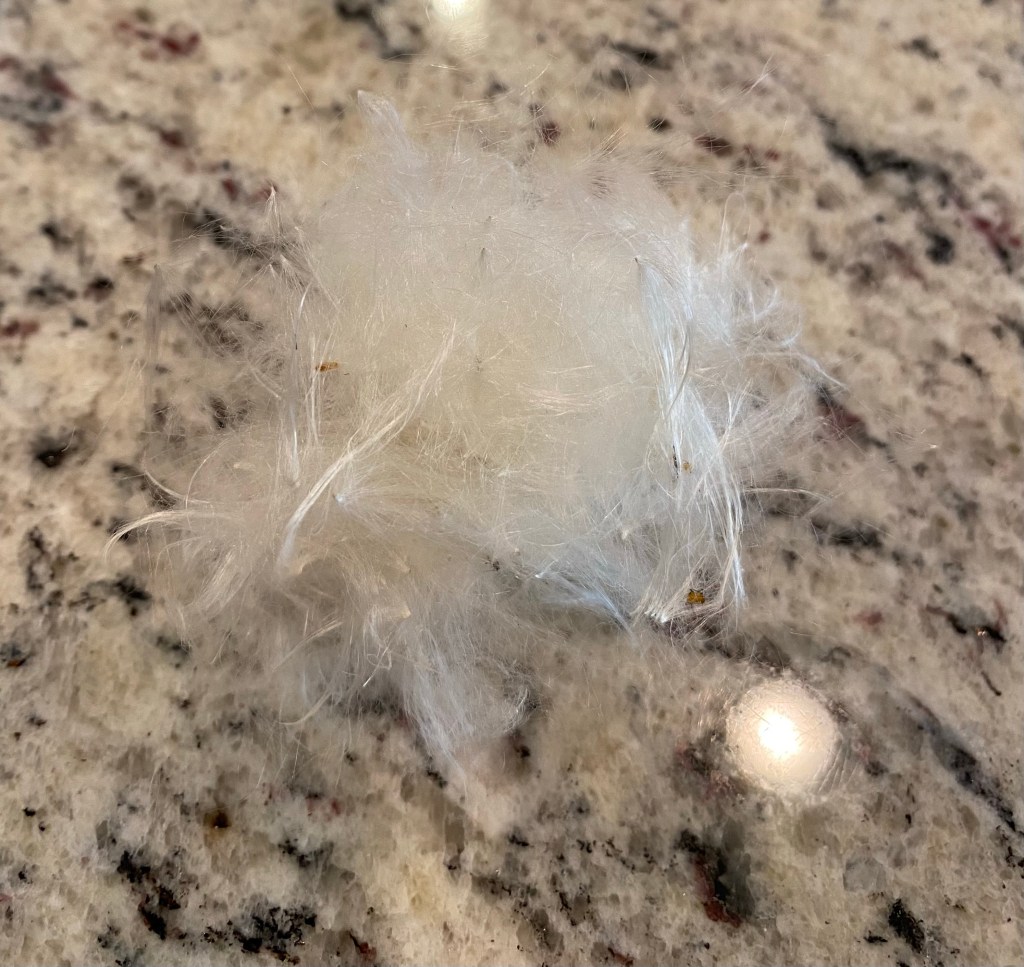
We gathered the fluff and I separated out the seeds. I didn’t have a spindle or flicker or any fiber processing tools with me (what was I thinking?!?), so I hand teased out the fiber and borrowed a pencil to attempt to spin the fiber.
Milkweed down with seeds removed
I would have preferred to spin these short fibers with a supported spindle, but after many determined attempts using a pencil to hold the spun single, I was able to at least achieve the semblance of yarn. The single was very fragile, so I doubled it to make a 2-ply yarn. The bit of yarn is brittle, but very soft. It is a thing to spin milkweed down, as I researched later, but most of the resources I found blended the milkweed with other fibers to give it strength. As my strand stands, it is really just an exercise in attainability, to see if I could. The yarn isn’t suitable to much purpose, however, it was a very enjoyable experiment.
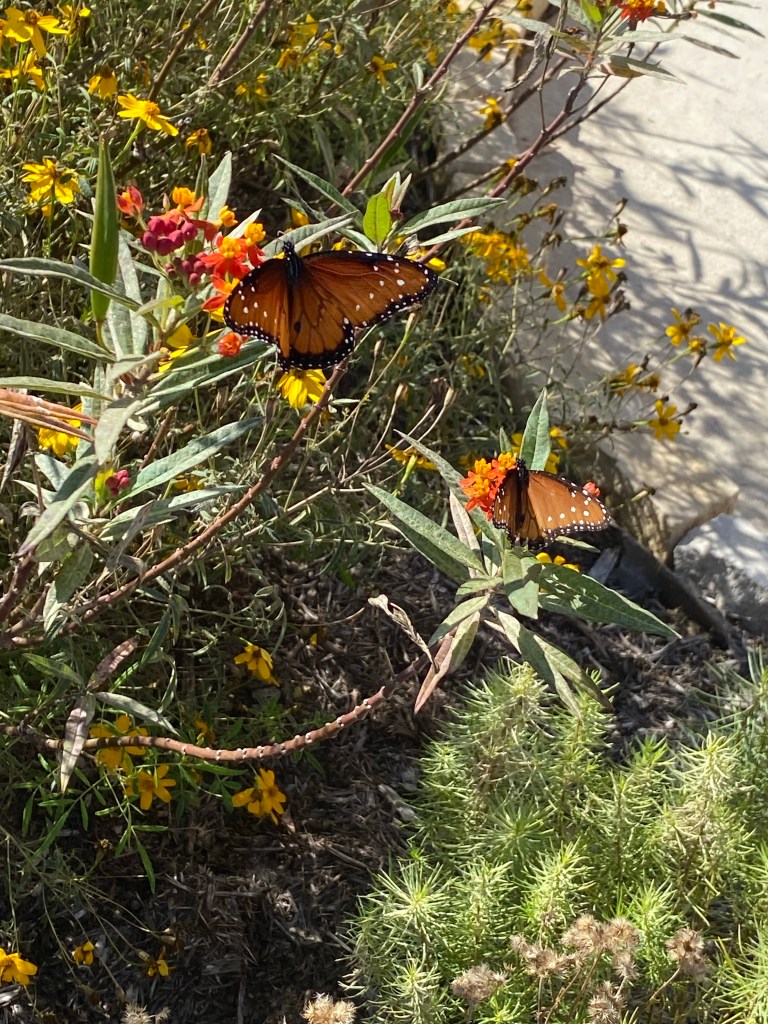
2-ply hand spun milkweed downButterflies visiting the tropical milkweeds





 Critters and Craft