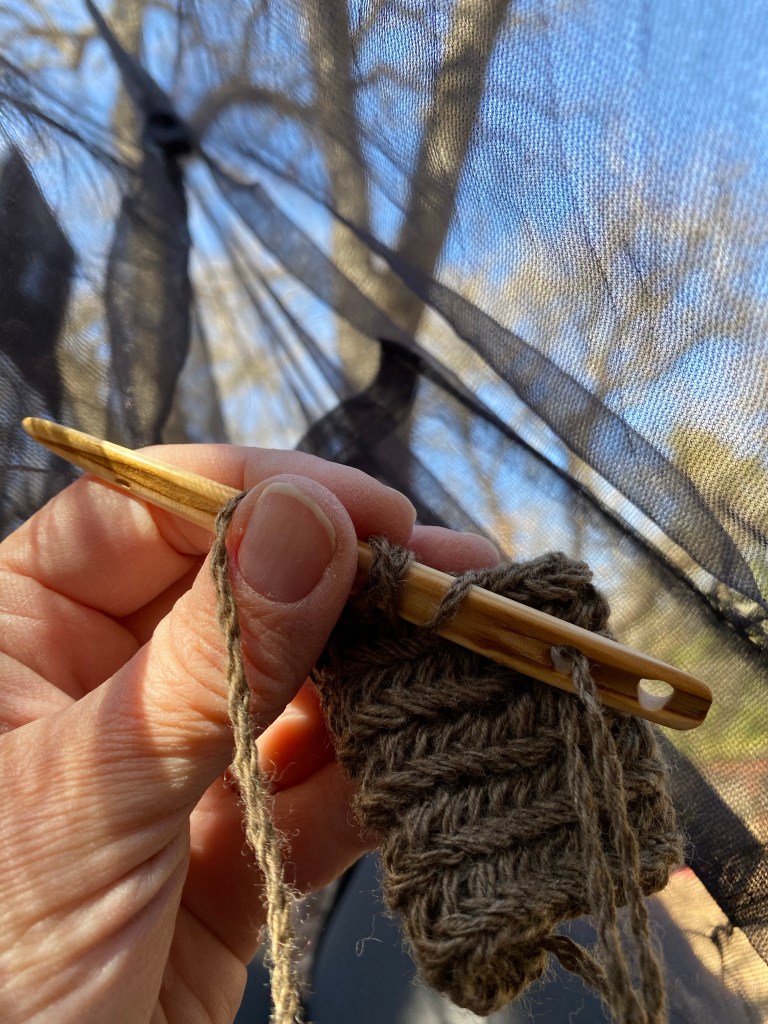
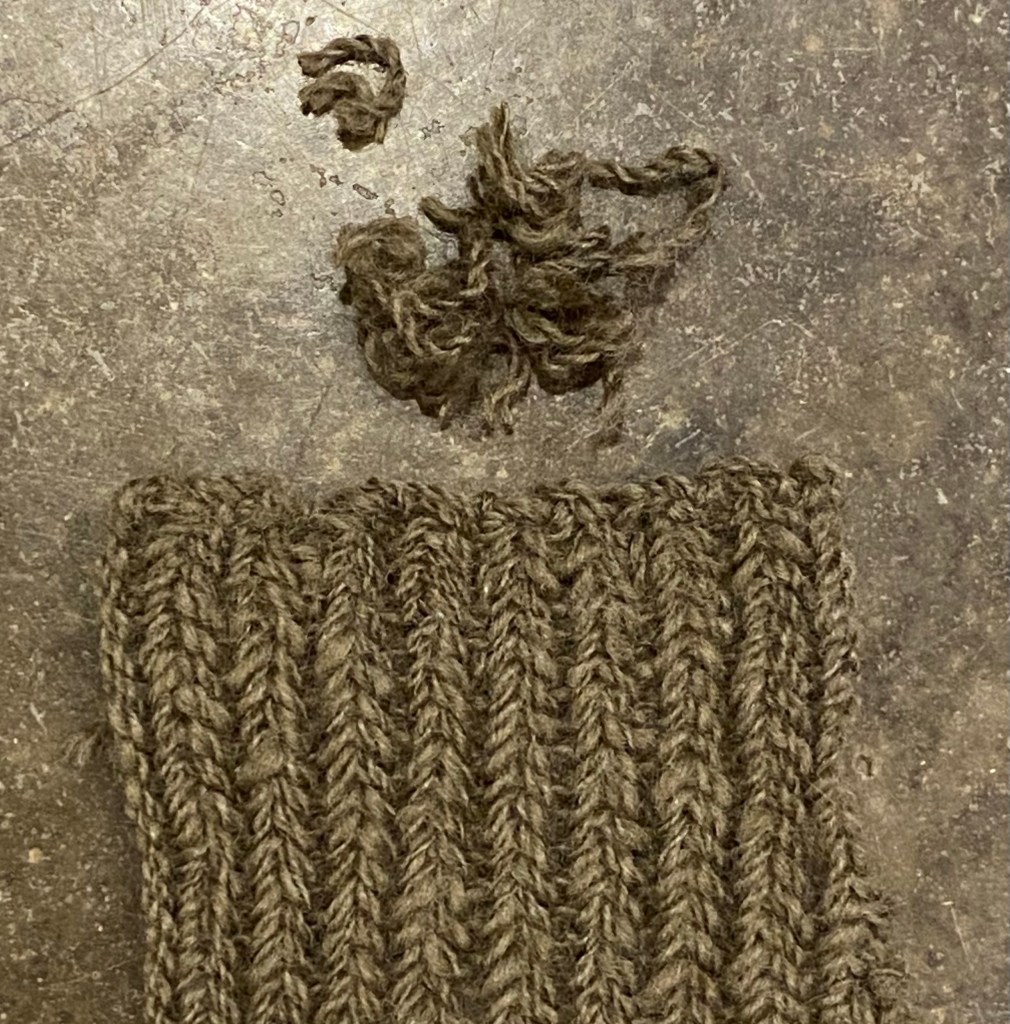
I did some crochet, some knitting, and now it is time for nålbinding! I only had two ply and four ply yarn left, but I tried using a tapestry needle as well as a hand-made nål on the two ply. Sizing the loops to the tapestry needle was much too small and much too tight, but the 25mm diameter nål made a nice fabric for both the two ply and the four strand cable ply. I stitched in the round, then cut the tubes open. The swatch does not unravel when cut! Although a few tiny bits of yarn do fall out. Of the three methods of fabric construction, nålbinding is the slowest, but I enjoy it the most. The process is soothing and the resulting fabric is nicely stretchy (at least with this stitch).
Nålbinding swatches made from hand spun merino woolNålbinding while laying outside in a hammockCleaned up the cut edge by removing the partial threads, snugging up the attached threads and running them down the back of the work
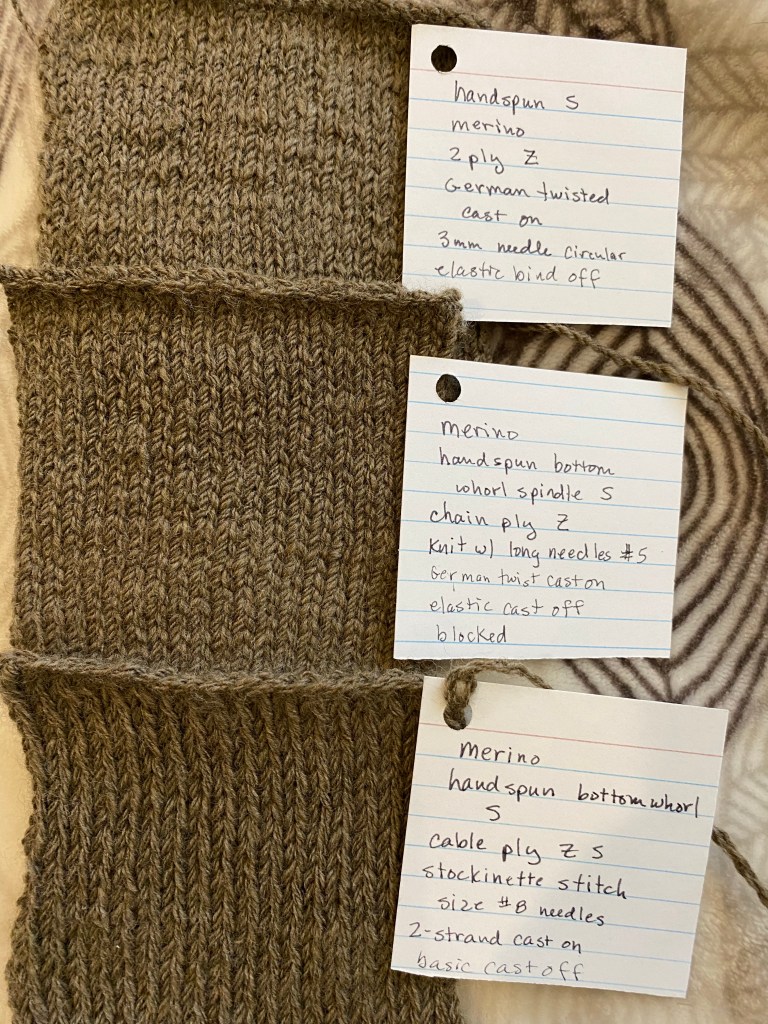
I had some more of my differently plied yarn, so I knit some swatches. I used different needle sizes for each yarn, but used stockinette for each piece. I was reminded how much faster I am with long straight needles than with circular needles, but my knitting is still slower than my crocheting. I like the knitted fabric, but don’t really care to knit. Ah well.
Knitted swatches of hand spun wool which was plied differently
All the knitted swatches had to be blocked because stockinette stitch is curly. The 2- ply was the softest, but the S plied four-strand had the most balanced stitches (the right and left side of each loop have the same number of twists). Most commercial yarn has an S ply.
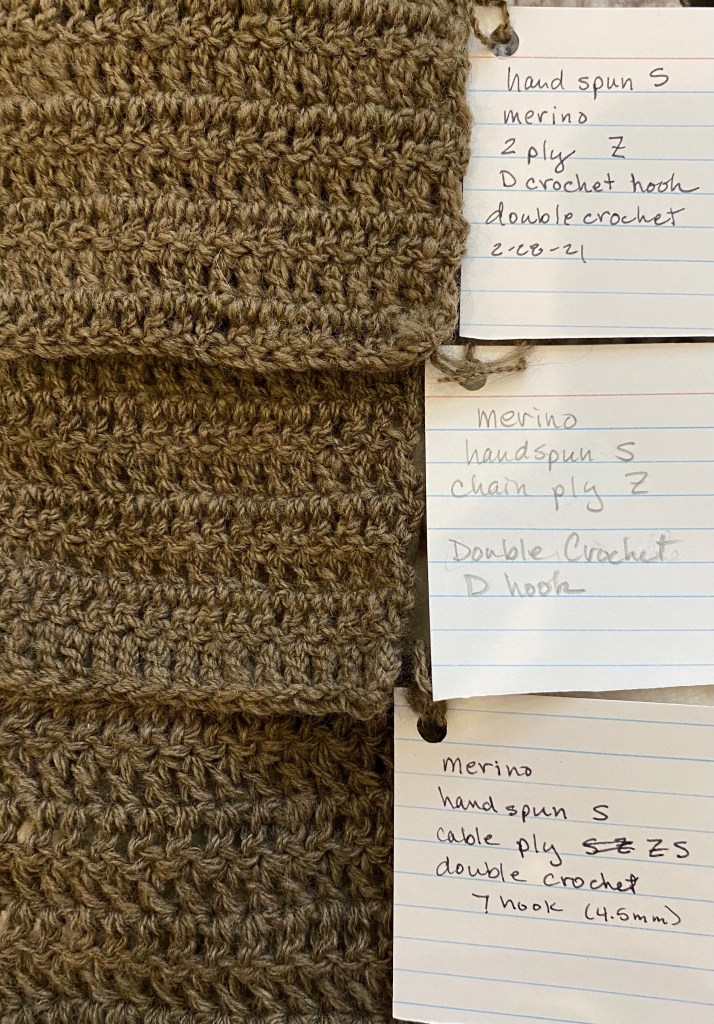
What to do with wee balls of yarn? Swatches! The experiments on my hand-spun yarn continue. I crocheted up a swatch from each of the three balls of yarn, one two-ply, one three-ply, and one four-ply. I used a double crochet stitch for each swatch, but used a different sized hook for the four-ply. I’ve labeled each swatch (as you do) with a bit of hole-punched card stock.
The stitch definition is nicer (to me) for the three and four ply yarns, but the two-ply is has the softest feel. Although, the three ply may have felt softer if I used a size larger hook.
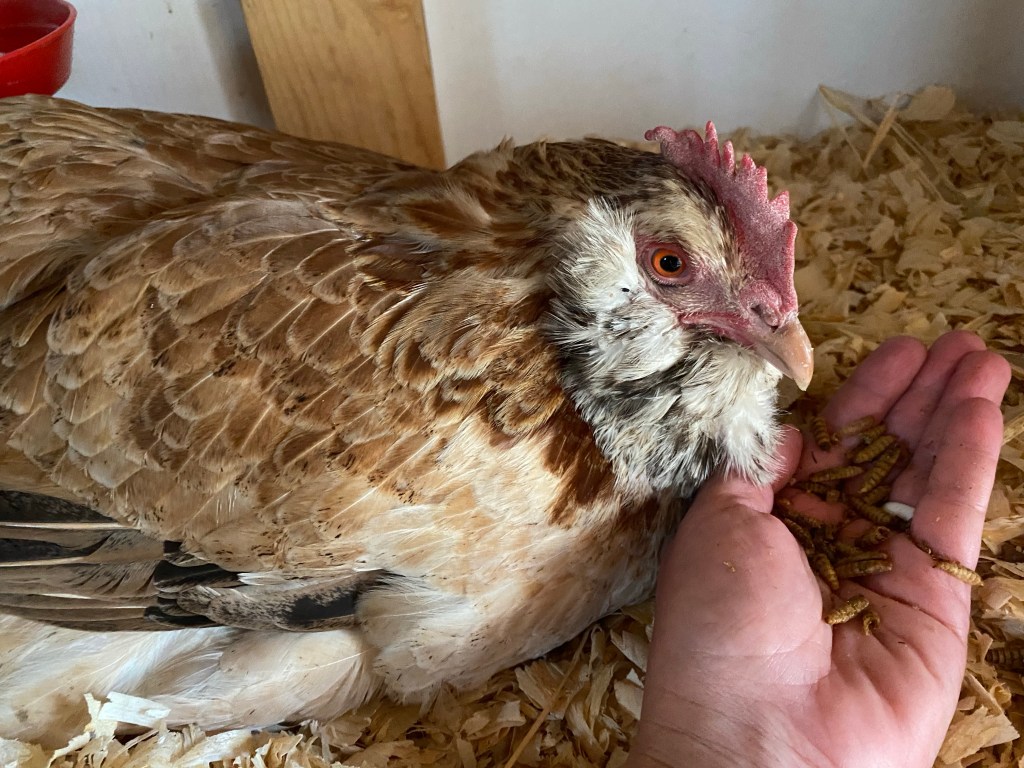
Poor Magic’s foot is bothering her. I thought it was a bumble (I did the bumble surgery and removed a large lump), but typically my hens are back in their feet and moving around better after the procedure. Magic just holds the foot up pathetically, then lays down in the dirt. So she is in the isolation ward away from the bugs. She has food and water, and gets hand fed grubblies. I’m hoping some rest time will help. And if it is something else, at least she is not mingling with the flock.
Powdered eggs is going to be my go-to method of long term egg storage! My hens are laying up a storm, and I finally had an excess of eggs to try dehydrating eggs. I followed the Dirty Gourmet’s instructions (here). I hand whisked the eggs until they were slightly foamy. Five 50g eggs fit in each of my fruit leather trays (I did two trays), just like hers did. I dehydrated at 140 degrees for 10 hours, then removed all the dry bits, but had to flip over a section on each tray and dry another couple hours. At this point it was bedtime, so I put all the bits in a gallon freezer bag in the freezer. In the morning I put all 10 dehydrated eggs in my food processor and blended until it was a coarse powder.
Dehydrated egg straight from the freezer processed in the food processor
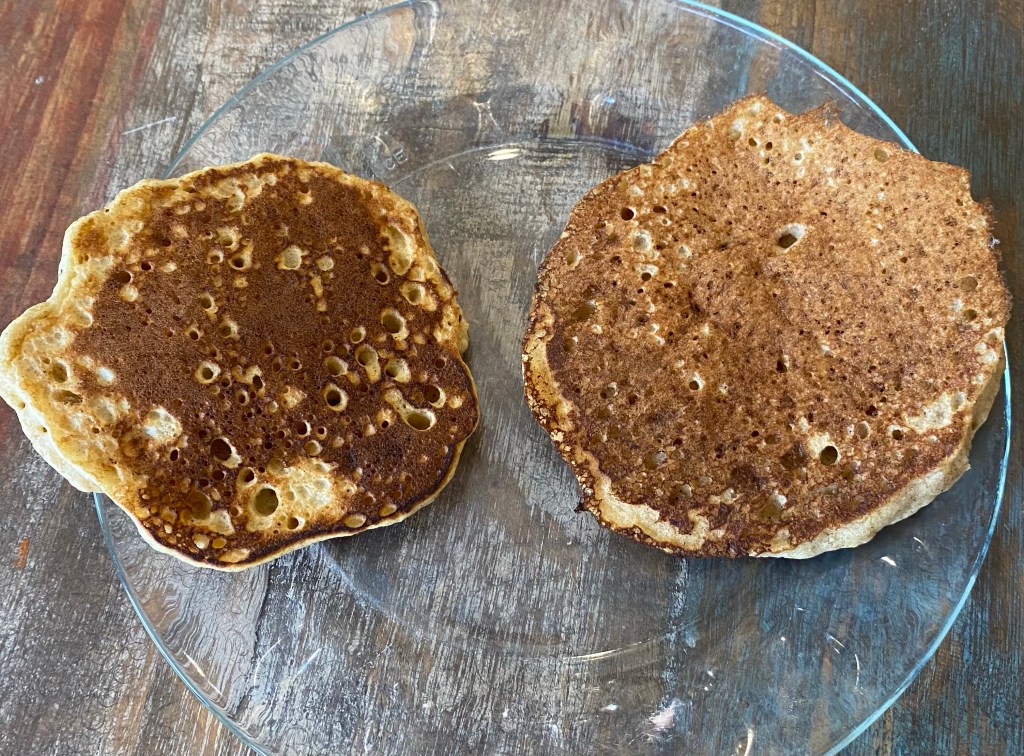
I weighed the resulting powder and figured that each egg was reduced to 12 g. The Dirty Gourmet recommends reconstituting with 1 Tablespoon and one teaspoon of water. I tried that, but the eggs were still quite thick. I weighed an egg shell (7 g) and taking the weight of the whole egg (50 g), figured that 31 g of water was lost for each egg (that is 2 Tablespoons). I used this ratio to rehydrate 3 eggs worth of powder and made two batches of pancakes, one with fresh eggs, and one with the powdered eggs. Both mixed and cooked up fine, and my family said they couldn’t taste a difference. I think the powdered eggs made a slightly finer textured pancake. The best part is that I think I can probably store 50 dehydrated eggs in a single gallon bag. I am storing the powder in the freezer as recommended, but the space savings is considerable! I think I can also comfortably process 15 eggs at a go. Maybe I won’t have to buy eggs next winter. Maybe.
Almond and oat pancakes made with fresh eggs (left) and reconstituted powdered egg (right)



 Critters and Craft