Male Queen

The Queen butterfly (Danaus gilippus) is a common butterfly in North Texas, and is the most frequently spotted in our Gregg’s Mist flower patch.

Photo description: Queen butterfly on a Gregg’s Mist Flower stalk
Photo description: Queen butterfly with wings open

In looking up the information on the Queen butterfly for this post, I found references for telling apart the males and females of the species. The males have dark patches on the hind wings, which are scent producing patches. So in my picture, it is a male Queen butterfly because the patches are evident.

Photo description: same butterfly zoomed in and a white arrow pointing to the one androconial scent patch

Honeysuckle

Once again the Japanese honeysuckle has exploded. The metal arbor that holds it is completely engulfed and the scent can bowl you over on a warm morning.

Photo description: Japanese Honeysuckle in bloom, about 10 feet tall

I do plan (again) to harvest the vines in the fall, but now I have a secret weapon: a stem stripper. This small metal tool is marketed for stripping thorns from rose stems, but works awesome on removing leaves from honeysuckle as well. It makes prepping the vines much faster.

Photo description: metal stem stripper tool with a stripped honeysuckle vine and one with the leaves still attached

I did take stereoscopic images and put them together. There is depth, but it lacks diversity. It is a great huge mound of honeysuckle, after all.

Photo description: stereoscopic parallel view of Japanese honeysuckle mound

Somebody’s happy

Photo description: cactus with one white bloom, carved stone dog in a terrarium

I have one happy cactus in my terrarium blooming away, one that wanted to bloom and I either missed it or it changed its mind, a few that are holding steady, one that slowly died, and one that bit the dust within days of replanting. I put up an artificial light that runs 9 hours a day (my choices are 3, 9, or 12), and water sparingly once a week. Here is the original post.

Jewel orchid home

When my jewel orchid failed to thrive in my mossarium, I transferred it to an old fancy Ball jar filled with moss in a south west facing window covered in a translucent frost window covering. It was happy there, so happy that it started on a new leaf.

Photo description: fancy Ball glass canning jar filled with moss and one jewel orchid
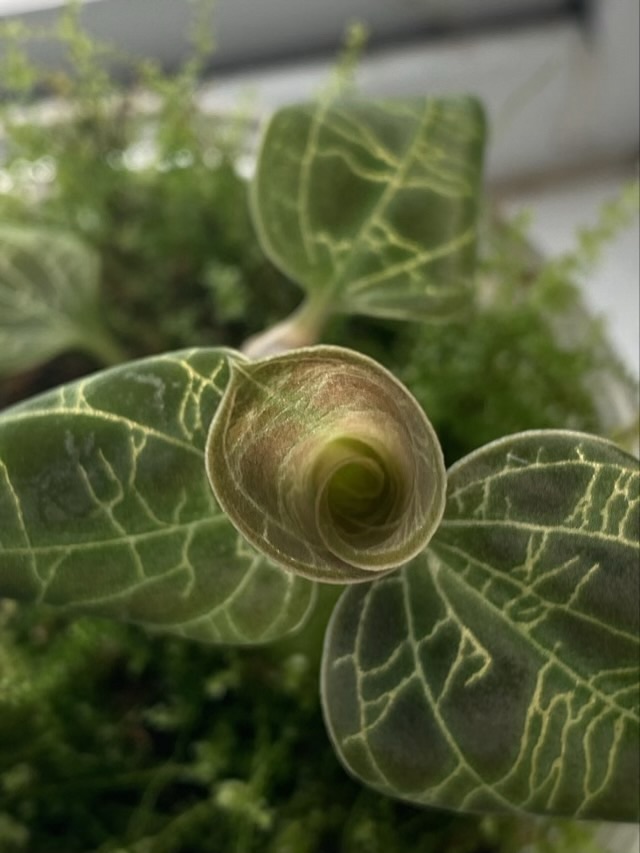
Photo description: top view down into the jar, new curled leaf visible on the orchid

There are two problems with the canning jar container: one, I can only see the jewel orchid when I open the jar; two, if the orchid gets happy enough to bloom there is no room for the flower spike. So I purchased a tall clear acrylic vase, transferred the orchid and his moss to a different canning jar, and used the vase as a lid.

Photo description: same window, different home for the jewel orchid, a smaller canning jar, but a taller clear cover

I can now see the orchid, and if it sends out a flower spike, it has somewhere to go. He remains happy in his new home, as his leaf opened fully with no curling or discoloration.

Photo description: 10 days after the last picture showing the jewel orchid with two fully formed leaves in a live moss bed in a small canning jar held up to the light

Starting seedlings

I have used little peat pellets this year to start my basil and pepper seeds. Maybe they will actually make it outside this year.

Photo description: rehydrated peat pots in acrylic trays in the window on hanging acrylic shelves

I’m very thankful for farmers, since I can only occasionally grow basil and peppers, and bomb out on everything else.