Decommissioned

When we added two chickens to the flock and had them separated, I put a hanging feeder in with them. When I integrated the flock I kept the hanging feeder full because I wasn’t sure the new hens would be able to use the Grandpa’s Feeder my original flock used. Turns out that all the hens preferred the hanging feeder. The advantage of the “Grandpa’s Feeder” is the wild birds and rats aren’t heavy enough to activate the lever and open the food bin. The disadvantage is that bugs can still get in. When checking feed I discovered that the entire bin was full of food riddled with holes.

Photo description: chicken feed in a Grandpa’s Feeder riddled with insect holes

One of the other advertised advantages of the Grandpa’s Feeder is that the metal grid and high sides keep the chickens from wasting food because they can’t fling it out of the container. A hanging feeder has this same advantage, so I emptied out the Grandpa’s feeder and decommissioned it, since I was only feeding bugs.
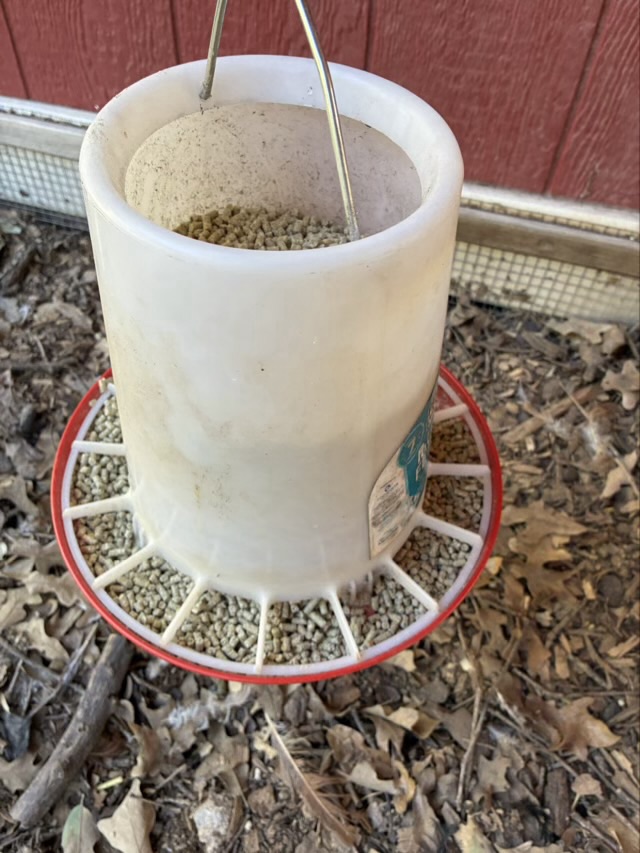
Photo description: hanging feeder filled with chicken feed

Another advantage of the hanging feeder is that I can see the food level from a distance. A disadvantage is that it is open on the top and if we get a heavy rain storm I loose a batch of feed to the wet. I’ve moved the feeder farther inside the porch area of the coop to see if that fixed the weather problem. Overall, the hens prefer the hanging feeder, and the hanging feeder is a fraction of the cost of a Grandpa’s Feeder.

Mesh repair

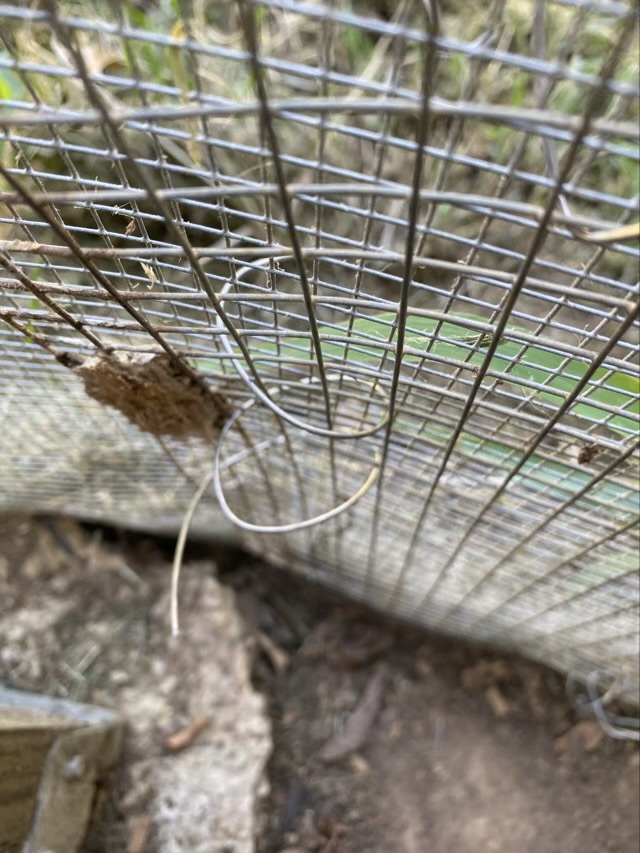
In the light of day I went out to repair the rips in the hardware cloth in the chicken runs so no more skunks could slips through. I took scraps of half inch hardware cloth and wired it to the damaged quarter inch hardware cloth.

Photo description: 1/4” hardware cloth with large rip along the bottom

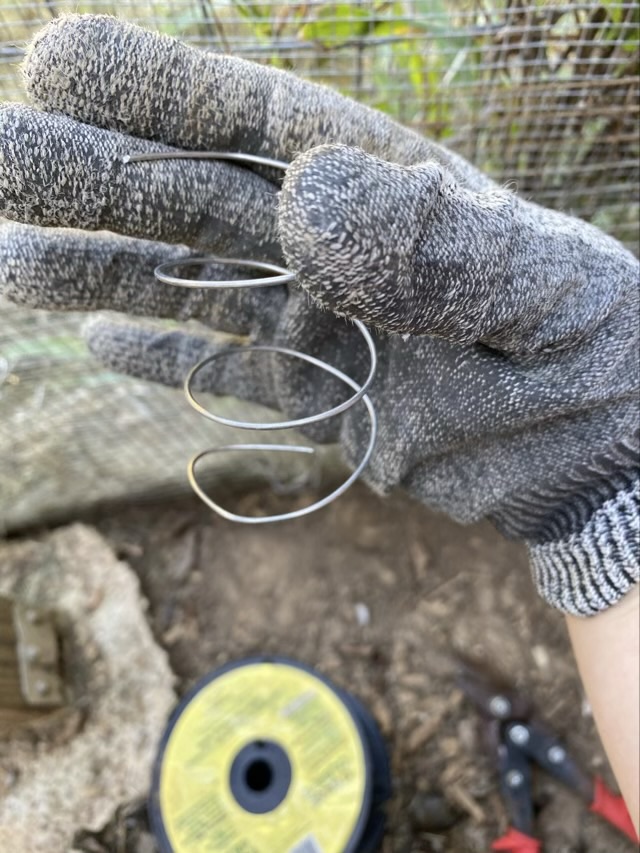
I found that with two layers of hardware cloth, making a spiral of aluminum wire made it easier to lace the wire through the cloth, since I didn’t have anyone on the other side to feed the wire back to me.

Photo description: hand formed wire spring shape from aluminum wire
Photo description: twisting the spring into two layers of hardware cloth

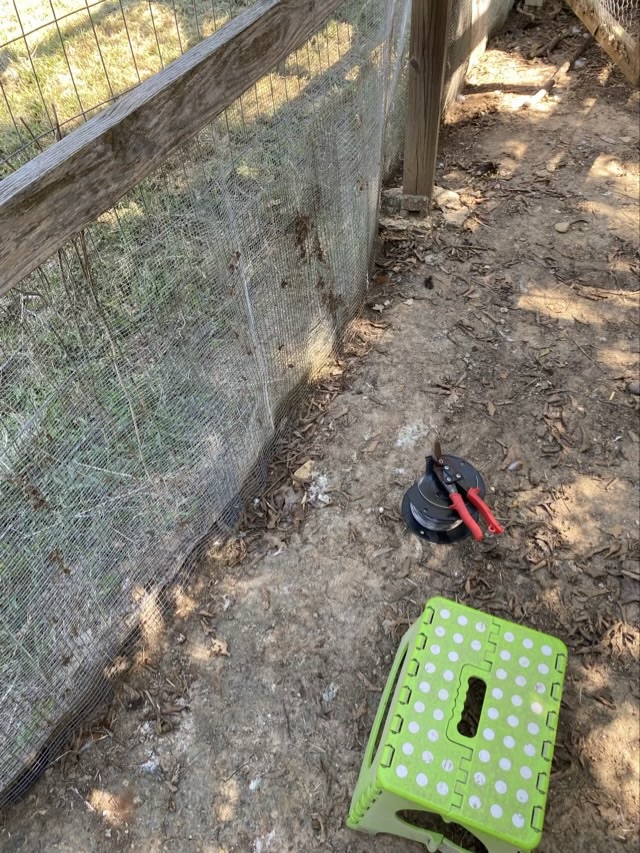
After threading the spring through the layers several times, I would tighten the loops and twist in the ends. Using this method and using smaller wire “ties”, I reinforced the rips, and secured the solid mesh over the weakened areas.

Photo description: double layer of hardware cloth installed to repair tears

I also put a layer of 2×4 no climb welded wire on the outside as protection from weed whackers. As a precaution, I have been making sure the coop is secure at night, rather than relying on run security. I do have an automatic chicken door, but I check each night that it is working, and verify it opened in the morning.

I think it was Jade that was taken down by the skunk, but it could have been Schmoo. I won’t be able to tell for sure until next molting season, since Jade has (had?) a very distinct feather loss pattern.

And now three

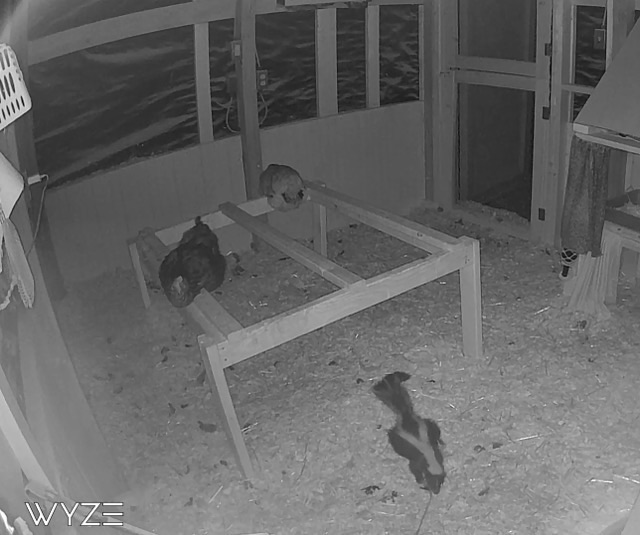
I lost my first chicken to predation this week. When I checked on the four remaining hens, one of the Faverolles was unmoving and had clearly been snacked on. Reviewing the camera footage showed a young skunk galavanting all over the inside of the coop. The chicken it killed was feeling poorly, she had been sleeping on the floor for a couple days rather than on the roost. I didn’t think anything of it because I’d never had a predator invade, I just built her up a throne of pine shavings in the corner so she could be close to her sisters.

Photo description: night view of the inside of the coop with two chickens on the roost and a skunk on the floor (the third living chicken is in a nest box)

I found where the skunk got in, the 1/4” hardware cloth on the meadow side of the runs is torn. I leave the coop door open all night during the summer to keep the temperatures down. For the last six years the runs have been secure enough to do so. Repairing the unauthorized entry will be in a future post.

Autowash

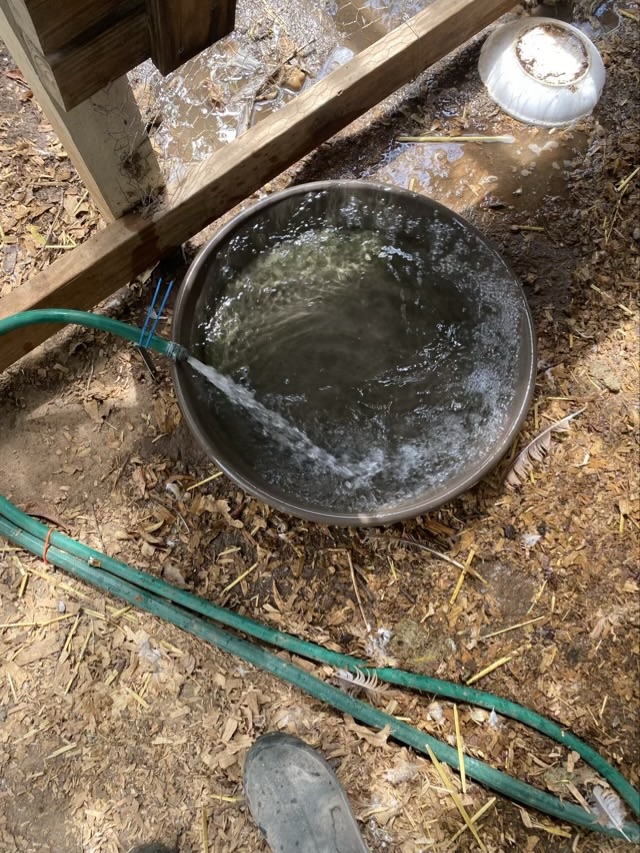
In the summer I put out a chicken foot bath to help my hens cool off in the Texas heat. Yes, they tend to drink from the same water they stand in, but I haven’t yet lost a chicken to heat stroke. To keep the water relatively clean, I set up a hose on a timer to rinse the foot bath twice a day. I’ve hammered the hose end down to a slit to give the water spray some power, and it only takes a minute for the bath to do a water exchange. By putting the hose on the high side of the bath at an angle, the water swirls around the shallow dish, and floating materials, like pine shavings and feathers, spill out on the opposite side.

Photo description: chicken foot bath made from a large plant tray and a hose set up to autowash

Egg!

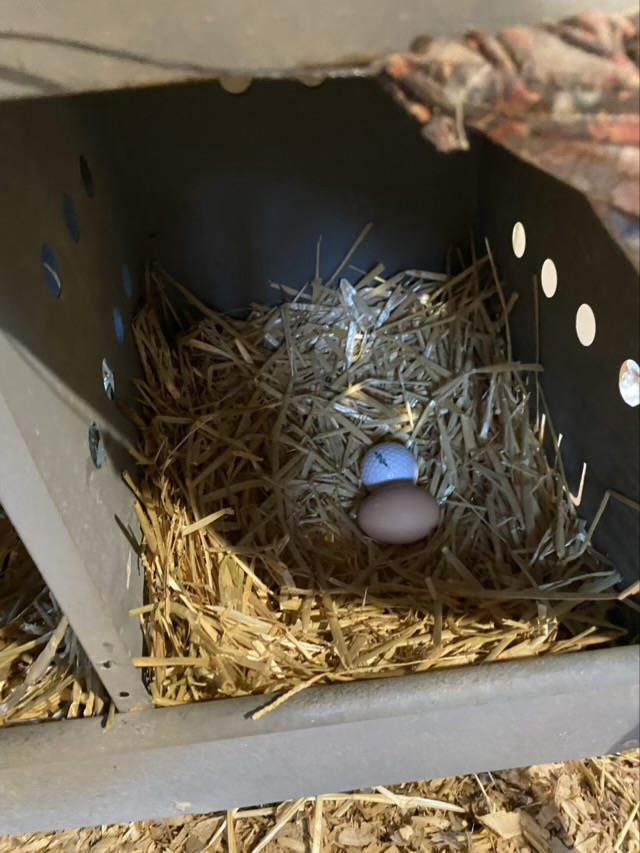
Wing ding the Black Star hen has started laying again.

Photo description: metal nest box lined with straw with a golf ball and egg

This is a really good demonstration of the difference between a good layer and fair layers. My Faverolles stopped laying in September and I’m not entirely sure they will ever lay again. They are coming up on their sixth year and their winter egg break keeps getting longer and longer. Even when they are laying, it isn’t every day, but closer to every other day. Wing Ding lays nearly every day. So if you are going for egg production, get a good layer. If you want sweet docile chickens and aren’t as concerned about egg production, then get Faverolles. Know that Faverolles will also be at the bottom of the pecking order if you have a mixed flock. Our flock has everything worked out so that no one’s feathers are being picked to extreme, but they have plenty of space and food and places to hide.

I’m mostly excited the Wing Ding is now laying eggs in the nest boxes in the big coop. The temporary outside coop we set up when the flock was separated gets terribly hot in the summer.