I had a bit of a shock looking for eggs in the nesting boxes recently, a very tiny egg.
Photo description: brown egg on a scale reading 17 grams
I found it where the new chickens lays their eggs, so I’m certain it came from one of the Black Star hens. I broke it open and there was no yolk.
Photo description: cracked egg with only egg white, no yolk
Maybe the term fairy egg comes from the thought that something stole the yolk? That would be old school fairy thinking, not the new tiny jingling sparkly fairies. Either way, it is not something concerning for the health of the chicken, just a hiccup in the production system. I do believe I have something going on with egg production, though. With six hens I’m finding maybe one egg a day. It could be that they are all older, 5 years old, well past prime laying. It could be the stress of a new pecking order or the heat. There could also be something stealing the eggs, although not fairies, but likely a snake sneaking a snack.
We now have a flock of chickens instead of two separate flocks.
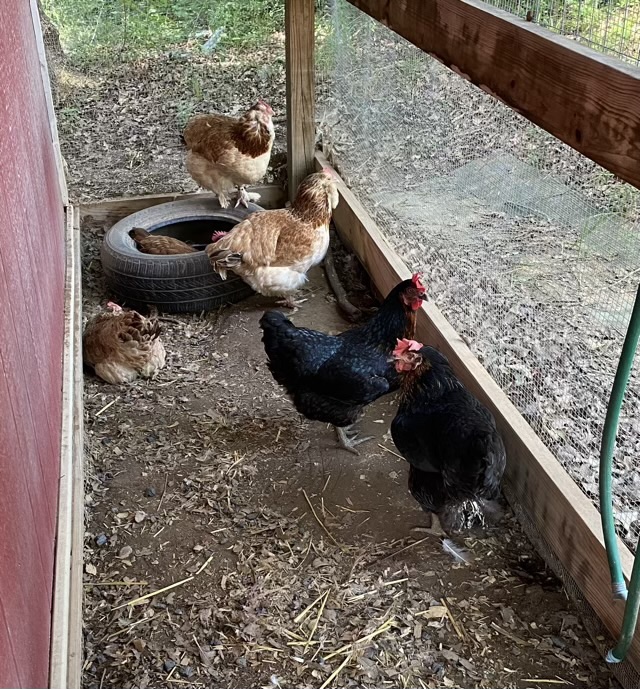
Photo description: two Black Star hens and four Faverolle hens in the coop breezeway, one hen in the tire dust bath
We’ve been keeping the new hens separate from the existing flock, with just a short periods of supervised time together. After three weeks, we opened up all the inside gates and let them mingle. It was already established that the Black Star hens would be dominant, and the Faverolles would run away if she even looked at them, so there was no reason for her to do anything more aggressive than look. We watched in person for a while, then monitored the cameras for the rest of the day. I took the picture above in the afternoon. The breezeway is the coolest part of the run; it is in deep shade and there is almost always a breeze from the shade of the back woods. The best place for all the chickens with summer coming in. Interestingly, they all went to bed in their separate areas. I was hoping the new chickens would find a place in the large coop (there is plenty of room), but they seem to like the little hen house.
We have started the integration process with the two new chickens with our existing flock. The first supervised mingling was a bit traumatic (there were in-flight, talons-out attacks), so we have initiated a very slow protocol. We’re swapping the flocks, so the new hens can explore the old coop, and the existing hens can explore the new coop. The Black Star hens will be dominant over the Faverolle hens (Faverolles are typically at the bottom of the pecking order), so we give treats to the Black Star first to let them know we know, and to try and reduce their need to physically establish dominance. A few pecks here and there is just the chicken way, but we don’t need any feet involved.
Photo description: two Black Star hens looking into a new coop area with caution
After the swap, we let the hens to back to their own sides, with careful observation of interactions, and some herding and guarding if necessary. We’ll continue this process until we can keep all the doors open all the time. Or not. The two groups can see each other through the poultry wire, and if need be will stay separated when unsupervised.
Taco the hen, who usually escapes notice on the blog because she is independent and aloof, passed away. A couple days before I noticed that her crop was hanging low and full, a sign of a good meal, or of sour crop. I was trying to keep an eye on it, and in hindsight I should have started a copper sulfate treatment. We had a previous hen live for almost a year with the condition, and I was honestly hoping it wasn’t sour crop. I found her surrounded by her sisters in the morning in the coop. I was up and in the coop early because we were preparing for the arrival of the two new hens, Wingding and Magnet, a pair of Black Star chickens coming in from family. Taco was given an air burial in the woods, and within a few hours we were welcoming the new hens to their new home.
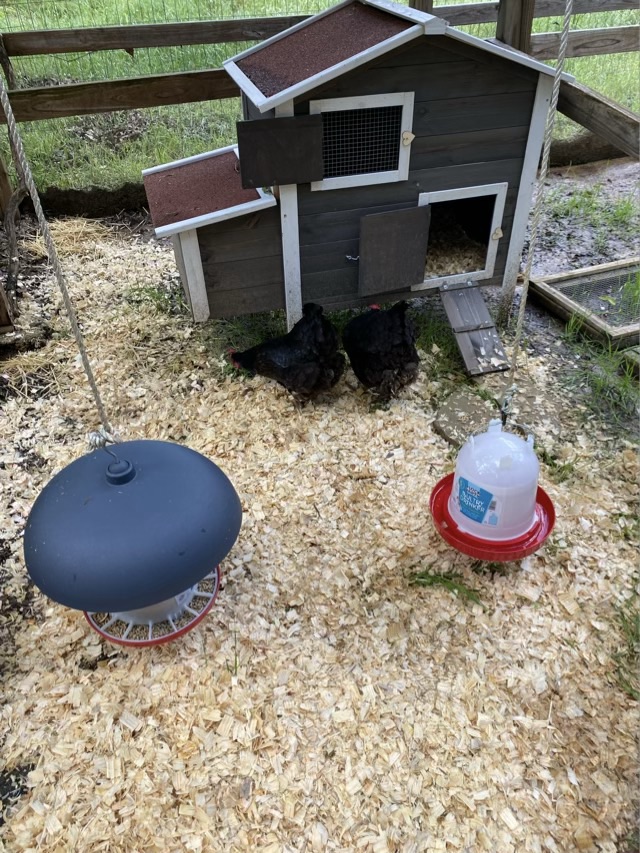
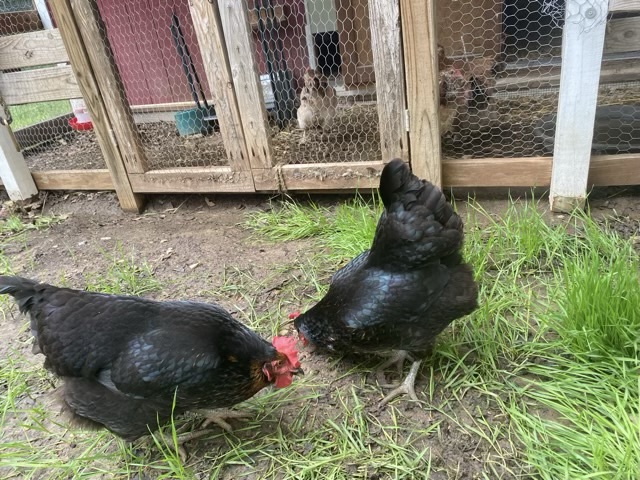
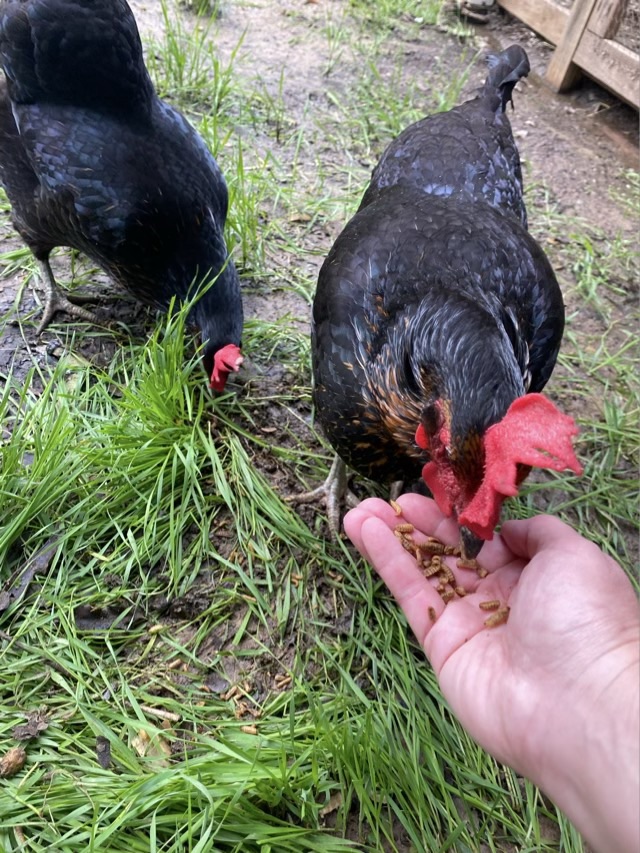
Photo description: two black hens investigating the pine flake spread on the ground to combat the mud from the previous day’s heavy rain, the new small coop behind them, hanging water and hanging feed in the foreground. The squirrel baffle over the feed is more to keep out the rain than squirrels.Photo description: two Black Star hens in the foreground, and at least three of four Faverolle hens in the background behind a poultry wire divider.Photo description: Magnet and Wingding accepting an offering of dried grubs.
So our current chicken count is at six. Two Black Star, and four Faverolle. We’ll keep them separated for a while where they can see each other, and later see what happens when they can mingle. Ideally they will share all the space, after they establish pecking order.
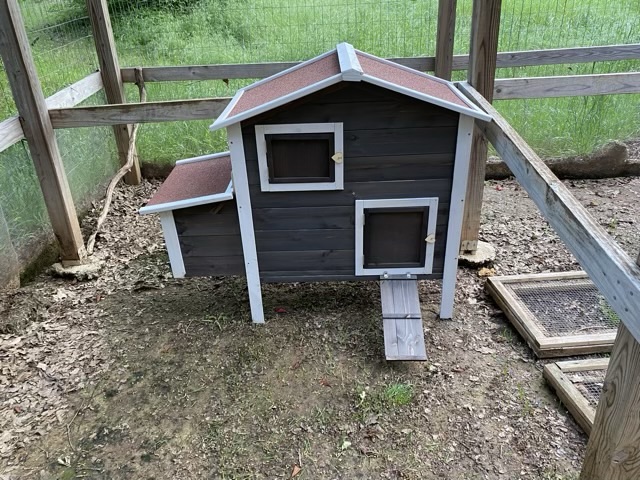
We will be taking in two additional family chickens since work is taking their current family out of state. I hope the new hens, who are about the same age as our hens, but a different breed, will be able to join the flock with few ruffled feathers, but to start, we will keep them in a separate area. The easiest way to accomplish this was to get or build a smaller coop in the current run. I have doors lined with chicken wire to separate the areas, and both flocks have plenty of outside space. I did not have time to build a small hutch from scratch, so I ordered one on Amazon for about $150.
Photo description: small hen hutch with nesting box attachment, vented roof, ventilation window, and coop door with ramp sitting on newly seeded dirt in the chicken run.
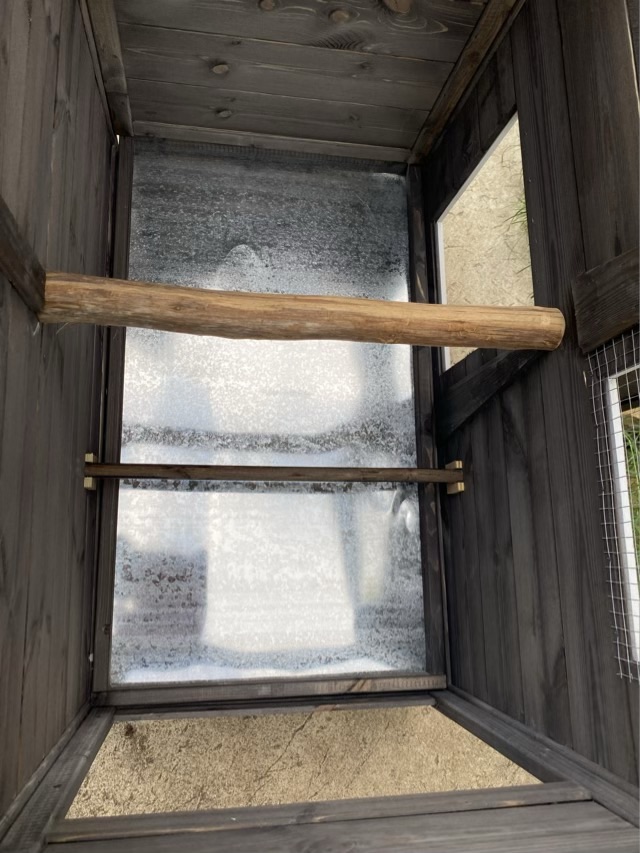
It was not a beginner build project, but I’m not a beginner, so it worked out. The wood is thin, but solid, not particle board. The directions were sparse, but my eldest and I were able to get through it. We built it on the back porch where we had a stable flat surface, then carried it to the run. The roost bar was a joke; a 3/4 inch dowel two inches from the bottom of the hutch. I found a 2 inch cedar branch and cut it to length and secured it with screws higher in the hutch.
Photo description: original roost bar near the removable metal floor, and the new cedar roost installed higher in the structure
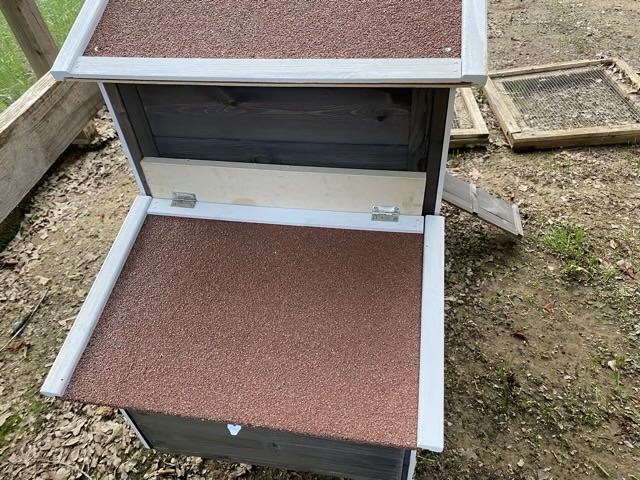
When we went to install the hinged roof of the nest boxes, there was a significant gap that made attaching difficult, so we cut a section of scrap trim (from the garage) to fit before attaching the hinges.
Photo description: extra trim installed to provide a sturdy surface for the hinged roof
We placed the hutch in the most shaded part of the runs. The run itself is entirely encased in hardware cloth and I have not had significant animal incursion in the five years it has been standing. We did make sure it was out of reach of questing raccoon hands. We’ll have a chance to see how it weathers storms this week.



 Critters and Craft