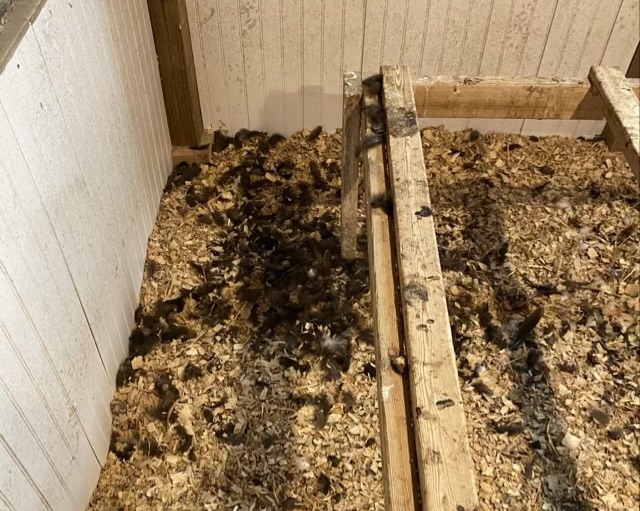
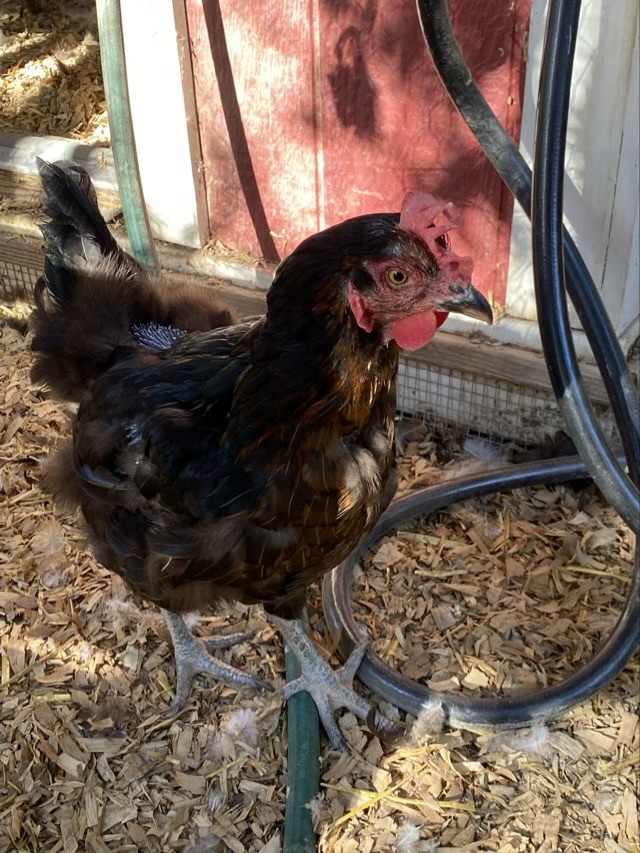
Wing Ding the Black Star hen doesn’t mess around with her molt. When I took a peek at the coop through the web cam, I thought a predator had broken into the coop and taken out a chicken. I went out and all four hens were fine, Wing Ding was just molting.
Photo description: pile of black feathers on flakes of pine shavings in the back corner of the roostPhoto description: Black Star hen in molt, looking quite bedraggled and spots with no feathers, with the new pin feathers coming in
This is one of the characteristics of a good layer. They molt quickly and get back to laying. My Faverolles are not good layers and take months to molt. They are all over five years old, though, so we might have seen the last of their eggs.
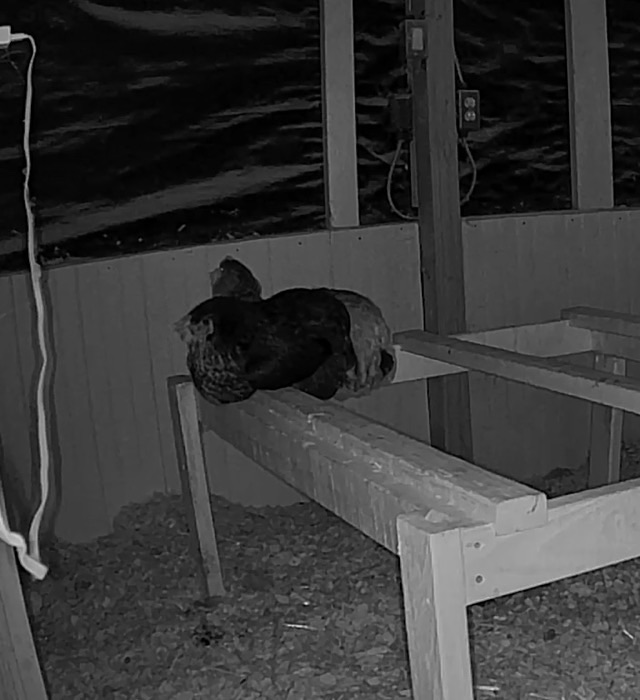
The back corner of the roost in the coop is the prime sleeping position for the chickens. Since Wing Ding the Black Star hen has taken to the roost, it has been her domain and the Faverolles have given her space. I caught them on camera recently snuggling up, though. I’m not sure if Wing Ding let them, or she was asleep when they shuffled over. Positive outcome either way.
Photo description: three hens in a tight group on the corner of a roost made with dimensional lumber, pine flakes on the floor and wainscoting on the wall
Magnet the Black Star hen that has been with us since May passed away. I found her in the coop in a quiet dark corner, cool, but rigor mortis hadn’t fully set. The day before she was fine. There were no signs of mites or outward disease or trauma and she was still at a healthy weight, so I expect something when wrong in her reproductive tract. Both Black Star hens had a hiatus from egg laying for the last month while they were in molt, and I’ve heard that the time when the processes starts up again has a higher mortality rate. I did not do a necropsy. Although I have done a couple in the past, it is intense and takes some uninterrupted time and space, which I didn’t have.
Photo description: three hens on the roost, one hiding in a nest box at night
We’ll keep an eye on Wing Ding, the other Black Star hen. She and Magnet had been coop companions before the move to our flock. They didn’t really hang out together at my place, especially at night, but they were the top two in the flock. Magnet was a sweet hen and coexisted well with my Faverolles.
Molting is not a pretty time for chickens. My Faverolles (hatchery quality) usually have a very slow molt so while there are feathers everywhere, they usually just look a little disheveled. Except for one hen that in the last couple molts has lost all her neck feathers at once. It is very disconcerting to walk into the coop and it looks like the chicken has been strangled. She is fine, though, and now the feathers are coming back in.
Photo description: Faverolle hen mid molt looking quite tattered
I checked my cameras in the chicken coop and was shocked to see all five hens in the coop! The new Black Star chickens have both finally accepted the roost. They took the prime corner spot, which sent Seashell off to the nest box, but she isn’t broody, so I’m not concerned.
Photo description: inside of my coop at night, two Black Star hens on the roost at the left, two Faverolle hens on the roost at the right, and the tail feathers of the third Faverolle hen in the top right of the nest boxes at the far right, mouths open because the high was over 100 degrees Fahrenheit that day
Molting has begun, and egg laying has stopped. They are all older hens as well, so we may have seen the last of the eggs until Spring (maybe).