Mesh repair

In the light of day I went out to repair the rips in the hardware cloth in the chicken runs so no more skunks could slips through. I took scraps of half inch hardware cloth and wired it to the damaged quarter inch hardware cloth.

Photo description: 1/4” hardware cloth with large rip along the bottom

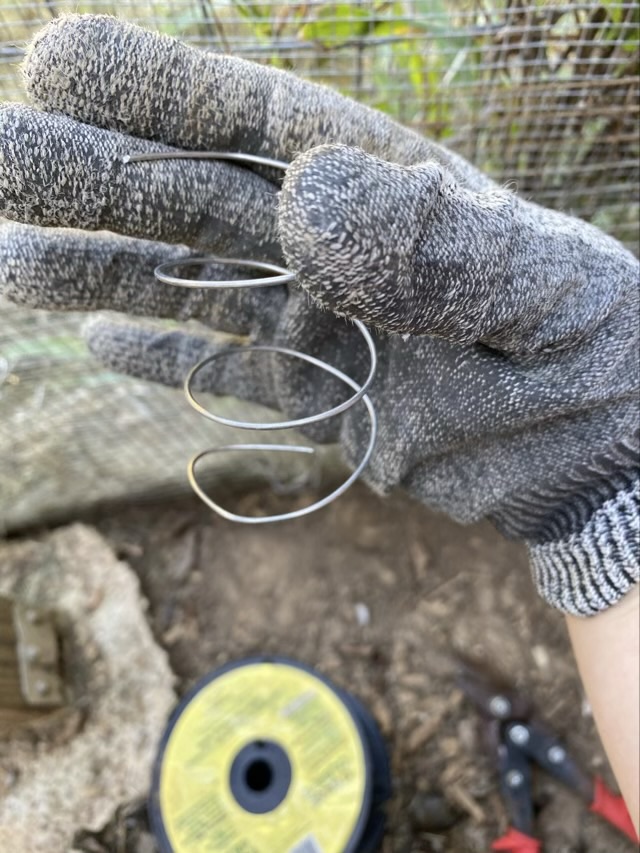
I found that with two layers of hardware cloth, making a spiral of aluminum wire made it easier to lace the wire through the cloth, since I didn’t have anyone on the other side to feed the wire back to me.

Photo description: hand formed wire spring shape from aluminum wire
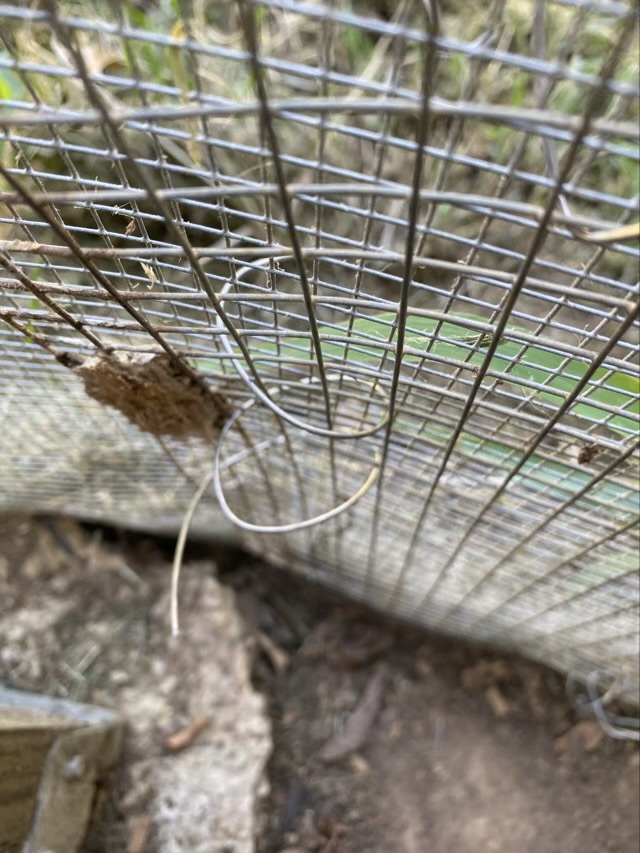
Photo description: twisting the spring into two layers of hardware cloth

After threading the spring through the layers several times, I would tighten the loops and twist in the ends. Using this method and using smaller wire “ties”, I reinforced the rips, and secured the solid mesh over the weakened areas.

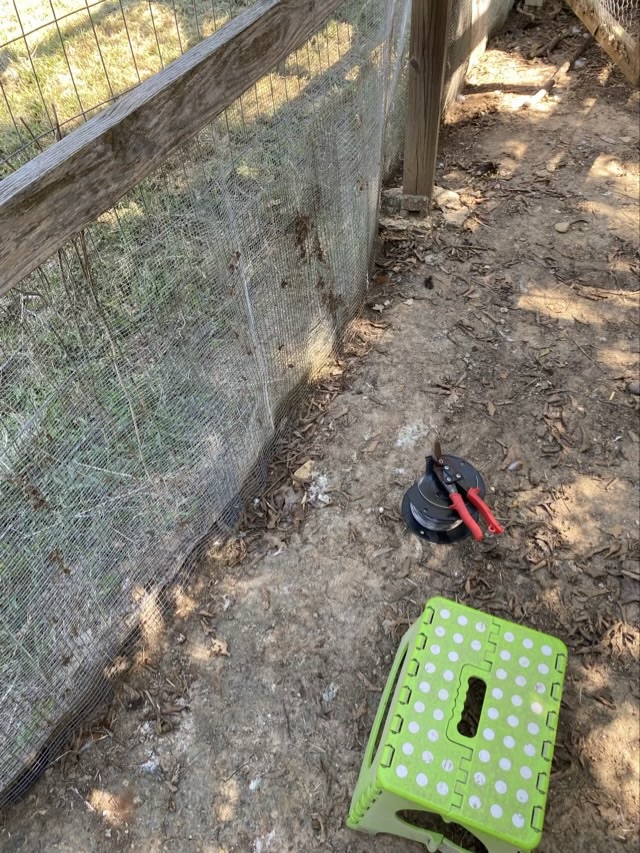
Photo description: double layer of hardware cloth installed to repair tears

I also put a layer of 2×4 no climb welded wire on the outside as protection from weed whackers. As a precaution, I have been making sure the coop is secure at night, rather than relying on run security. I do have an automatic chicken door, but I check each night that it is working, and verify it opened in the morning.

I think it was Jade that was taken down by the skunk, but it could have been Schmoo. I won’t be able to tell for sure until next molting season, since Jade has (had?) a very distinct feather loss pattern.

And now three

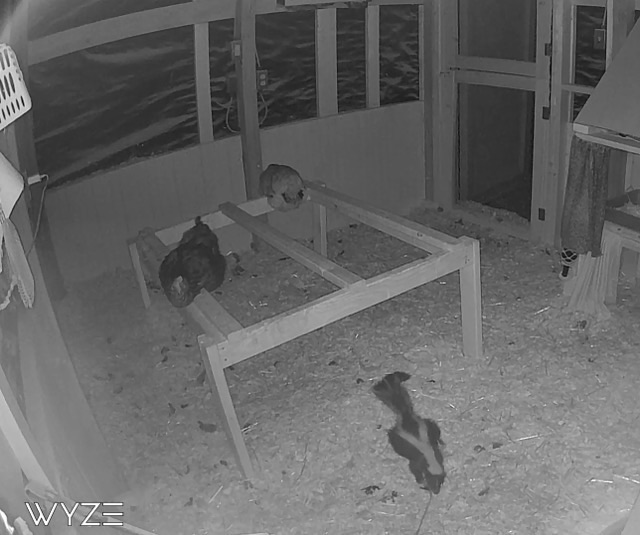
I lost my first chicken to predation this week. When I checked on the four remaining hens, one of the Faverolles was unmoving and had clearly been snacked on. Reviewing the camera footage showed a young skunk galavanting all over the inside of the coop. The chicken it killed was feeling poorly, she had been sleeping on the floor for a couple days rather than on the roost. I didn’t think anything of it because I’d never had a predator invade, I just built her up a throne of pine shavings in the corner so she could be close to her sisters.

Photo description: night view of the inside of the coop with two chickens on the roost and a skunk on the floor (the third living chicken is in a nest box)

I found where the skunk got in, the 1/4” hardware cloth on the meadow side of the runs is torn. I leave the coop door open all night during the summer to keep the temperatures down. For the last six years the runs have been secure enough to do so. Repairing the unauthorized entry will be in a future post.

The problem with comb identification

Photo description: Jade as a young hen, just started laying eggs
Photo description: Jade as an old hen, no longer egg laying and in molt

Chickens’ combs change, which makes using them as identification is tricky. When they are ready to lay eggs, the combs are bright red and full, when they are not in season, the combs loose color and mass. Above are two pictures of Jade the hen, the first when she was under a year old, the second at six years old. I can still count the tines, but other structures are more difficult to discern. Colored leg bands were the best identification for me, because I could see them at a distance, but they do need diligent maintenance. There is a technique of wing banding, where a skilled chicken farmer clips a small band through the web of the wing. I see now why breeders would prefer that more permanent method. A couple of my similar looking hens removed their plastic leg bands, then I couldn’t tell them apart anymore and rather gave up on the whole id part. I believe the last remaining unidentified Faverolle is Schmoo. Jade I identified by her molting pattern, and Seashell has a unique coloring. Wing Ding is still with us, and as the only Black Star hen, she is easy to identify, and very hard to ignore when she comes for her treats.

Molt ID

My Faverolle hens have started their fall molt. I can tell because Jade always looks like something took a chunk of her neck and gave her a good shake. Molting isn’t pretty.

Photo description: Faverolle hen in molt, with a large section of neck feathers mossing

On the plus side, this has allowed me to identify her as Jade. All three remaining Faverolles have removed their colored leg bands in the past couple years, and I know Seashell by sight, but Jade and Schmoo are harder to tell apart, except at molting. Jade is the only one that sheds all her neck feathers at once. Schmoo kept her leg band on the longest. None of the three lay eggs anymore. They are over six years old.

Autowash

In the summer I put out a chicken foot bath to help my hens cool off in the Texas heat. Yes, they tend to drink from the same water they stand in, but I haven’t yet lost a chicken to heat stroke. To keep the water relatively clean, I set up a hose on a timer to rinse the foot bath twice a day. I’ve hammered the hose end down to a slit to give the water spray some power, and it only takes a minute for the bath to do a water exchange. By putting the hose on the high side of the bath at an angle, the water swirls around the shallow dish, and floating materials, like pine shavings and feathers, spill out on the opposite side.

Photo description: chicken foot bath made from a large plant tray and a hose set up to autowash